Newsroom


Replacing some chemical fertilizers with manure can boost crop yields while helping soils store more carbon and nutrients, but the benefits depend on where and how long manure is applied, according to a recent study published in Soil and Tillage Research.
The study was led by researchers at the State Key Laboratory of Loess Science of the Institute of Earth Environment (IEE) at the Chinese Academy of Sciences (CAS).
For decades, farmers have relied heavily on chemical fertilizers to grow more food, but this approach can come at a hidden cost: it can disrupt the soil's internal nutrient balance. Long-term fertilizer use can push the ratio of carbon to nitrogen to phosphorus (C:N:P) far off course, leaving microbes short of carbon. As a result, they start breaking down the soil's natural organic matter, releasing carbon dioxide and gradually reducing soil fertility.
Manure offers a more natural alternative because its C:N ratio (about 9 to 21) is much closer to what microbes prefer. Replacing some chemical fertilizers with manure could therefore help restore the soil's nutrient balance.
But until now, it has remained unclear exactly where, when, and for how long this approach works on a global scale — and whether it consistently improves both crop yields and soil health.
The new study has addressed these questions. By analyzing 710 paired experiments from 179 sites around the world, the researchers identified the key factors that determine whether manure substitution succeeds or fails.
They found that manure application alleviated the microbes' carbon shortage and changed their behavior, shifting them from "mining" existing soil organic matter for energy to "building" new organic matter and helping lock it onto mineral particles. Simply put, the microbes stop consuming the soil's natural carbon and instead help store it. This resulted in a net increase of 27.8% in soil carbon, 24.4% in nitrogen, and 29.2% in phosphorus, while the microbial biomass itself increased by 35% to 77%, depending on the nutrient.
The researchers also uncovered a surprising time lag: crop yields increase steadily for about 19 years after the switch to manure before leveling off, while soil nutrients continue to accumulate for up to 30 years before reaching saturation. This 10-year gap reflects two different limiting factors: crop yields are constrained by how much nutrient plants can take up in one season and by genetic potential, leading to diminishing returns, whereas soil storage is limited by the number of available binding sites on mineral particles, which take longer to fill.
There are also chemical thresholds: if soil phosphorus increases by more than 72.4%, the extra yield benefit fades, while a decline of more than 26% in the N ratio can cause yields to fall. This is because too much phosphorus can inhibit microbial enzymes that help plants access nutrients, creating a new stoichiometric "danger zone" that needs to be carefully managed.
However, manure is not a global cure-all. The researchers found that a true win-win – higher yields and healthier soils — occurs only under specific conditions: an initial soil C ratio between 11.6 and 12.8, indicating moderate nitrogen limitation, and annual rainfall between 1119 and 1237 mm, typical of humid regions. In very dry areas, decomposition slows, while in very wet areas, nutrients leach away. In both cases, manure substitution can result in a lose-lose outcome. If manure is applied only in suitable regions, however, the global potential is substantial. Based on a 19% yield boost, it could produce an additional 482 to 708 million tons of grain each year while simultaneously increasing soil carbon, nitrogen, and phosphorus pools by 26-32%.
According to the researchers, this study gives clear timeframes and ecological "filters" to guide the use of manure. The core idea is to restore microbial balance so that soil can once again retain more carbon, but phosphorus accumulation and the timing mismatch between yield gains and soil nutrient buildup must be carefully considered.
The researchers suggested combining manure pretreatment to standardize its quality with precise, region-specific application — only then can it meet food security goals while also reaping climate and environmental benefits.
The study was jointly supported by the National Natural Science Foundation of China, the Horizon Europe Programme, and the Shaanxi Youth Science and Technology Star Project.
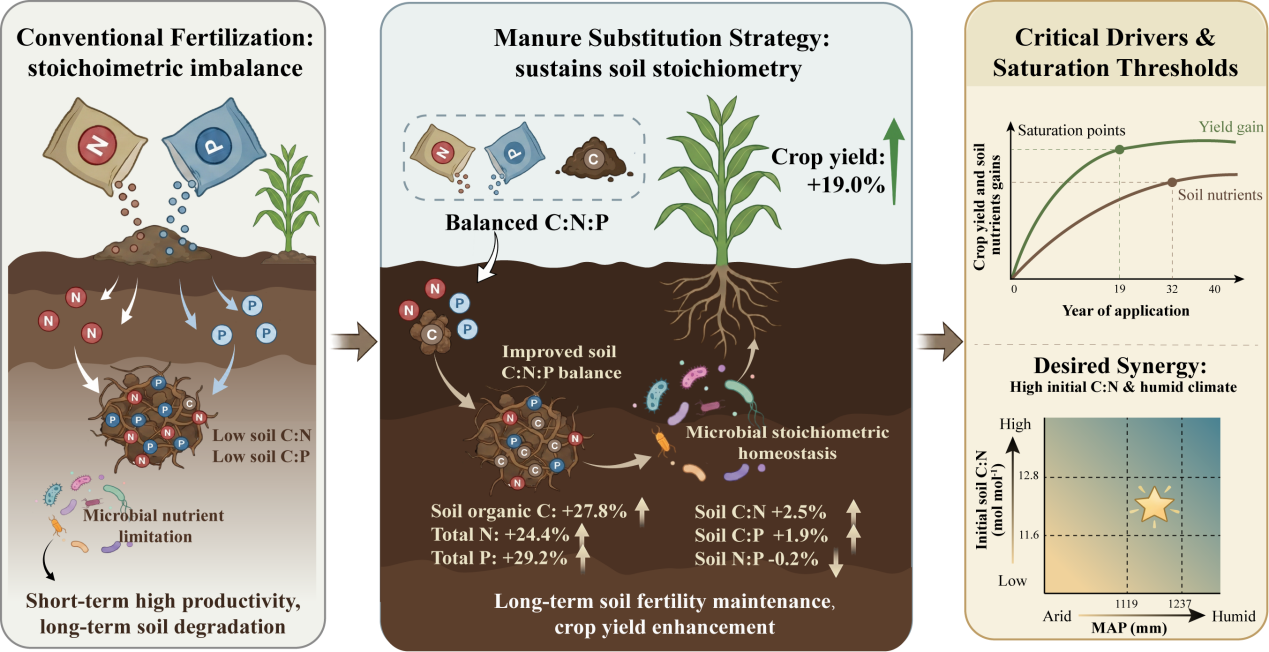
Manure substitution for chemical fertilizers improves soil nutrient balance and enhances crop yield. (Image by ZHENG Li, et al)