
Newsroom


Massive stars form within cold, dense molecular clouds, where gas contracts under gravity and can readily fragment into numerous smaller cores. A new study has revealed how massive stars avoid excessive fragmentation of their surrounding material and obtain sufficient "fuel" to sustain their growth.
Recently, MENG Dezhao, a PhD student in the star formation and evolution group at the Xinjiang Astronomical Observatory of the Chinese Academy of Sciences, together with collaborators at home and abroad, investigated how massive protostars heat their surrounding environments using data from the ALMA-QUARKS survey.
They found that intense radiation from protostars can suppress further fragmentation in surrounding hot molecular cores, thereby creating favorable conditions for massive stars to continue accreting material and growing.
The results have been published in The Astrophysical Journal Supplement Series.
In this study, the researchers identified 83 hot molecular cores in 58 massive star-forming regions. They used methyl cyanide as a molecular "thermometer" to map the temperature and density distributions within these hot cores and applied radiative-transfer modeling to estimate the luminosities of the central protostars.
The results showed that these hot cores become cooler with increasing distance from their centers, indicating that their envelopes are continuously heated by the embedded protostars.
Further analysis revealed that the more luminous a protostar is, the more resistant its surrounding gas becomes to fragmentation. The researchers used the thermal Jeans mass to characterize the critical mass required for gravitational fragmentation. On average, the thermal Jeans mass in the sample was approximately twice the mass of the hot-core envelope.
This finding suggests that protostellar heating acts as a "thermal barrier" by raising the threshold for gas fragmentation, allowing material to remain concentrated in a small number of massive cores rather than being dispersed into numerous low-mass objects.
The researchers also found that more massive molecular clumps tend to host more luminous protostars and consequently experience stronger thermal feedback. These findings provide new observational constraints on the coevolution of massive protostars, hot molecular cores, and their parental molecular clumps.
This work was supported by the National Science and Technology Major Project of China, the National Key R&D Program of China, and the National Natural Science Foundation of China.
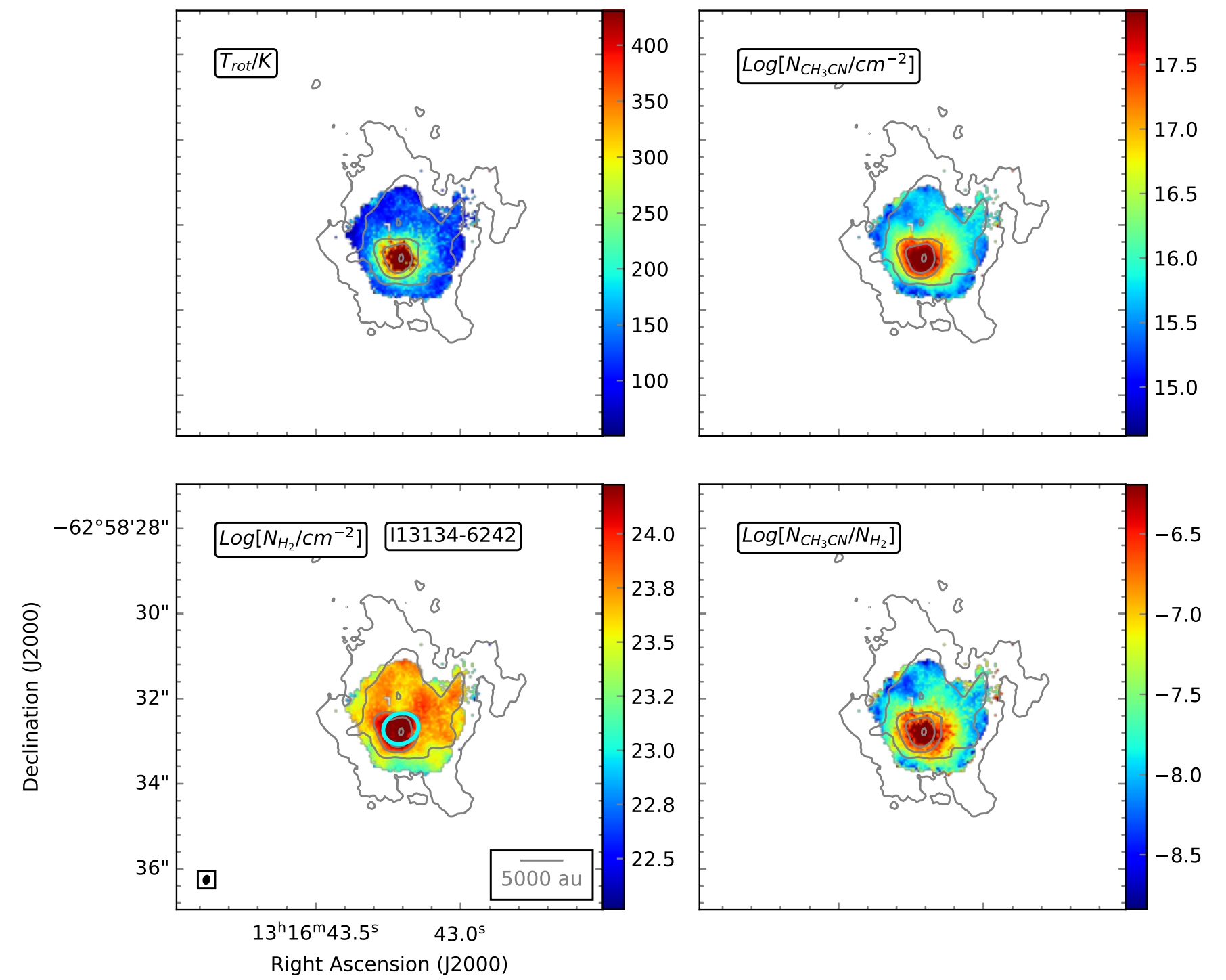
An example of temperature, density and abundance distributions. (Image by XAO)
