
Newsroom


Researchers from the Ningbo Institute of Materials Technology and Engineering (NIMTE) of the Chinese Academy of Sciences (CAS), in collaboration with Zhejiang University and Yongjiang Laboratory, have developed a sublayer chemistry strategy to synthesize MXenes with both semiconducting and ferromagnetic properties.
The study was published in Nature on July 22.
Two-dimensional (2D) transition metal carbides/nitrides (MXenes) are among the most promising emerging members of the 2D material family, with broad application potential in energy storage, electromagnetic shielding, and catalysis due to their high electrical conductivity and tunable surface chemistry. However, conventional MXenes are primarily based on early transition metals, making it difficult to achieve both semiconducting and magnetic electronic structures simultaneously.
To overcome this limitation, the researchers proposed a sublayer editing approach based on the sublayer chemistry concept. Using layered lanthanide monohalides (LnT, where Ln denotes a lanthanide and T represents a halogen) as intermediates, they designed a two-step synthesis in which graphite is converted into carbide anions and then integrated into the Ln–Ln lanthanide bilayers, forming a T–Ln–C–Ln–T MXene framework. This strategy enabled the synthesis of six previously unreported lanthanide MXenes with chlorine- or bromine-terminated surfaces.
The resulting materials exhibit semiconducting behavior, with optical band gaps of 1.26-1.71 eV and tunable room-temperature resistivities ranging from 0.329 to 36.1 Ω·cm. Meanwhile, they show ferromagnetic ordering at low temperatures.
First-principles calculations reveal that carbon insertion and halogen termination open the band gap by reducing the density of d electrons near the Fermi level, while the localized 4f electrons retain their magnetic moments. This unique electronic structure allows semiconducting and ferromagnetic properties to coexist in a single material.
This work demonstrates that sublayer editing based on chemical and structural principles can overcome the material constraints of conventional MXenes, incorporating lanthanide functionalities into the MXene framework. It opens new avenues for exploring materials that couple charge transport with spin functionality.
This study was supported by the National Natural Science Foundation of China, the National Key Research and Development Program of China and the Pioneer R&D Program of Zhejiang Province.
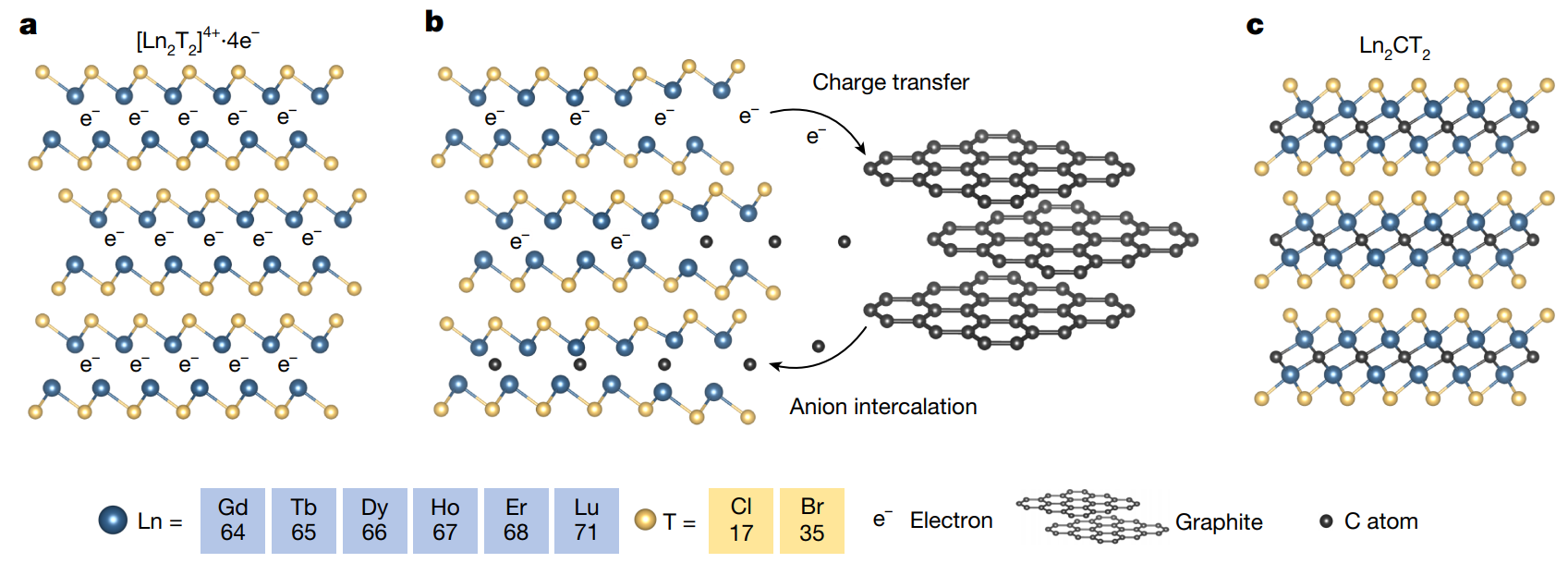
Synthesis process of lanthanide MXenes (Image by NIMTE)
