Newsroom


Scientists have discovered a remarkably well-preserved 100-million-year-old beetle fossil that provides a rare glimpse into the evolution of the intricate sensory and communication systems used by fireflies and their relatives today. Fireflies belong to the order Coleoptera, which includes all beetles.
This fossil specimen preserves both elaborate antennae and fully intact abdominal light-emitting organs. The presence of these two features in a single fossil provides pivotal evidence for reconstructing the early evolution of sensory and signaling systems in fireflies and their close relatives.
The study was led by LI Yanda, a Ph.D. student at the University of Bristol and Prof. CAI Chenyang of the Nanjing Institute of Geology and Palaeontology of the Chinese Academy of Sciences (NIGPAS).
Their findings were published in Proceedings of the Royal Society B on July 29.
Insects communicate using a variety of signals, including chemical odors, acoustic signals, color patterns, and bioluminescence. These sophisticated communication systems constitute a critical foundation for their remarkable evolutionary success and extraordinary taxonomic diversity. However, fossil evidence documenting the origin of such traits has remained scarce due to the extremely low preservation potential of soft tissues and delicate microstructures.
The newly described fossil, Icaroramus, is a distinctive new genus of lampyroid beetles identified from Kachin amber in Myanmar, approximately 100 million years old. Phylogenetic analyses indicate that the new genus belongs to the extinct family Cretophengodidae. The preservation of its antennae and abdominal light-emitting organs in a single fossil individual provides pivotal evidence for reconstructing the early evolution of sensory and signaling systems in fireflies and their close relatives.
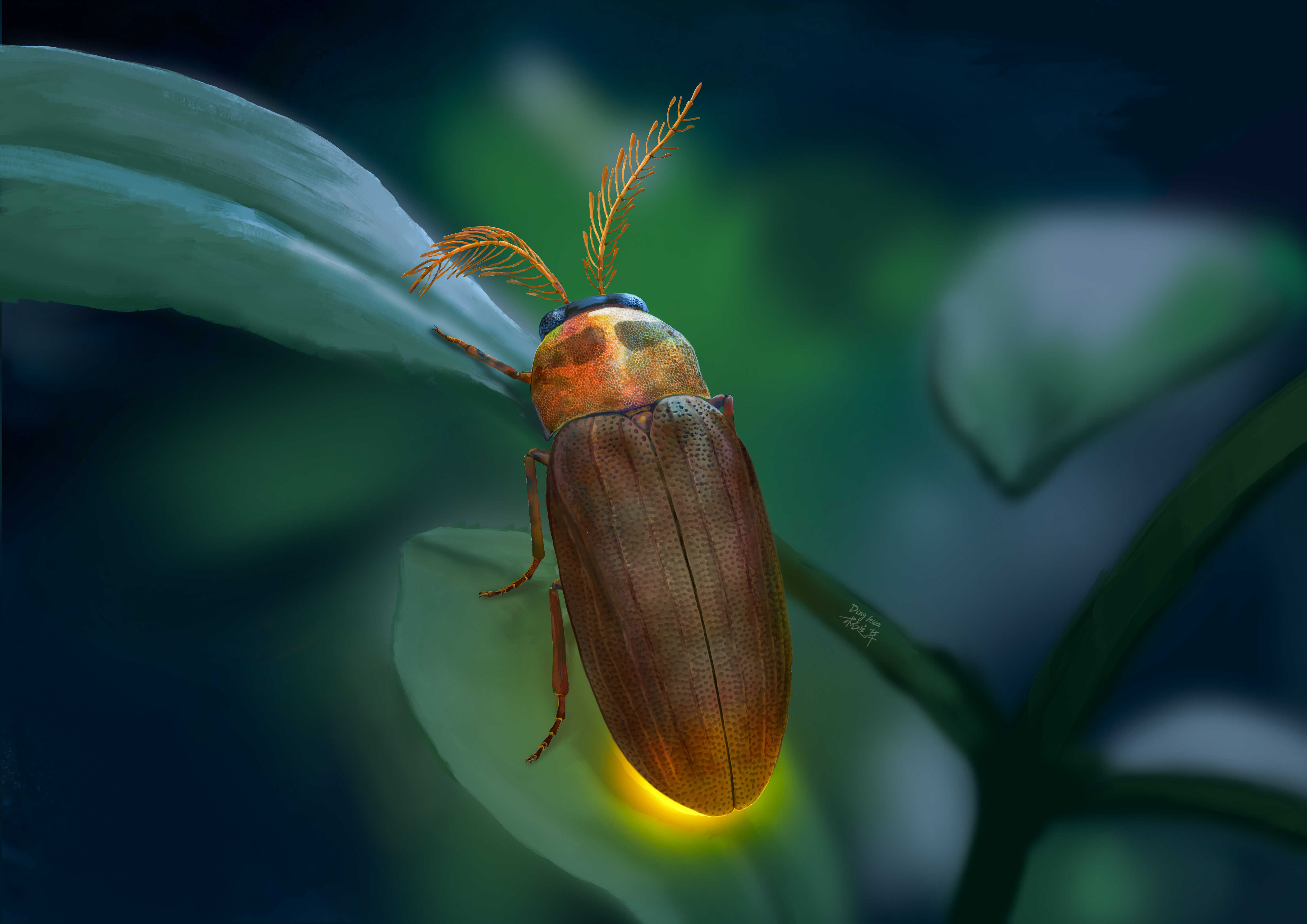
The most striking morphological trait of Icaroramus is its unusual antennae. Consisting of twelve segments, the antennae have two pairs of lateral rami with different morphologies on antennomeres 4 to 11. The proximal pair of rami at the base of each antennomere is elongated with dilated apices and coarse setae. In contrast, the medial pair near the segment’s midpoint is shorter and more slender, covered only with fine hairs. Such heteroramose antennae, characterized by two morphologically distinct pairs of lateral branches on a single antennomere, are unprecedented across the entire Coleoptera order. The researchers suggest that this unusual morphology may result from a partial reactivation of the antennal segmentation program within individual antennomeres, generating extra branching outgrowths.
Many extant insect lineages that locate mates via chemical communication have well-developed branched antennae that enhance the detection of trace airborne pheromones. The complex antennae of Icaroramus suggest that it relied heavily on pheromonal cues during mate searching. Furthermore, the clear morphological differentiation between the two sets of antennal rami may reflect the functional partitioning of olfactory sensilla, which would enable the beetle to discriminate between distinct chemical signals. This highly specialized chemosensory capacity demonstrates that Cretaceous lampyroids had evolved sophisticated ecological adaptations.
In contrast, the exact biological function of the abdominal photic organs cannot be definitively resolved from fossil material alone. Living firefly clades that use light signals for courtship generally exhibit simplified antennae. Yet Icaroramus combines elaborate light organs with highly branched antennae, a combination inconsistent with most modern fireflies dependent on luminous mating signals. Accordingly, the bioluminescent organs of Icaroramus most likely functioned for aposematic anti-predator defense, though a supplementary role in mate attraction cannot be entirely ruled out.
Together, these findings indicate that lampyroid beetles had already evolved highly specialized sensory structures and functional bioluminescence by the mid-Cretaceous period, around 100 million years ago. This fossil provides rare evidence that multiple communication strategies had already emerged early in the evolutionary history of fireflies and their relatives.
This work was supported by the National Key Research and Development Program of China.

Icaroramus perisi and its unique heteroramose antennae (Image by NIGPAS)
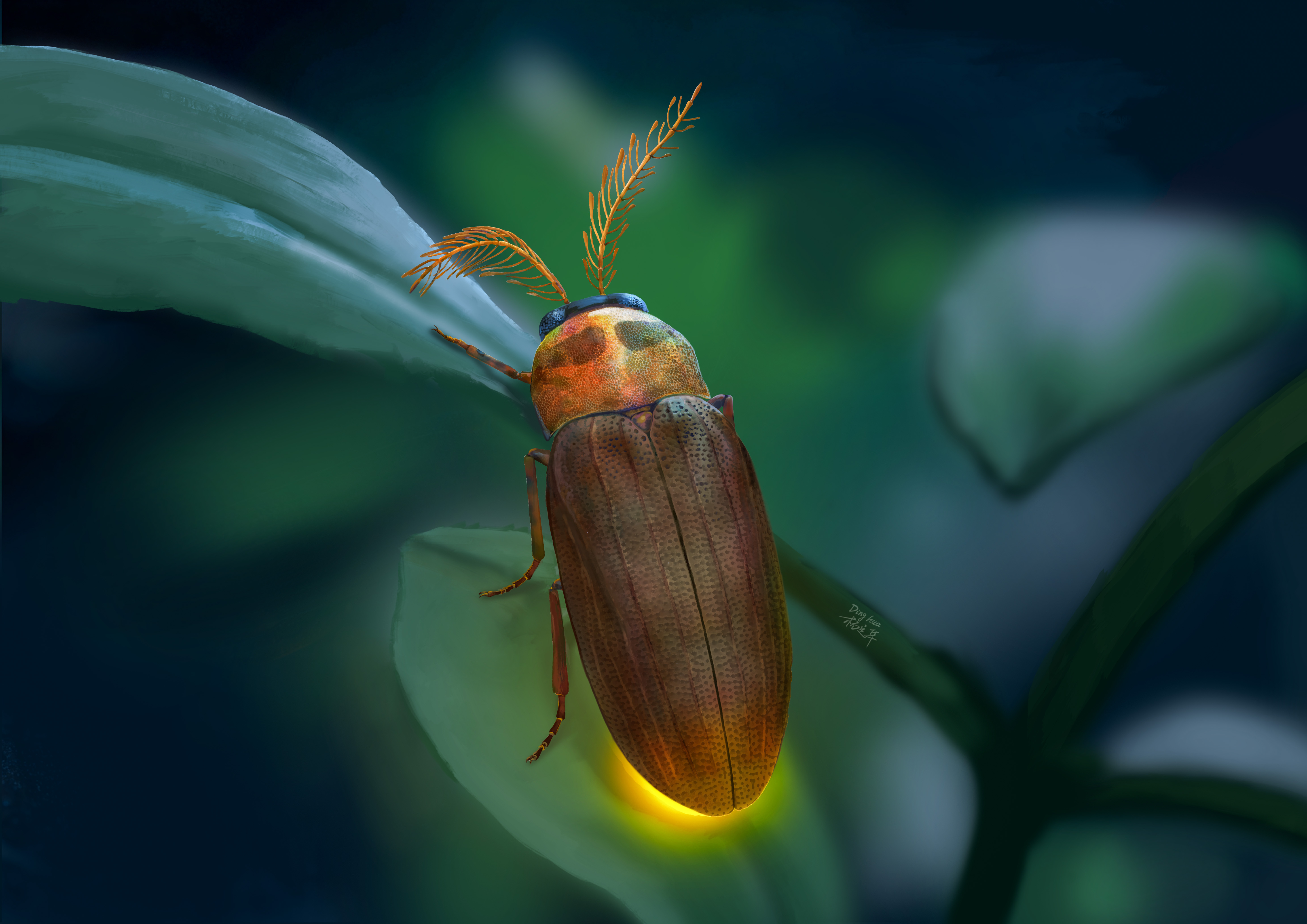
Ecological reconstruction illustrating luminous Icaroramus in a Cretaceous forest (Image by YANG Dinghua)