Newsroom


Nanosecond laser-driven proton FLASH radiotherapy can maintain its cancer-killing effect while reducing damage to normal cells. This new irradiation method protects normal bronchial epithelial cells by preserving mitochondrial function and reducing ferroptosis, an iron-dependent form of cell death, according to a new study published in iMed on July 13.
The study was carried out by a team led by Prof. HUANG Qing from the Hefei Institutes of Physical Science of the Chinese Academy of Sciences, in collaboration with the Shanghai Institute of Optics and Fine Mechanics of CAS, and Shandong University.
Radiotherapy is widely used to treat cancer, but radiation can also harm surrounding healthy tissues. FLASH radiotherapy, which delivers radiation at an ultra-high dose rate, has attracted attention because it may reduce normal tissue damage without weakening tumor control.
In this study, the researchers used a laser-driven proton platform to deliver radiation pulses lasting about 12.9 nanoseconds. They compared the effects of this approach with conventional proton irradiation on lung cancer A549 cells and normal bronchial epithelial BEAS-2B cells.
The results showed that both treatments effectively killed cancer cells. However, compared with conventional irradiation, nanosecond FLASH irradiation caused significantly less damage to normal cells. Further analysis found that FLASH irradiation helped maintain mitochondrial structure and function while reducing ferroptosis.
The researchers also found that conventional irradiation triggered the stress-related protein ATF3 in normal cells, weakening antioxidant defenses and increasing oxidative damage. In contrast, the extremely short FLASH pulse appeared to suppress this stress response, allowing normal cells to better tolerate radiation exposure.
According to the researchers, the findings suggest that the manner in which radiation energy is delivered, rather than simply the total dose, is an important factor influencing cellular responses. This work may contribute to the development of safer and more precise radiotherapy approaches.
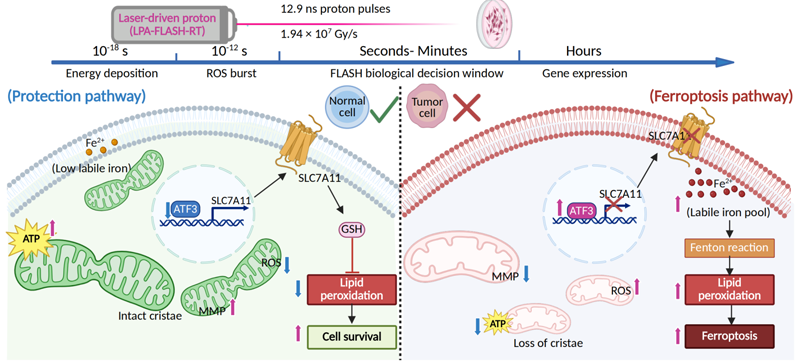
Schematic of normal tissue sparing in laser-proton FLASH-RT. (Image by SHAO Changsheng)