
Newsroom


A new study found that salinity plays a key role in shaping alpine lake biodiversity, influencing the composition and ecological functions of macroinvertebrate communities. Specifically, low-salinity lakes supported more indicator species and a broader range of functional traits, whereas high-salinity lakes were dominated by a small number of salt-tolerant aquatic insects.
The study, led by a research team from the Institute of Hydrobiology (IHB) of the Chinese Academy of Sciences (CAS), was published in Environmental Science & Technology on July 10.
Alpine lakes are highly sensitive sentinels of climate change. Changes driven by altered precipitation, glacier and permafrost melt, evaporation, and human activities are causing significant shifts in lake salinity worldwide. However, how these changes affect biological communities in cold, high-altitude ecosystems remains poorly understood.
The Qinghai–Tibet Plateau contains nearly 40% of the world's alpine lakes. These lakes cover a wide salinity gradient and provide habitats for benthic macroinvertebrates, which play essential roles in food webs, nutrient cycling, and ecosystem stability. Understanding their responses is therefore important for predicting how alpine lake functions may change in a warming world.
In this study, the researchers surveyed 77 littoral sites across 40 lakes on the Qinghai–Tibet Plateau. They collected 38,295 macroinvertebrate individuals representing five phyla, 23 families, and 48 genera, and integrated taxonomic and trait data with environmental measurements and community-assembly analyses.
The researchers found that salinity was the strongest measured correlate of community variation. Both taxonomic and functional diversity showed a continuous decline as salinity increased, rather than peaking at intermediate salinity as reported for some lowland inland lakes. Low-salinity lakes supported more indicator taxa and a much broader functional trait space, whereas high-salinity lakes were dominated by a small number of tolerant aquatic insects.
They further identifed a clear shift in community assembly along the salinity gradient. Strong deterministic filtering prevailed in high-salinity lakes, mixed deterministic and stochastic processes characterized moderate-salinity lakes, and a higher apparent stochastic component occurred under low salinity. Moderate-salinity lakes therefore formed a critical transition zone in which assembly mechanisms changed and biodiversity erosion accelerated.
Taxa displayed three contrasting strategies. Ephydra and Hydrophilus were closely associated with hypersaline conditions; Cricotopus tolerated an exceptionally broad salinity range; and taxa such as Orthocladius had low salinity optima but relatively broad tolerance. As salinity declined, functional richness expanded sharply and salt-sensitive groups, including EPT insects, oligochaetes, and mollusks, became more prominent.
Progressive-removal simulations also indicated an asymmetric response: salinization produced substantially greater losses of regional diversity and functional distinctiveness than freshening. Because the plateau's regional species pool is largely freshwater-derived, rising salinity removes many freshwater taxa that cannot be readily replaced by specialized halophiles.
According to the researchers, the findings highlight low- and moderate-salinity lakes as priorities for conserving regional biodiversity and maintaining functional breadth, while hypersaline lakes remain important reservoirs of specialized taxa.
They suggest that salinity should be interpreted as the strongest measured correlate rather than an isolated causal driver, and emphasize the need for long-term monitoring that incorporates other factors, including nutrients, productivity, organic matter, habitat conditions, and biological interactions.
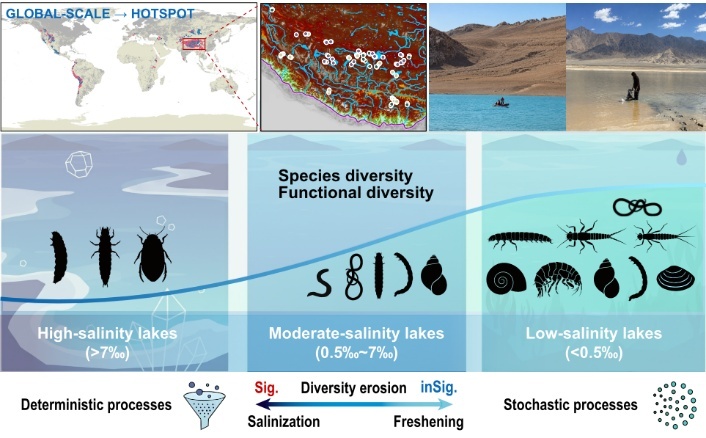
Salinity-driven biodiversity erosion and community assembly shifts in the global alpine lake hotspot. (Image by IHB)
