
Newsroom


The Ediacaran Period (635-538 Ma) is a critical interval in the evolution of habitability on Earth. However, the Ediacaran timeframe is not as precise as the well-established astronomical time scales for more recent periods. This hinders global stratigraphic correlations and the subdivision of the Ediacaran system, generating controversies about the tempo of deep-ocean oxygenation and eco-evolutionary dynamics. Cyclostratigraphy enables the construction of high-resolution astrochronology for deep-time sediments through a workflow that identifies geological imprints of Milanković cycles and uses specific orbital forcing cycles as a metronome for time-depth calibration.
Recently, Prof. WANG Wei from the Nanjing Institute of Geology and Palaeontology of the Chinese Academy of Sciences (NIGPAS), together with XUE Naihua, a double PhD student from the Vrije Universiteit Brussel and the University of Münster, collaborated with an international research team to establish the longest astronomical time scale (ATS) for the Ediacaran Period to date (spanning from 635.1 ± 0.6 Ma to 568.3 ± 6.8 Ma), based on a drilled core near the Jiulongwan section in Yichang, South China.
This ATS provides a series of new age constraints for Ediacaran geochemical perturbations and fossil assemblages, revealing significant temporal heterogeneity of the Shuram carbon isotope excursion, as well as a coupling relationship between carbon isotope fluctuations and second-order sea-level oscillations in the inner-shelf basin of South China. The study was published in Precambrian Research on July 15.
To construct the ATS, the researchers utilized multiple geological datasets, including meter-scale δ13Ccarb analysis, gamma ray (GR) logging with 5-cm measuring interval, millimeter-scale X-ray fluorescence (XRF) core scanning and a sedimentation-rate-dependent meshing scheme. They also considered the uncertainties of the absolute age anchor, the long eccentricity term, and the astronomical tuning within each segment. They considered error accumulation and propagation as well, ultimately providing an age model with a quantified uncertainty assessment.
Using the new astrochronology, the researchers established updated age constraints for major carbon isotope perturbations and fossil assemblages preserved in the inner-shelf basin of South China, including the EN3/DOUNCE (triggered ≤ 584.2 ± 5.2 Ma, lasting 12.2 ± 1.4 Myr–15.9 ± 1.7 Myr), the EN2/BAINCE (≤ 599.5 ± 3.2 Ma to ≤ 593.2 ± 4.0 Ma), the WANCE (nadir ≤ 613.9 ± 2.0 Ma), large acanthomorphic acritarchs (632.5 ± 0.48 Ma to ≤ 584.2 ± 5.2 Ma), the Lantian biota (~616 Ma to ~593 Ma), the Weng'an biota (≤ 613.9 ± 2.0 Ma to ≤ 584.2 ± 5.2 Ma), and the Miaohe biota (<568.3 ± 6.8 Ma to ~550 Ma).
Previous studies have assumed and/or emphasized the isochronism of the Shuram excursion in South China, Oman, northwestern Canada, and other locations. The newly established astrochronology highlights a novel perspective on the temporal heterogeneity of the Shuram excursion. Compared with records from open-ocean settings, the Shuram excursion record in South China exhibits temporal heterogeneity in terms of a potentially earlier onset and prolonged duration. Notably, the decline from approximately 0 ‰ to the isotopic minimum occurred over 4.2 ± 0.4 Myr, which is roughly 3.5 times longer than the duration of the onset reported from Oman. The researchers suggest that the future investigations into the mechanisms driving the Shuram excursion and associated biogeochemical changes should account for the spatiotemporal heterogeneity in δ13C perturbations.
To explore the potential drivers of temporal heterogeneity in Ediacaran shallow-marine carbon cycle perturbations, the researchers used lithological encoding, astronomically calibrated sedimentation rates, and time-domain ρ1 (lag-1 autocorrelation coefficient) modeling to reconstruct approximately 67-Myr record of relative sea-level changes in the inner-shelf basin of South China.
Their analysis revealed that negative carbon isotope excursions in the South China are highly coupled with "M"-shaped secondary sea-level changes. Together, the ρ1 modeling and sedimentological and lithological evidence effectively indicate large-scale sea-level oscillations. This offers a possible dynamic mechanism for the fundamental carbon-isotope framework of the Ediacaran period.
This study was supported by the Strategic Priority Research Program of the CAS, the National Key Research and Development Program of China, the National Natural Science Foundation of China, VUB Strategic Research program and others grants.
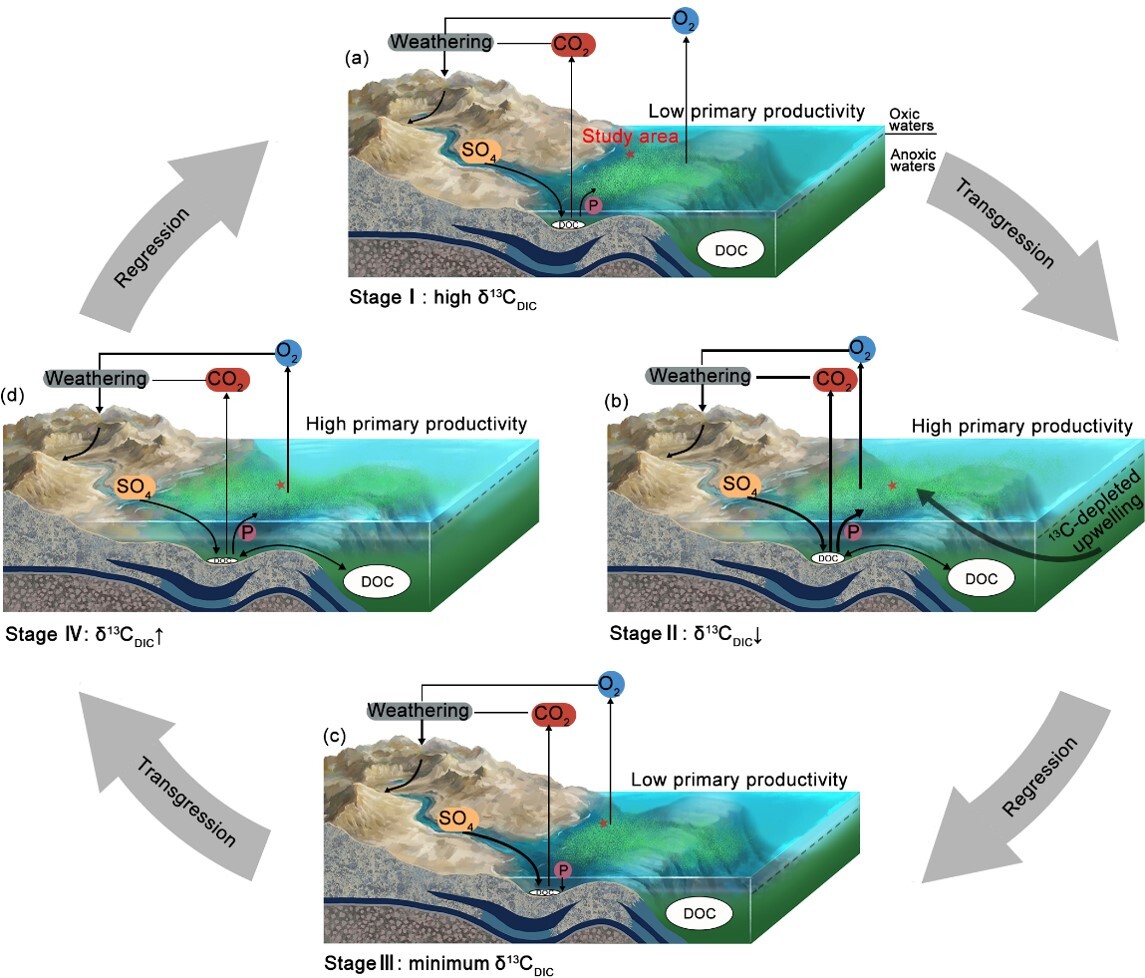
A 3D conceptual model for depicting the dynamics of the EN3/DOUNCE in South China, paced by the second-order sea-level oscillations. (Image by NIGPAS)
