Newsroom


Photocatalytic reduction of CO2 offers a promising approach to storing energy from intermittent sunlight in carbon-containing fuels and chemicals, thereby enabling carbon recycling. Single-atom Cu catalysts have attracted attention because they enhance CO2 photoreduction. However, the roles of single-atom active sites and adjacent atoms in these catalysts have not been well understood.
Now, a new study published in Chem Catalysis has revealed how dynamic Cu and Ti active sites in single-atom Cu-TiO2 catalysts cooperate under light to reduce CO2 to CO.
The researchers, led by Prof. BI Yingpu and WANG Kangkang from the Lanzhou Institute of Chemical Physics (LICP) of the Chinese Academy of Sciences (CAS), conducted an experimental study of the dynamic interactions of CO2 and H2O molecules at the surface active sites of single-atom Cu-TiO2 catalysts by integrating in-situ X-ray photoelectron spectroscopy with infrared spectroscopy.
They found that single-atom Cu and adjacent Ti sites play distinct roles during CO2 photoreduction. Specifically, H2O adsorption and electron injection at single-atom Cu sites promote CO2 adsorption and activation at adjacent Ti sites, and their cooperative catalysis significantly improves CO2-to-CO conversion efficiency.
They further found that single-atom Cu-TiO2 exhibits substantially enhanced activity for CO2-to-CO conversion (161.1 μmol g-1 h-1) relative to pristine TiO2 (31.8 μmol g-1 h-1).
"These experimental findings challenge the conventional speculations on single-atom Cu catalysts and provide new insights for the re-evaluation of static structure–activity models," said BI.
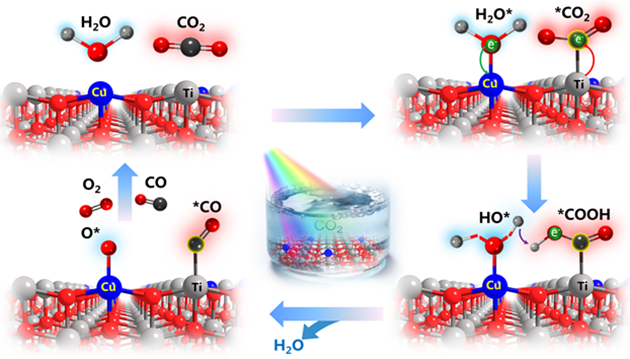
Schematic illustration of the photocatalytic process of CO2 reduction over the Cu-TiO2 catalysts. (Image by LICP)