Newsroom


Earth differs markedly from Venus and Mars in terms of habitability, among other features. Scientists have now discovered another major difference between Earth and its neighbor planets. In a new study focused on understanding the long-term cycling of volatile elements and compounds between Earth's interior and its surface, scientists have discovered that Earth has a balanced sulfur cycle.
The researchers determined that 57 ± 3 million tons of sulfur enter Earth's mantle each year through the process of subduction, which involves plate tectonics. In contrast, 60 ± 14 million tons return to Earth's surface each year through volcanic and magmatic activity. These inflows and outflows are balanced within the uncertainty of these values.
The study, which was published in PNAS on July 8, was led by Prof. LI Jilei from the Institute of Geology and Geophysics (IGG) of the Chinese Academy of Sciences (CAS). The team collaborated with researchers from Yale University, Freie Universität Berlin, and University College London.
While the deep water cycle is known to be significantly imbalanced and the carbon cycle approximately so, scientists have lacked reliable numerical estimates of Earth's sulfur cycle. Previous studies relied on global average values for sediment thickness and sulfur content, introducing considerable uncertainty.
To address this problem, the researchers divided the global subduction system into 32 individual subduction zones and compiled data from over 1,500 scientific ocean drilling sites to establish the first comprehensive dataset of sedimentary sulfur contents.
The study found that the average sulfur concentration of subducting sediments is approximately 2,450 μg/g—less than half the previously accepted value of 6,000 μg/g—leading to more accurate estimates of the sulfur cycle.
Furthermore, the study revealed pronounced regional variability. Accretionary zones such as Sunda and Japan account for roughly 75% of global sulfur input from sediments, while the Solomon Islands and Java subduction zones represent major global hotspots of sulfur input due to their exceptional lengths. Sulfur recycling efficiency—the ratio of arc sulfur output to slab sulfur input—varies from nearly 0% to almost 100% among individual subduction zones, with a global average of approximately 37%.
The study also discovered a characteristic sulfur isotope pattern: sulfur entering the mantle through subduction is isotopically lighter than sulfur released by volcanic activity, indicating that sulfur is extensively transformed during deep recycling rather than simply returned to the surface unchanged.
According to the researchers, the findings carry implications beyond Earth sciences. The near-steady-state sulfur balance may explain why Earth avoided the extreme sulfur accumulation seen on Venus or the permanent sequestration observed on Mars.
The researchers noted that this sulfur cycle balance may not have persisted throughout Earth's history. Specifically, during much of the Phanerozoic, thinner sediment cover and higher mantle temperatures likely favored a net sulfur output state. Going forward, understanding the evolution of Earth's sulfur cycle may help explain why Earth, Venus, and Mars developed so differently.
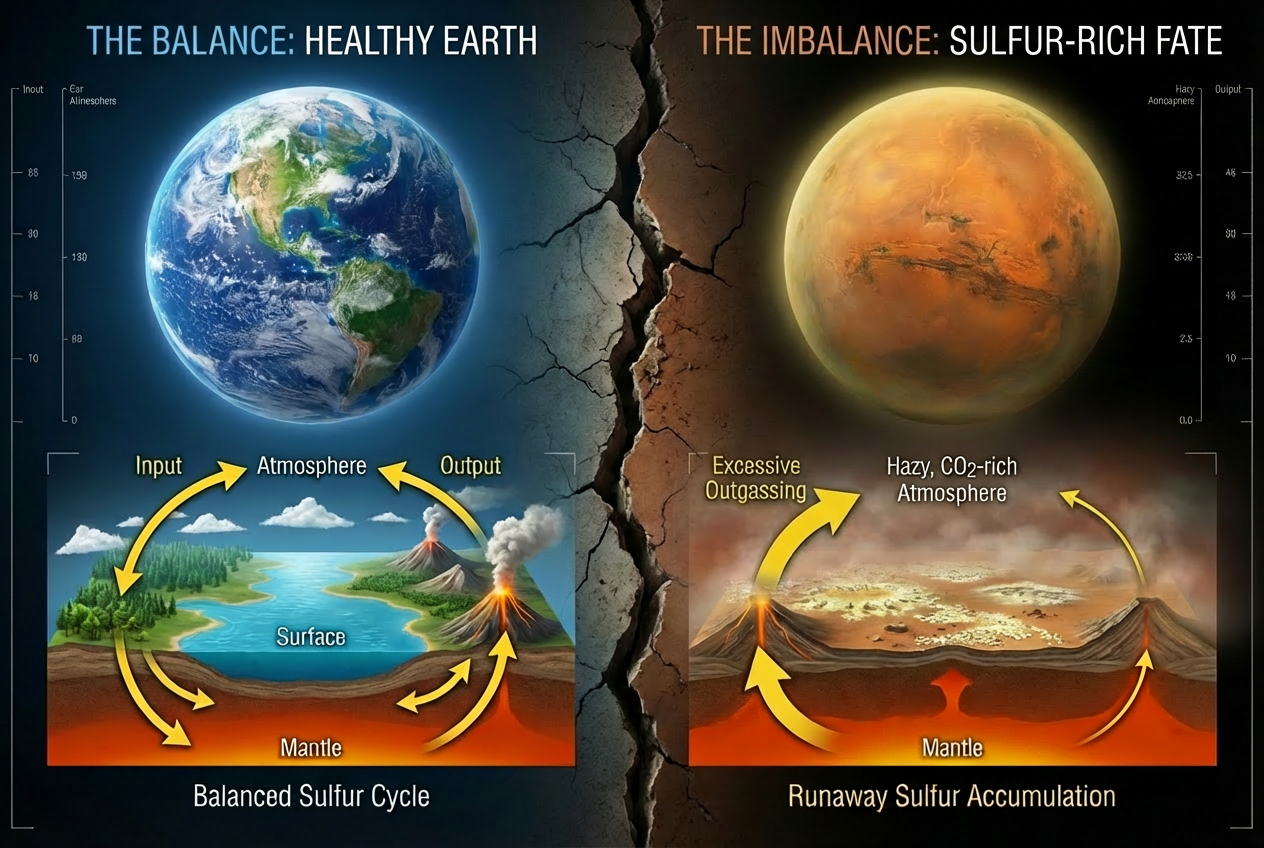
AI-generated conceptual comparison of the balanced deep sulfur cycle on habitable Earth and the imbalanced sulfur cycle on uninhabitable Mars (Image by IGG).