
Newsroom


The Moon has been bathed in solar wind for billions of years, but the two hemispheres are struck by solar wind of different speeds and energies.
Now, research based on China's Chang'e-6 samples reveals that Earth's magnetosphere has shaped this difference. The study was published in Nature Geoscience.
The solar wind, a continuous stream of high-speed charged particles from the Sun, bombards the Moon's surface directly. The lunar regolith has preserved a record of this bombardment, serving as a natural archive of solar-wind-derived volatiles, including the noble gases (He, Ne, Ar, Kr, Xe). These chemically inert elements are highly reliable tracers of solar-wind implantation and provide valuable clues to this process.
Before this study, the lack of far-side samples prevented direct experiments on systematic differences in solar-wind implantation between the two hemispheres.
However, China's Chang'e-6 mission returned 1.935 grams of regolith from the South Pole-Aitken basin on the lunar far side, offering the first opportunity to directly compare solar-wind implantation processes on the near side and far side.
Based on the lunar samples, a research team led by the Institute of Geology and Geophysics (IGG) of the Chinese Academy of Sciences (CAS) conducted a noble-gas isotopic investigation on the Chang'e-6 regolith and determined the concentrations and isotopic compositions of He, Ne, Ar, Kr, and Xe.
The work was carried out by ZHANG Xuhang, a postdoctoral researcher at IGG under the supervision of Professor HE Huaiyu, together with collaborators from the University of Science and Technology of China and the Chang'e-7 volatile payload team.
In the analysis, the researchers first noticed that the Ne isotopic composition of the Chang'e-6 regolith is highly distinctive. The average 20Ne/22Ne ratio is 11.34 ± 0.22, substantially lower than what is reported for all previously analyzed nearside lunar samples yet close to the theoretical isotope composition expected after strong solar-wind fractionation. This implies that the lunar far side underwent stronger isotopic fractionation, resulting in preferential enrichment of the heavier isotope.
As for Kr and Xe, their release behavior also differs from that of near-side samples. In the stepwise-heating experiments, solar-wind-derived Xe in the Chang'e-6 regolith was released predominantly at high temperatures, producing a single high-temperature release peak. In contrast, Chang'e-5 samples exhibited a distinct double-peaked release pattern, with significant Xe release at both low and high temperatures. This indicates that solar-wind ions penetrated significantly deeper into the far-side regolith than into the near side—meaning the far side was exposed to higher-energy particles.
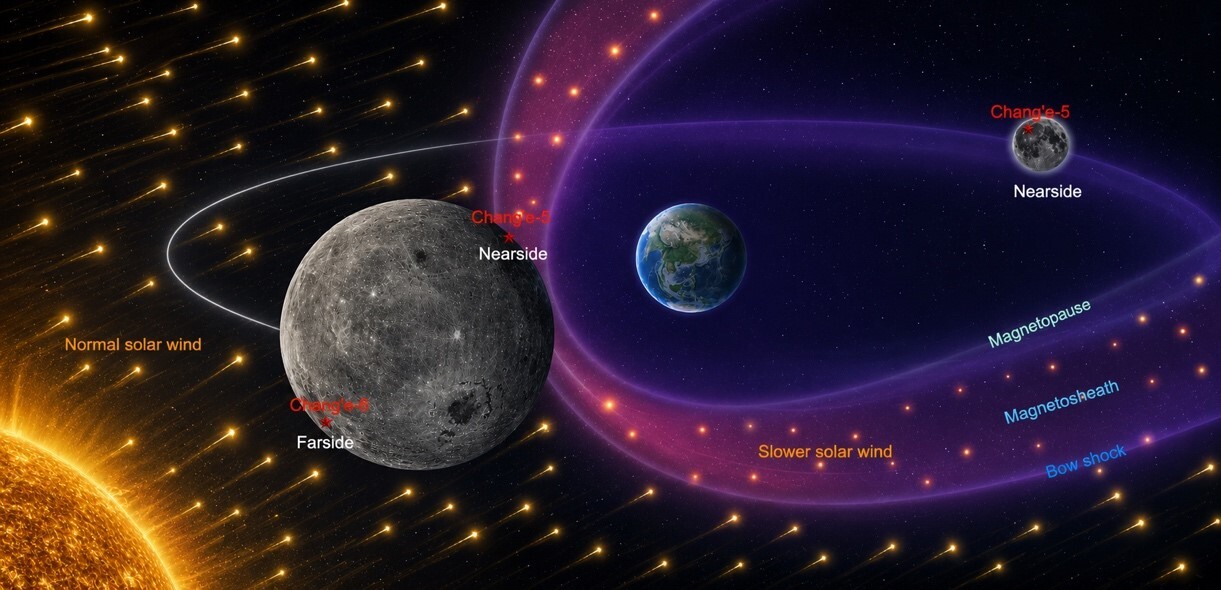
Schematic illustration of the contrasting solar wind environments experienced by the lunar nearside and farside under the influence of Earth's magnetosphere. (Image by ZHANG Xuhang)
But why do the Moon's two hemispheres receive solar wind of different energies?
The research team attributes this difference to the "speed-governing" effect of Earth's magnetosphere. As the Moon orbits Earth, it periodically passes through the magnetosheath—a buffer zone around the magnetosphere—where the ambient solar wind is slowed from its typical velocity of 400 km/s to about 200 km/s.
This slower solar wind primarily reaches the lunar near side, resulting in shallower implantation depths within the near-side regolith. In contrast, the far side, which permanently faces away from Earth, remains directly exposed to undisturbed solar wind, allowing ions to penetrate deeper into the regolith.
The researchers suggest that approximately 25% of the total solar-wind exposure at the Chang'e-5 landing site was influenced by this decelerated solar wind, whereas the Chang'e-6 landing site experienced no such shielding effect.
By providing the first direct empirical evidence from lunar far-side samples, this study confirms the speed-governing effect of Earth's magnetosphere on solar-wind implantation into the lunar surface, an effect permanently preserved in both the implantation-depth distributions and isotopic signatures of noble gases within the regolith.
Furthermore, the researchers noted that heavy noble gases in lunar soils may serve as "fossil records" of past interactions between Earth's magnetosphere and the solar wind, offering a novel approach for reconstructing the long-term evolution of Earth's magnetosphere when combined with paleomagnetic records.
The findings also show that interactions within the Sun–Earth–Moon system are more complex than previously recognized. According to the researchers, these results open a new window into these ancient dynamics, revealing that Earth's nearest celestial neighbor preserves previously unknown records of these interactions.


