
Newsroom


Previously overlooked natural forest expansion represents a larger carbon sink than secondary forests, highlighting its potential role in mitigating global climate change, according to a new study.
Led by Prof. DU Yun at the Innovation Academy for Precision Measurement Science and Technology (APM) of the Chinese Academy of Sciences (CAS), in collaboration with researchers from the GFZ Helmholtz Centre for Geosciences, the Joint Research Centre, Lancaster University, and other institutions, the study was recently published in Nature Geoscience.
Tropical moist forests, which are widely distributed across the tropics, play essential roles in maintaining biodiversity, regulating the terrestrial carbon cycle, and mitigating climate change. However, over recent decades, extensive deforestation driven by human activities, together with increasing forest degradation caused by fires, extreme droughts, and selective logging, has turned tropical forests into major global carbon sources.
Natural forest regeneration is regarded as one of the most cost-effective nature-based solutions for removing atmospheric carbon dioxide. It mainly includes three recovery pathways: secondary forests, degraded forests, and forest expansion.
Although existing datasets suggest that the area of natural forest expansion in moist tropical regions slightly exceeds that of secondary forests, its carbon sink capacity has remained unquantified, creating considerable uncertainty in assessing the contribution of tropical forest regeneration to climate change mitigation.
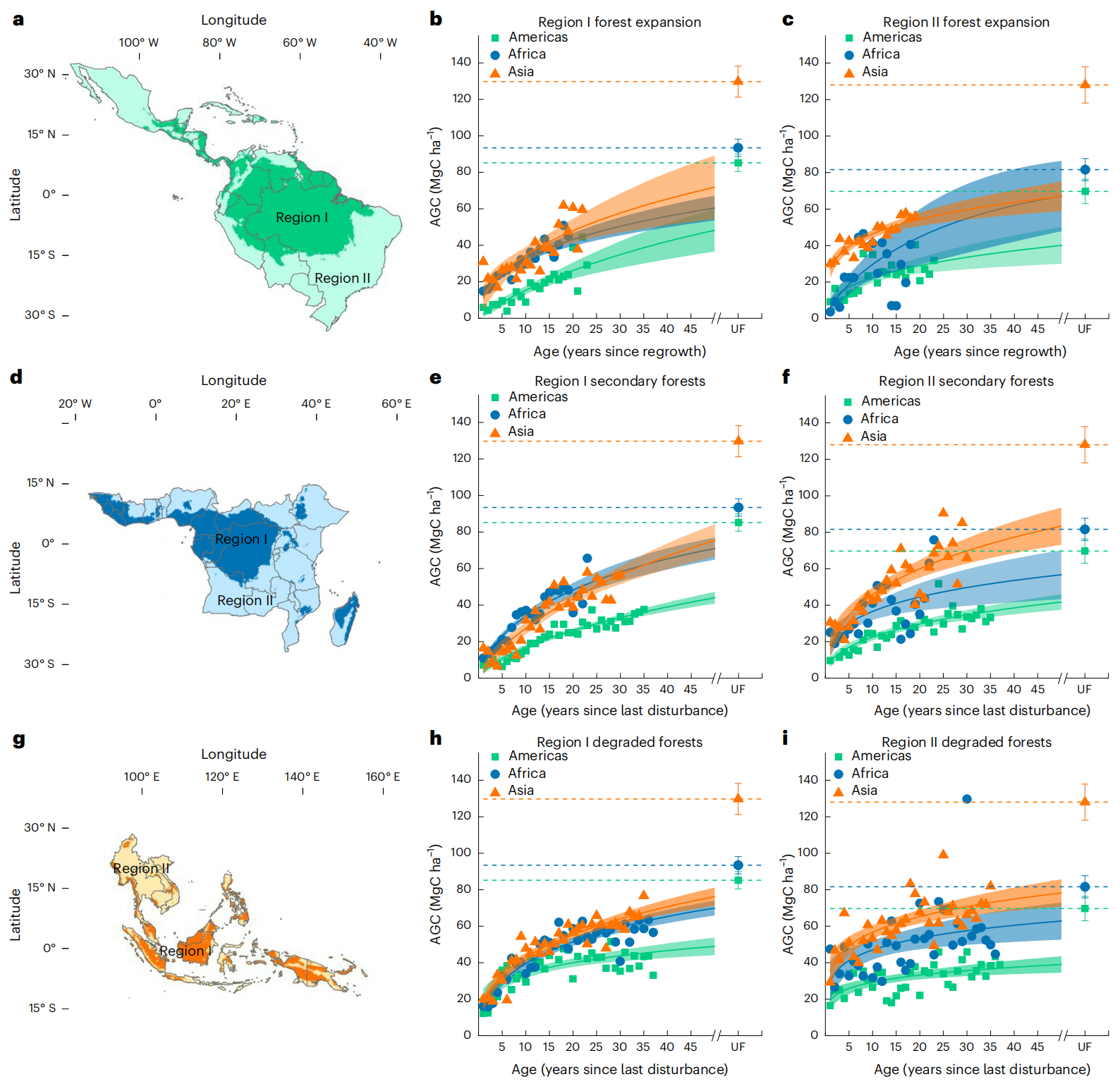
Modeled region-specific AGC accumulation for naturally regenerating forests. Climatic Regions I and II for the tropical Americas (a), Africa (d) and Asia (g). Modeled AGC accumulation curves for natural forest expansion (b, c), secondary forest (e, f) and degraded forest (h, i) in Regions I and II across the three tropical regions. (Image by APM)
To address this knowledge gap, the research team integrated the Joint Research Centre Tropical Moist Forest (JRC TMF) change product with NASA GEDI LiDAR biomass footprint data to derive fine-resolution spatial distributions of forest age for pantropical forest regeneration, including natural forest expansion, secondary forests, and degraded forests, from 1985 to 2022.
Using the classical "space-for-time" substitution approach, the researchers developed above-ground carbon (AGC) accumulation models for different climate zones and recovery pathways, and further investigated the climatic and environmental drivers influencing forest carbon accumulation and model predictions.
Based on these models, they quantified and compared carbon accumulation rates and carbon sink capacities among the three types of naturally regenerating forests across tropical America, Africa, and Asia under different climatic conditions. The study also evaluated their contributions to offsetting carbon emissions caused by forest degradation and deforestation. In addition, future carbon sink potentials of the three natural forest regeneration pathways by 2030 were projected under five forest restoration scenarios.
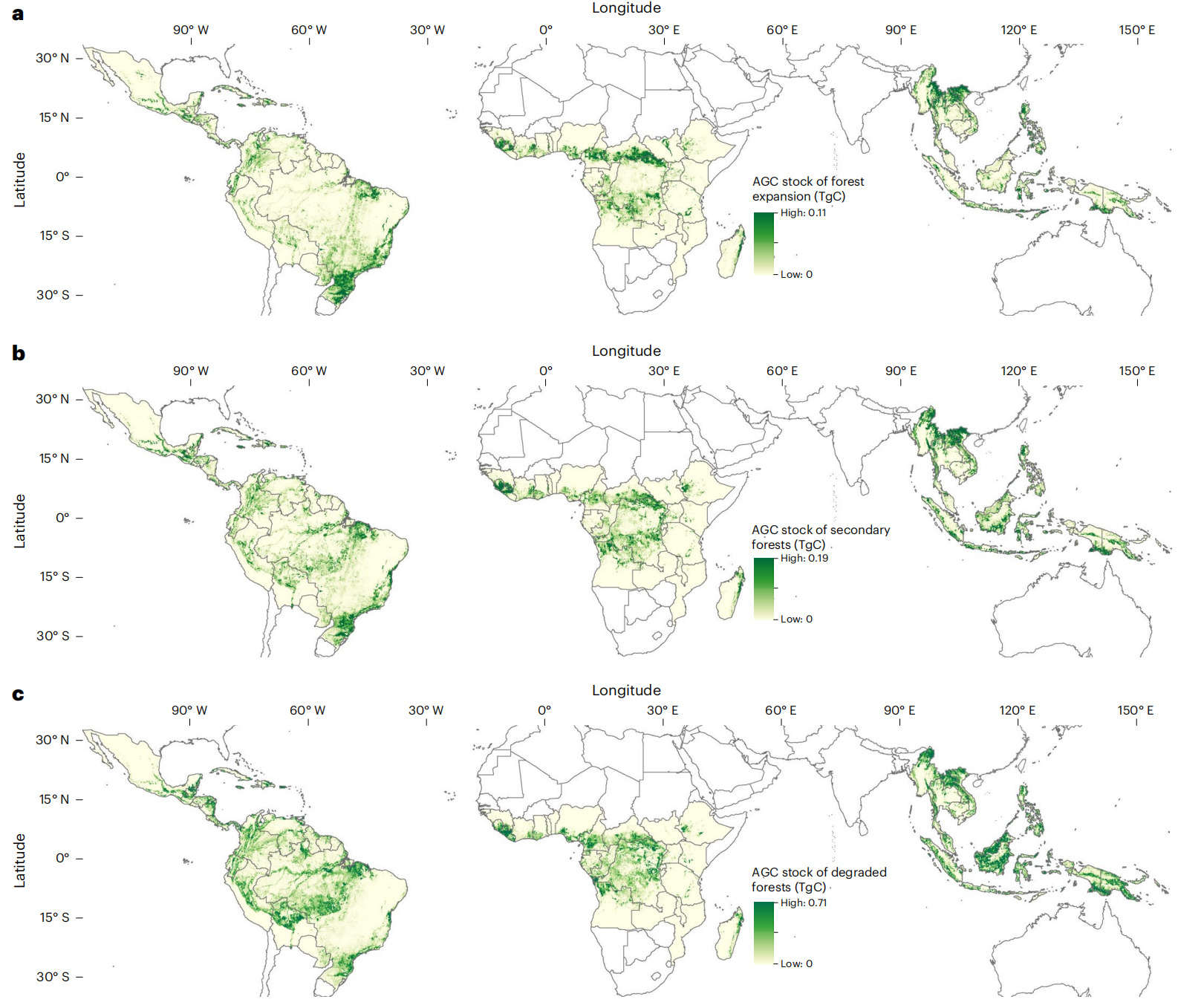
Pantropical carbon stocks of natural forest expansion (a), secondary forest (b) and degraded forest (c) using region-specific AGC accumulation models. (Image by APM)
The study found that the area of natural forest expansion across moist tropical regions is 6% larger than that of secondary forests, while exhibiting comparable AGC accumulation rates as secondary forests, particularly in the tropical Americas. Compared with secondary and degraded forests, AGC accumulation in natural forest expansion is more sensitive to climatic and environmental changes, possibly because these forests are generally located in drier regions farther from intact old-growth forests.
Across the pantropical region, the total AGC uptake from natural forest expansion reached 795±132 Tg C, which is 5.4% greater than that of secondary forests (754±105 Tg C). Natural forest expansion additionally offset 2.4±0.6% of carbon emissions resulting from forest deforestation and degradation, whereas regrowth of secondary and degraded forests offset 2.3±0.5% and 13.6±2.1%, respectively.
According to the researchers, the findings indicate that the capacity of natural forest regeneration to offset disturbance-related carbon emissions remains limited, suggesting that reducing deforestation and forest degradation should continue to be the top priority for mitigating global climate change.
Meanwhile, the study identifies natural forest expansion as an overlooked pan-tropical carbon sink with considerable climate mitigation potential, particularly when sustainably managed alongside the effective protection of old-growth and regenerating forests.
ZHANG Jiaojiao
Innovation Academy for Precision Measurement Science and Technology
E-mail: zhangjiaojiao@apm.ac.cn

