
Newsroom


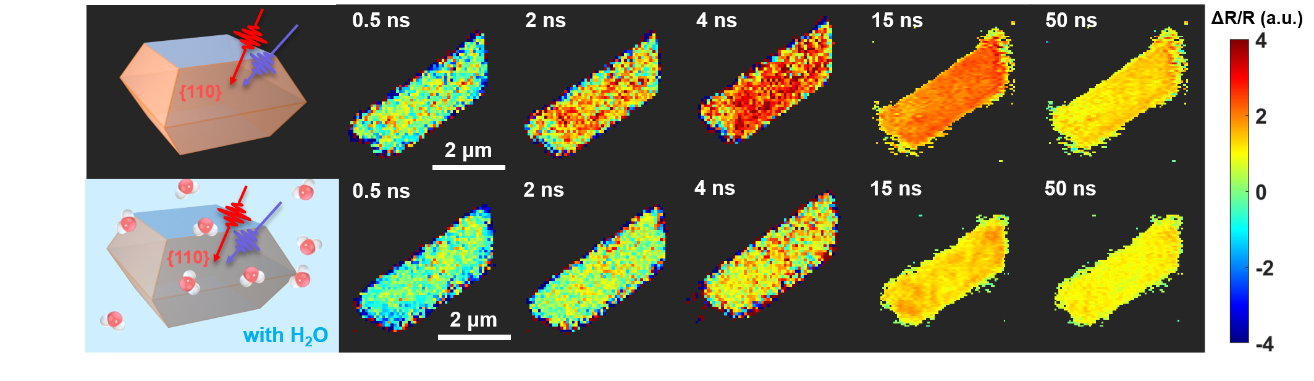
A new study has visualized the spatiotemporal evolution of photogenerated holes in a facet-engineered bismuth vanadate photocatalyst using a home-built in-situ transient reflection microscope (TRM).
Led by Prof. TIAN Wenming, Profs. LI Rengui and LI Can from the Dalian Institute of Chemical Physics (DICP) of Chinese Academy of Sciences (CAS), the study was published in National Science Review.
Artificial photosynthesis offers a compelling strategy for converting solar energy into renewable chemical fuels. However, the efficiency of photocatalytic reactions is largely limited by a series of complex photophysical and photochemical processes occurring at the nanoscale solid-liquid interface. Following light absorption, photogenerated carriers undergo multiple steps, including charge separation, carrier trapping, and interfacial transfer. These processes can introduce significant energy losses and determine the overall reaction efficiency.
Although semiconductor carrier dynamics have been extensively studied, directly tracking the evolution of photogenerated carriers on individual photocatalyst crystals under realistic reaction conditions remains a major challenge. A comprehensive understanding of how carriers migrate, become trapped, and participate in interfacial reactions is therefore essential for the rational design of efficient photocatalysts.
Schematic illustration of the proposed photogenerated hole evolution pathway involving three steps: ultrafast charge separation, hole trapping, and rapid interfacial transfer (Image by SUN Fengke)
In this study, the researchers tracked the complete spatiotemporal evolution of photogenerated carriers with nanoscale resolution under realistic reaction conditions. They discovered that photogenerated holes undergo three sequential steps: ultrafast photogenerated charge separation within 5 ps, defect-state trapping with a time constant of approximately 1.5 ns, and rapid interfacial hole transfer mediated by oxygen-related defect with a time constant of approximately 19 ps.
According to the researchers, this complete, in-situ visualization of carrier evolution across the solid-liquid interface clarifies the functional role of trapped holes and highlights the essential contribution of surface defect states to efficient photocatalytic oxidation.
The findings provide important insights for understanding photocatalytic reaction mechanisms and offer a theoretical basis for improving photocatalytic performance through defect engineering, they said.
