Newsroom


A recent study published in Physics Letters B reveals the dual role of shell effects in producing neutron‑rich heavy nuclei: while for few‑nucleon transfer products near the entrance channel, shell effects enhance yields; for neutron‑rich products, they have the opposite effect. This finding offers theoretical guidance for efficiently synthesizing these nuclei in the laboratory.
The study was led by the researchers from the State Key Laboratory of Heavy Ion Science and Technology, the Institute of Modern Physics (IMP) of the Chinese Academy of Sciences (CAS).
Synthesizing and studying neutron-rich nuclei near the neutron magic number 126 hold special scientific significance, as their properties are critical for understanding the cosmic origin of heavy elements such as gold and platinum. However, efficiently producing these nuclei has long posed an experimental challenge for traditional methods such as fusion‑evaporation, fission, and projectile fragmentation.
In recent years, multinucleon transfer reactions have attracted considerable attention as a promising alternative approach. Shell effects are a key factor influencing the dynamics of these reactions, yet the underlying mechanism has remained unclear.
The researchers conducted a systematic study on shell effects. They developed a theoretical model that incorporates a deformation‑dependent mass formula and a scaling factor that continuously tunes the strength of shell corrections, enabling them to systematically track the evolution of shell effects from nucleon exchange to fragment deexcitation.
Through comparative calculations for collisions of xenon‑136 projectiles with three different targets—lead‑208, mercury‑204, and mercury‑208—the researchers found that shell effects act as a double‑edged sword. For few‑nucleon transfer products near the entrance channel, shell effects enhance their yields; for neutron‑rich products requiring the transfer of many nucleons, however, shell effects strongly suppress their production. This suppression is most pronounced when the target is the doubly magic nucleus lead‑208.
Based on these findings, the study suggests that magic nuclei should be avoided as collision partners. Instead, researchers recommend using non-magic targets, specifically proposing an optimized reaction system involving the bombardment of mercury-204 with uranium-238. Calculations show that this reaction can significantly enhance the production probability of neutron-rich isotopes such as iridium-203 and osmium-202.
According to the researchers, this study not only clarifies the role of shell effects in multinucleon transfer reactions, but also provides a new roadmap for future experiments that are essential for understanding the origin of heavy elements in the universe.
This work was supported by the National Natural Science Foundation of China, the National Key Research and Development Program of China, and the Strategic Priority Research Program of CAS.
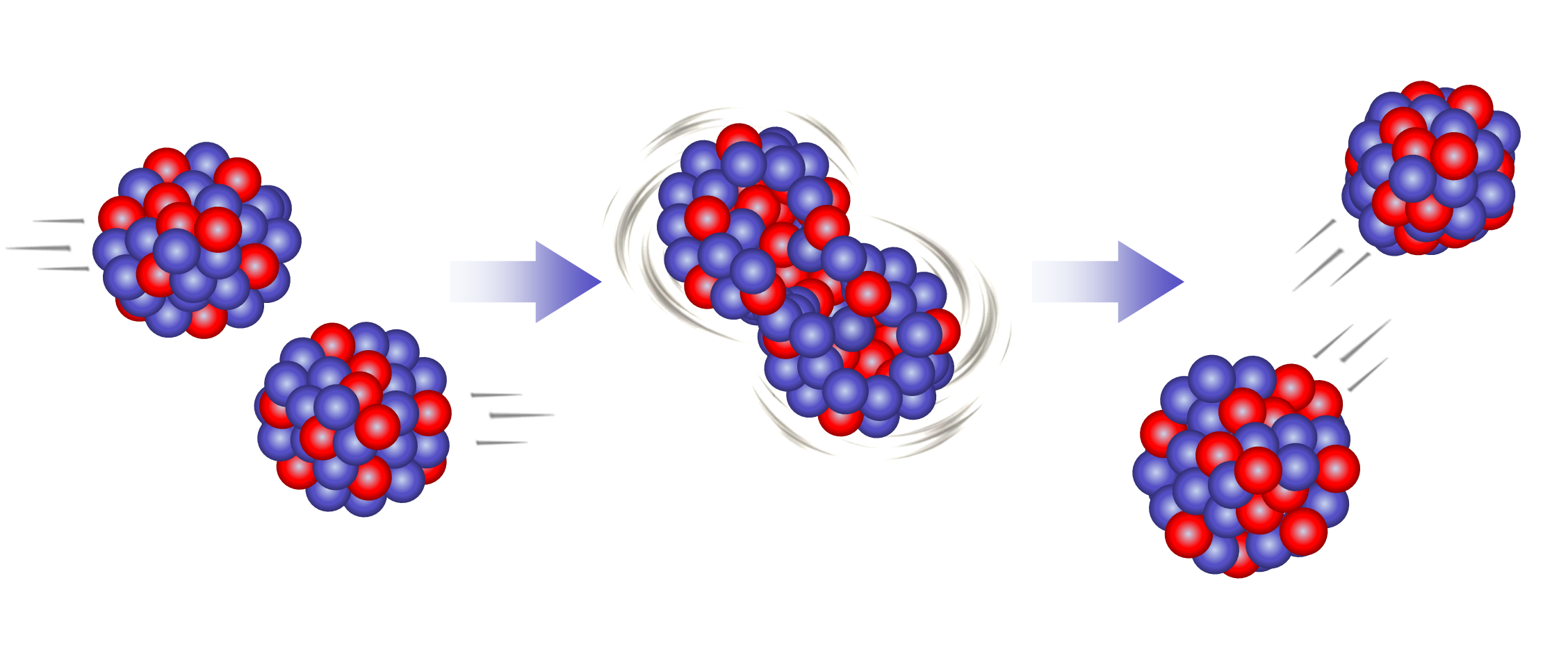
Schematic diagram of multinucleon transfer reaction (Image by DAI Fanchao)