
Newsroom


Dispersal allows species to respond to climate change by shifting their geographic ranges, colonizing new habitats, and tracking favorable environmental conditions. However, the successful establishment of self-sustaining populations by dispersers is often limited by niche mismatch in new habitats.
A new study shows that climate-driven niche filtering plays a central role in determining whether dispersing populations can become established and adapt over the long term.
Led by Prof. LIU Jie from the Kunming Institute of Botany (KIB) of the Chinese Academy of Sciences and Prof. LI Dezhu from Shandong Agricultural University, along with other domestic and international researchers, the study was published in Integrative Plant Biology on July 6.
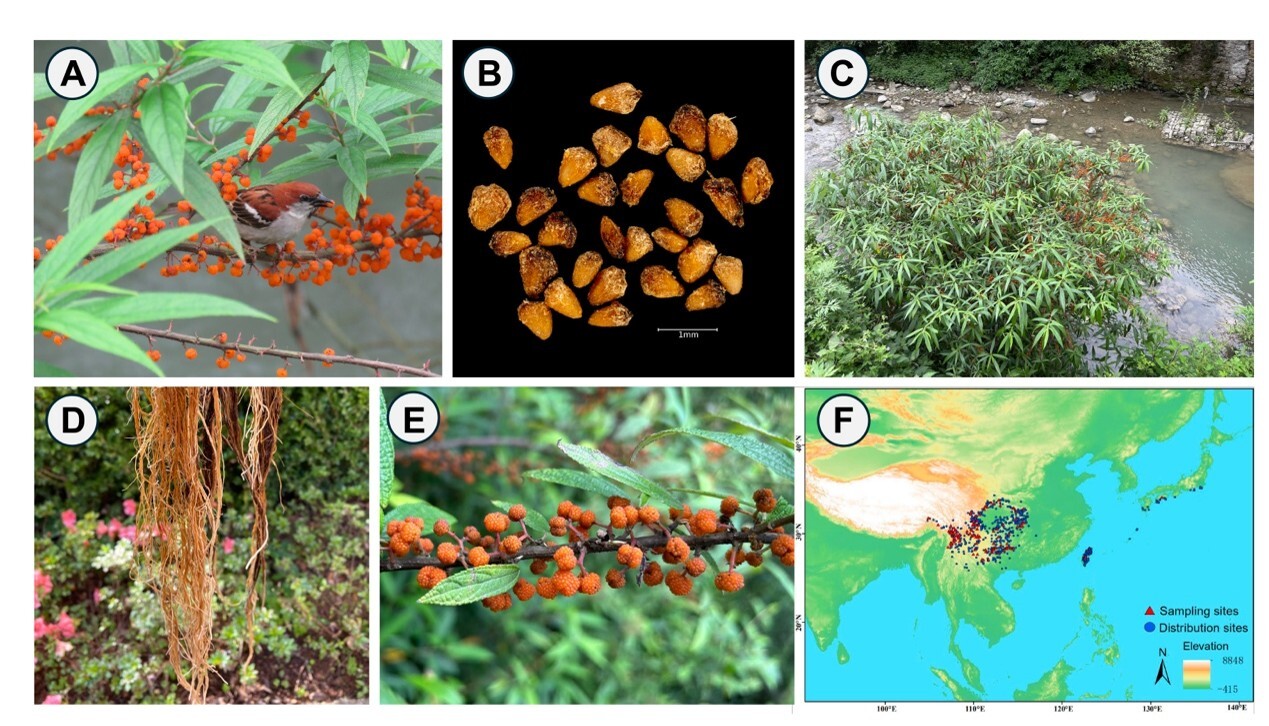
Riparian ecosystems, shaped strongly by topographic, hydrological, and climatic gradients, serve as a feasible natural system in which to test the effects of niche filtering. Debregeasia orientalis C.J. Chen (Urticaceae) is a characteristic riparian shrub that is mostly found in biodiversity hotspots in the mountainous regions of Southwest China. It possesses multiple dispersal vectors, including birds, wind, and water flow. Therefore, this species acts as an ideal model to unravel the coupled mechanisms linking dispersal, niche filtering, and genomic divergence.
Using D. orientalis as a model system, the researchers integrated biogeography, macroecology and population genomics to systematically analyze how climate-mediated niche filtering constrains post-dispersal colonization, genomic differentiation and local adaptation. They also evaluated lineage-specific vulnerability under future climate change scenarios.
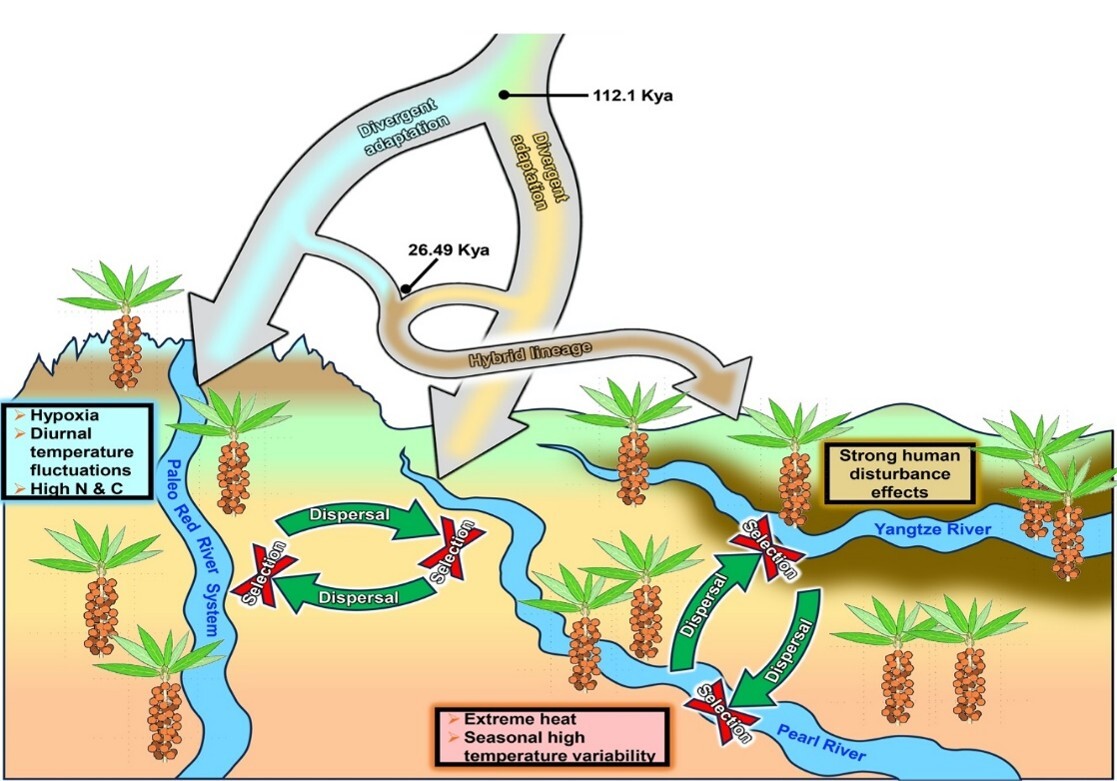
The researchers used a chromosome-scale reference genome and whole-genome resequencing data from 332 individuals to identify three genetically distinct lineages within D. orientalis. Two of these lineages diverged during the early Last Glacial Period, and the third originated from more recent hybridization. Despite historical and ongoing gene flow, clear genetic isolation persists among lineages.
Further ecological analyses revealed substantial niche differentiation across the three lineages. Genomic scans detected selective sweep signatures associated with hypoxia tolerance, thermal adaptation and responses to anthropogenic disturbance, confirming the genetic basis of local adaptation. Climate-driven niche filtering was identified as a major factor restricting lineage admixture and maintaining stable genetic structure.
The researchers found that even with the species' high dispersal capacity, cross-lineage gene exchange and colonization are strictly limited by niche constraints; niche matching directly determines post-dispersal colonization success, thus genomically validating the pivotal role of niche filtering. Genomic offset predictions revealed that certain lineages will face substantially higher maladaptation risks under future climate change.
This study establishes an integrated analytical framework linking post-dispersal niche filtering and long-term genomic divergence. For riparian plants, it systematically demonstrates that climate-driven niche filtering constitutes a major factor in maintaining genetic boundaries and shaping historical lineage divergence and contemporary adaptive capacity.
These findings advance our mechanistic understanding of species distribution dynamics and lineage differentiation. They also provide theoretical support for riparian ecosystem conservation and wild germplasm management under climate change, and deliver critical scientific evidence for designing lineage-specific conservation strategies for riparian biome.
Morphology, habitat and geographical distribution of D. orientalis. (Image by KIB)
Schematic diagram of evolutionary history and adaptation in D.orientalis (Image by KIB)
