Newsroom


A research team led by Prof. ZHANG Yajie from the Ningbo Institute of Materials Technology and Engineering (NIMTE) of the Chinese Academy of Sciences has developed an innovative oxidation process that converts 5-hydroxymethylfurfural (HMF) into 2,5-furan dicarboxylic acid (FDCA) at a cost competitive with petroleum-based counterparts.
The study was published in Bioresource Technology.
Biomass, one of Earth's most abundant renewable resources, can be catalytically converted into chemicals and fuels that serve as sustainable alternatives to fossil resources. This process plays a crucial role in achieving carbon neutrality.
Among these renewable chemicals, FDCA is regarded as the only bio-based aromatic dicarboxylic acid with commercialization potential comparable to that of petroleum-derived terephthalic acid (TPA). However, its widespread industrial adoption has been hindered by high production costs, driven by the price of the feedstock HMF and the cost of the oxidation process required to produce FDCA.
After over a decade of dedicated research, the scientists developed an engineered NaClO/KBr/TEMPO-based oxidation process to convert HMF into FDCA. They systematically investigated the oxidation mechanism, validated the process at a 100-metric-ton pilot scale, and evaluated its economic and technical feasibility for 100,000-metric-ton operations.
Using water as the reaction solvent, the process achieves a near-quantitative conversion of HMF to FDCA, with yields approaching 100%.
Building on this process and collaborating with upstream and downstream industries, the researchers proposed a three-chain coupling strategy that integrates photovoltaics, the chlor-alkali industry, and the FDCA industry. Photovoltaics supply green energy to the chlor-alkali industry and FDCA oxidation. In return, the waste salt (NaCl) generated from FDCA electrolysis in the chlor-alkali industry serves as feedstock for FDCA oxidation and helps resolve the issue of solid waste from the reaction.
With an annual production capacity of 100,000 metric tons, the theoretical cost of FDCA is estimated to range from $721 to $1,101 per ton, which is comparable to the cost of petroleum-based TPA.
By coupling FDCA production with China's photovoltaic and chlor-alkali sectors, the strategy simultaneously delivers green energy use and green products across the entire process, offering new insights for the transformation and upgrading of the traditional chlor-alkali industry.
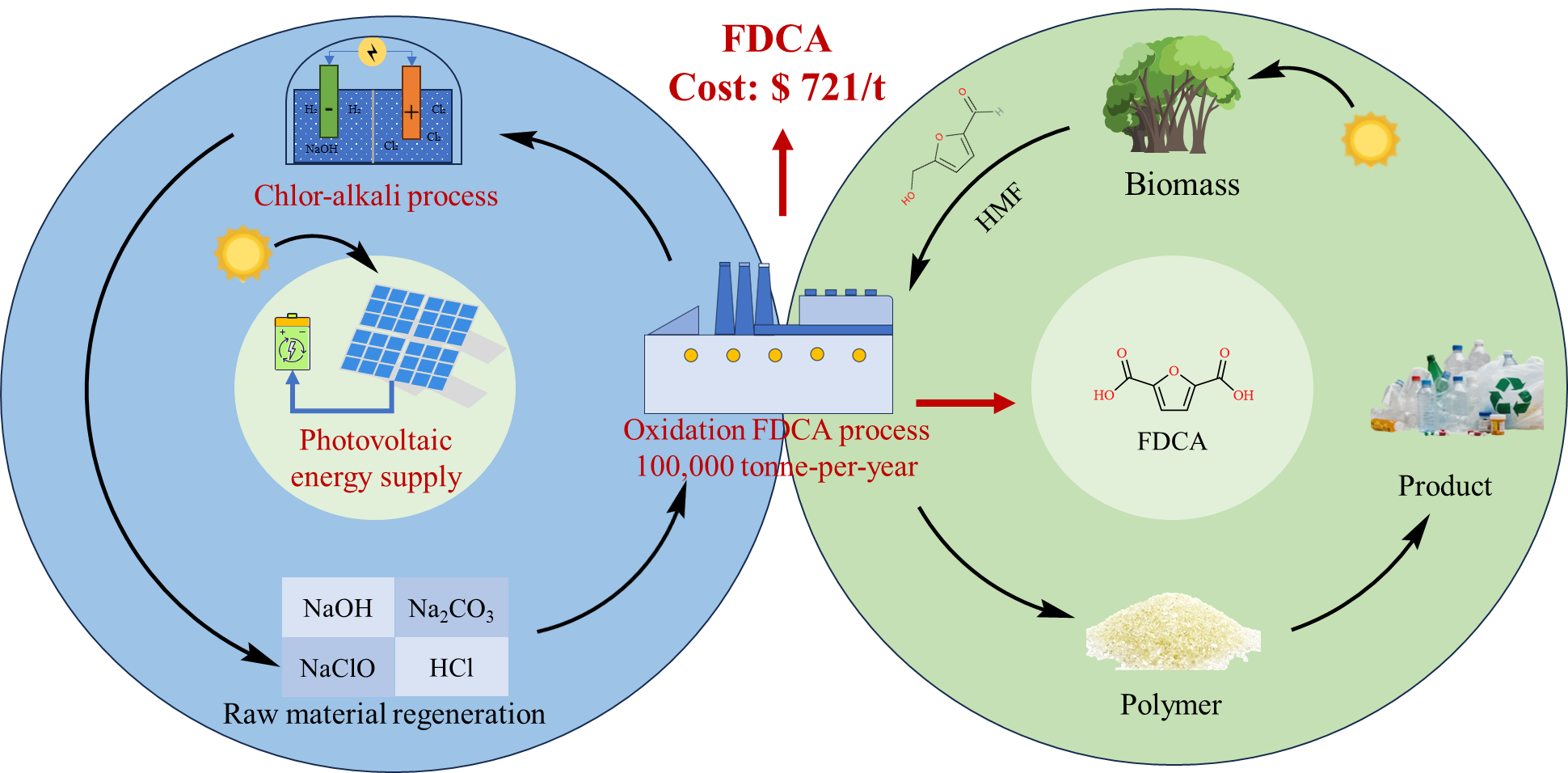
Novel green strategy to produce bio-based FDCA (Image by NIMTE)