
Newsroom


Pulsars in space act like rotating cosmic lighthouses, continuously beaming out regular radio signals. A new study has identified an exceptional pulsar—J0846−3533—that displays three entirely different emission variations at the same time, a phenomenon that had never been fully and systematically analyzed through observations before.
The study, led by Prof. WEN Zhigang, Prof. YUAN Jianping, and Ph.D. student WANG Zhen from the Xinjiang Astronomical Observatory (XAO) of the Chinese Academy of Sciences (CAS), has been published in The Astrophysical Journal.
In the study, the researchers used observational data from Australia's Parkes 64-meter radio telescope. They collected and analyzed more than 10,000 single pulses of J0846−3533, confirming that a single pulsar can host three unique emission behaviors simultaneously.
According to the study, the pulsar shows highly variable radiation performance. It can briefly cut off its radio emission—like a lighthouse temporarily switching off. Its pulse profile can also shift shape rapidly: the trailing part of the pulse shines brighter under normal conditions, while the radiation intensity of the central region surges dramatically after a transition.
In addition, the pulsar's brightness undergoes stable, periodic flickers, completing a full brightness cycle every two rotations. This feature was clearly detected in two observation runs separated by three years.
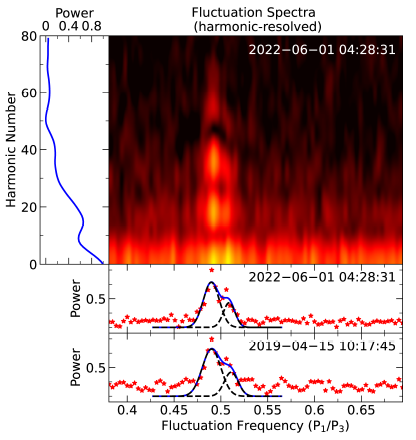
Harmonic-resolved fluctuation power spectra for PSR J0846−3533. (Image by XAO)
This study expands the sample library of pulsars with coexisting multiple emission phenomena. It verifies that mode switching and temporary emission cessation are both triggered by large-scale rearrangement of electric currents within the neutron star's magnetosphere.
Meanwhile, periodic brightness fluctuations arise from cyclic changes in the efficiency of particle acceleration inside the star. This work clearly distinguishes two completely separate mechanisms behind pulse intensity variations, the researchers said.
The study also reveals obvious differences in activity across different emission zones of the pulsar. It advances our understanding of the extreme magnetic environments around neutron stars and provides critical observational evidence for establishing a unified theory describing pulsar magnetospheric dynamics, they added.
The researchers said they will conduct observations with higher sensitivity and longer continuous duration in future work to investigate whether periodic brightness fluctuations vary with emission modes and further refine theories on pulsar radio emission.
