Newsroom


A research team led by Prof. WANG Chunyang from Institute of Metal Research (IMR) of the Chinese Academy of Sciences has identified the atomistic origin of structural failure in lithium cobalt oxide (LiCoO2) cathodes operating under extreme 5 V charging conditions.
The study was published in the Journal of the American Chemical Society on June 21.
LiCoO2 is one of the most widely used cathode materials in consumer lithium-ion batteries due to its high volumetric energy density, stable voltage profile, and excellent compatibility with established manufacturing processes. As the demand for longer runtimes in smart devices, portable electronics, and highly integrated 3C products grows, raising the upper cutoff voltage of LiCoO2 from the conventional commercial range of approximately 4.2–4.4 V to nearly 5 V is considered a promising way to unlock its latent capacity and enhance battery energy density.
However, deep delithiation under such ultrahigh-voltage conditions markedly amplifies the structural instability of cathode materials, leading to rapid capacity decay and shortened cycle life. Although the phase transition behavior and structural degradation of LiCoO2 under conventional voltage ranges have been extensively investigated, the atomistic origin and evolution of structural failure under the extreme 5 V operating condition remain unknown and unknown.
Using super-resolution transmission electron microscopy, the researchers traced the structural evolution of LiCoO2 under deep delithiation and discovered that degradation begins not only at the surface, but also through a far more complex, system-wide lattice response.
During deep delithiation at 5 V, LiCoO2 undergoes more than just conventional surface oxygen loss and rock-salt/spinel reconstruction. Instead, it first experiences pronounced global lattice deformation. In-plane shear breaks the originally ordered O3 layered structure into nanoscale mosaics composed of O3, O1, and reoriented O3 (O3r) domains, while also inducing complex structural motifs such as sub-nanometer twins and highly strained structural units.
Meanwhile, non-shear deformation, including local lattice fluctuations, bending, and kinking, further promotes the nucleation and propagation of intragranular cracks. These highly strained structural units become kinetically trapped, giving rise to irreversible degradation structures that are difficult to reverse during subsequent electrochemical cycling.
Upon prolonged cycling, the complex lattice deformation becomes coupled with lattice oxygen loss, leading to the formation of a previously unreported multilayered "sandwich-like" degradation architecture on the LiCoO2 surface. This degraded surface layer hinders Li+ reinsertion and the recovery of the layered structure, while further aggravating local stress concentration and oxygen-loss-induced structural failure.
These findings demonstrate that a global-lattice-deformation-dominated chemo-mechanical degradation mode is the key origin of LiCoO2 failure under extreme high-voltage operation. The degradation follows a self-reinforcing failure chain of electrochemical reaction stress, lattice deformation, coupled phase transformation, mechanical destabilization and lattice oxygen loss, and, ultimately, capacity decay.
Guided by this atomistic failure map, the researchers further proposed a cooperative structural regulation strategy to stabilize LiCoO2 under the extreme 5 V condition. Specifically, "pillaring-type" dopants were introduced to enhance the resistance of the layered framework against global lattice deformation, while sulfur-containing species were employed to stabilize the near-surface oxygen structure and suppress surface degradation induced by the coupling between lattice deformation and oxygen loss.
As a proof of concept, Mg/S co-doped LiCoO2 exhibited improved structural stability and capacity retention during 5 V cycling. After 10 cycles, pristine commercial LiCoO2 retained only 67.73% of its capacity, whereas the capacity retention of the Mg/S co-doped sample increased to 83.93%. Meanwhile, the formation of O1/O3/O3r mosaics, highly strained structural units, and intragranular cracks was significantly suppressed.
In summary, this work reveals, for the first time, the atomistic origin of structural failure in LiCoO2 cathodes under extreme high-voltage operating conditions. It moves beyond the conventional understanding that mainly attributes cathode degradation to surface reconstruction and oxygen release, and establishes a new mechanistic picture of global-lattice-deformation-dominated chemo-mechanical failure.
These findings provide a theoretical basis for the structural design and performance optimization of next-generation high-energy-density LiCoO2 cathodes. This study also highlights the indispensable role of advanced electron microscopy in uncovering structure-property relationships in energy materials.
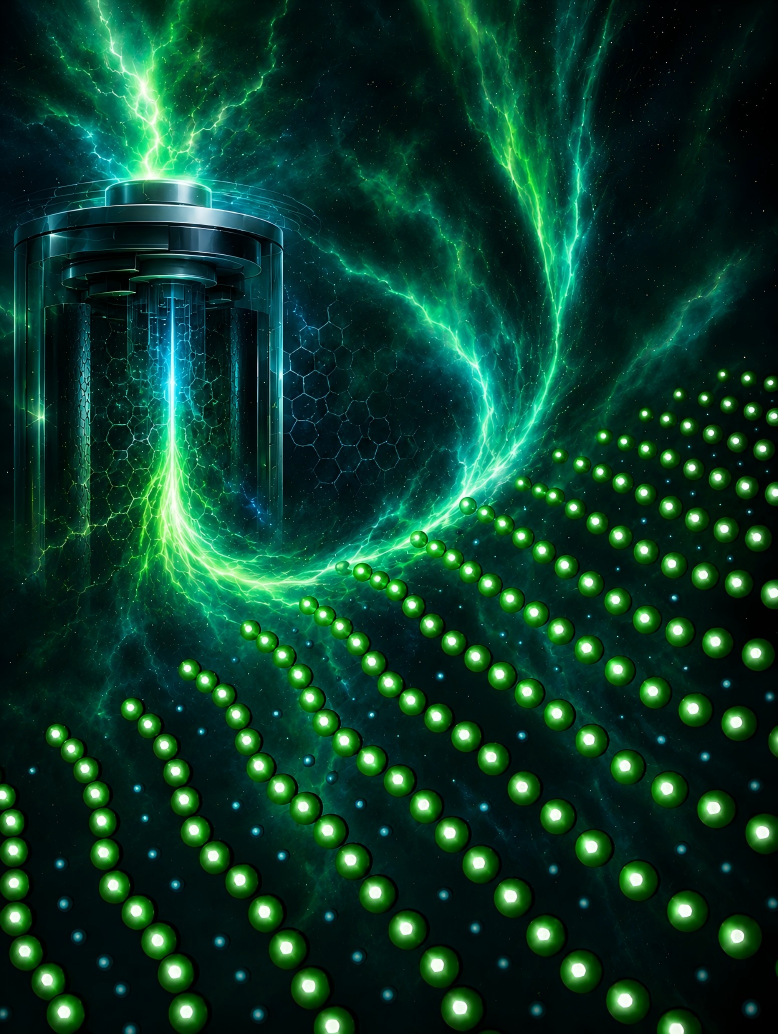
Schematic illustration of the atomistic failure mechanism of LiCoO2 under extreme high-voltage operation. (Image by IMR)