Newsroom


Phase transformations—in which a material changes from one crystal structure to another, thereby acquiring dramatically different properties—are ubiquitous in nature. Understanding the microscopic mechanisms of these transformations is essential for controlling material properties and designing functional devices.
A research team led by Profs. CHEN Xingqiu and SUN Yan from the Institute of Metal Research (IMR) of the Chinese Academy of Sciences, in collaboration with Prof. NIU Haiyang from Northwestern Polytechnical University, has uncovered a previously unknown phase transformation mechanism in monolayer molybdenum telluride (MoTe2).
The study, published in PNAS on June 29, reveals a phase-transformation pathway that is fundamentally distinct from the conventional martensitic model in which many atoms move together through concerted shear displacements.
The newly identified mechanism shows that the transformation from one phase to another occurs through a one-dimensional "domino-like" chain reaction. This discovery opens new avenues for programmable electronic and photonic devices.
The emergence of two-dimensional materials has reinvigorated phase transformation research, as reduced dimensionality gives rise to physical behaviors absent in their bulk counterparts.
In monolayer transition metal dichalcogenides, the phase transformation between the semiconducting 1H phase and the semimetallic 1T' phase has long been understood as a martensitic process. However, the latter process predicted high energy barriers that were inconsistent with experimental observations, which showed that such transformations occurred under accessible conditions. As a result, the underlying kinetics and microscopic mechanisms were the subject of longstanding debate.
To resolve this issue, the researchers used deep learning potential-accelerated molecular dynamics simulations to systematically study the 1H-to-1T' phase transformation in monolayer MoTe₂. Instead of supporting the conventional martensitic model, the simulations showed that the transformation proceeds through a one-dimensional chain reaction, in which tellurium atoms sequentially hop along a specific crystallographic direction. This triggers structural rearrangement, accompanied by Peierls distortion and local topological changes.
This pathway has a substantially lower energy barrier than the martensitic shear route. It also gives rise to a free-energy landscape with multiple metastable states. This is distinct from the classical nucleation-and-growth scenario.
The researchers further elucidated the kinetic origins of the single-domain and multi-domain 1T' morphologies observed in simulations with different cell sizes. They also proposed strategies to control phase transformations based on these kinetic characteristics. Through theoretical calculations, they demonstrated that reversible switching between single-domain and multi-domain configurations could enable rapid modulation of electronic states.
They also discovered that the phase-transformation intermediates accessible through this mechanism exhibit significantly enhanced second-order nonlinear optical responses, with light-induced shift current responses in the visible range increasing from approximately 70 μA/V2 to about 470 μA/V2.
In summary, this work deepens our understanding of phase-transformation mechanisms in two-dimensional materials and provides a new paradigm for phase engineering in low-dimensional systems, with promising implications for programmable electronics and optoelectronic devices.
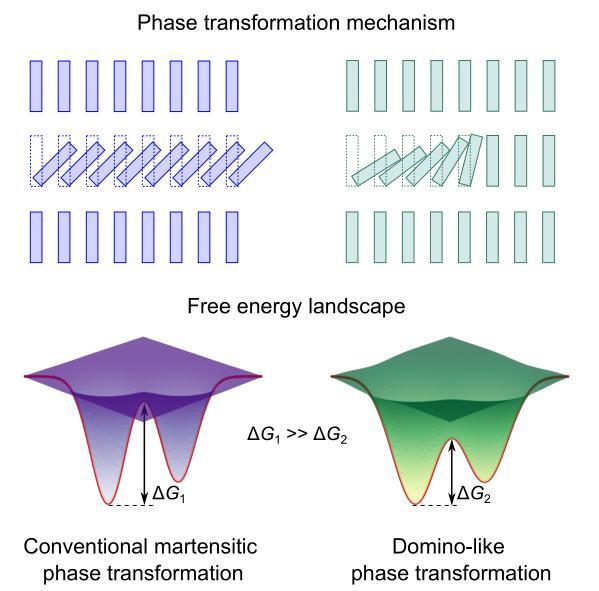
Comparison of conventional martensitic and domino-like phase transformations. (Image by IMR)