
Newsroom


A research team led by Academician ZHU Jiaojun from the Institute of Applied Ecology of the Chinese Academy of Sciences (CAS) has published a commentary in PNAS on June 12, calling for greater caution in estimating the carbon sequestration potential of afforestation in the Taklamakan Desert.
Responding to a recent PNAS article on carbon sink estimation in the Taklamakan Desert, the commentary provides a scientific assessment of claims that large-scale afforestation under China's Three-North Protective Forest Program has transformed the hyper-arid region into a measurable terrestrial carbon sink, urging more rigorous interpretation of carbon accounting in hyper-arid desert ecosystems.
The discussion centers on a PNAS article from January 2026 that attributed a measurable carbon sink to the afforestation in the Taklamakan Desert. In contrast, ZHU and his colleagues used long-term field observations and established ecohydrological processes in arid environments to reassess the climatic constraints and carbon dynamics of such systems.
According to the researchers, the Taklamakan Desert receives less than 80 millimeters of annual precipitation, yet experiences potential evaporation exceeding 2,500 millimeters. The region lacks the environmental conditions necessary for stable natural vegetation development.
The researchers also questioned the seasonal framework used in the earlier study, which divided the year into "wet" and "dry" seasons. They noted that, in hyper-arid, inland deserts, such as the Taklamakan, there is no true wet season. The so-called dry season corresponds to winter when average temperatures fall to around minus five degrees Celsius, effectively halting plant physiological activity.
Under these conditions, the researchers argued, comparisons of vegetation carbon uptake across such seasonal categories are not physiologically meaningful.
Regarding atmospheric carbon dioxide variation, the commentary addressed the reported summer decline of approximately three parts per million (ppm) and its attribution to local afforestation. The researchers pointed out that this magnitude falls within the 4- to 6-ppm range of background seasonal fluctuations observed across the Northern Hemisphere due to large-scale vegetation phenology. Therefore, they stated that regional afforestation in the Taklamakan, where vegetation is mainly distributed along desert edges, cannot reasonably explain the observed background atmospheric signal.
From a hydrological perspective, the researchers further highlighted the strong dependence of desert-edge vegetation on groundwater extraction and irrigation. They noted that groundwater levels in parts of the region are declining at an estimated rate of 8.6 millimeters per year, raising concerns about long-term water sustainability.
Due to the low productivity and limited resilience of arid ecosystems, the researchers cautioned that climate variability and increasing drought stress could further weaken vegetation stability. There is a possibility that areas currently acting as weak carbon sinks could shift toward becoming carbon sources.
The commentary also clarified the role of afforestation in the Three-North Shelter Forest Program, stating that the program's primary objective in the Taklamakan Desert is to control desertification and limit desert expansion rather than to create a carbon sink. They stressed that carbon sequestration should be considered a secondary outcome, limited by water resources and economic factors.
The researchers also warned against extrapolating carbon sink estimates derived from desert-edge ecotones to the entire Taklamakan Desert. They noted that such generalization could distort scientific understanding and policy expectations.
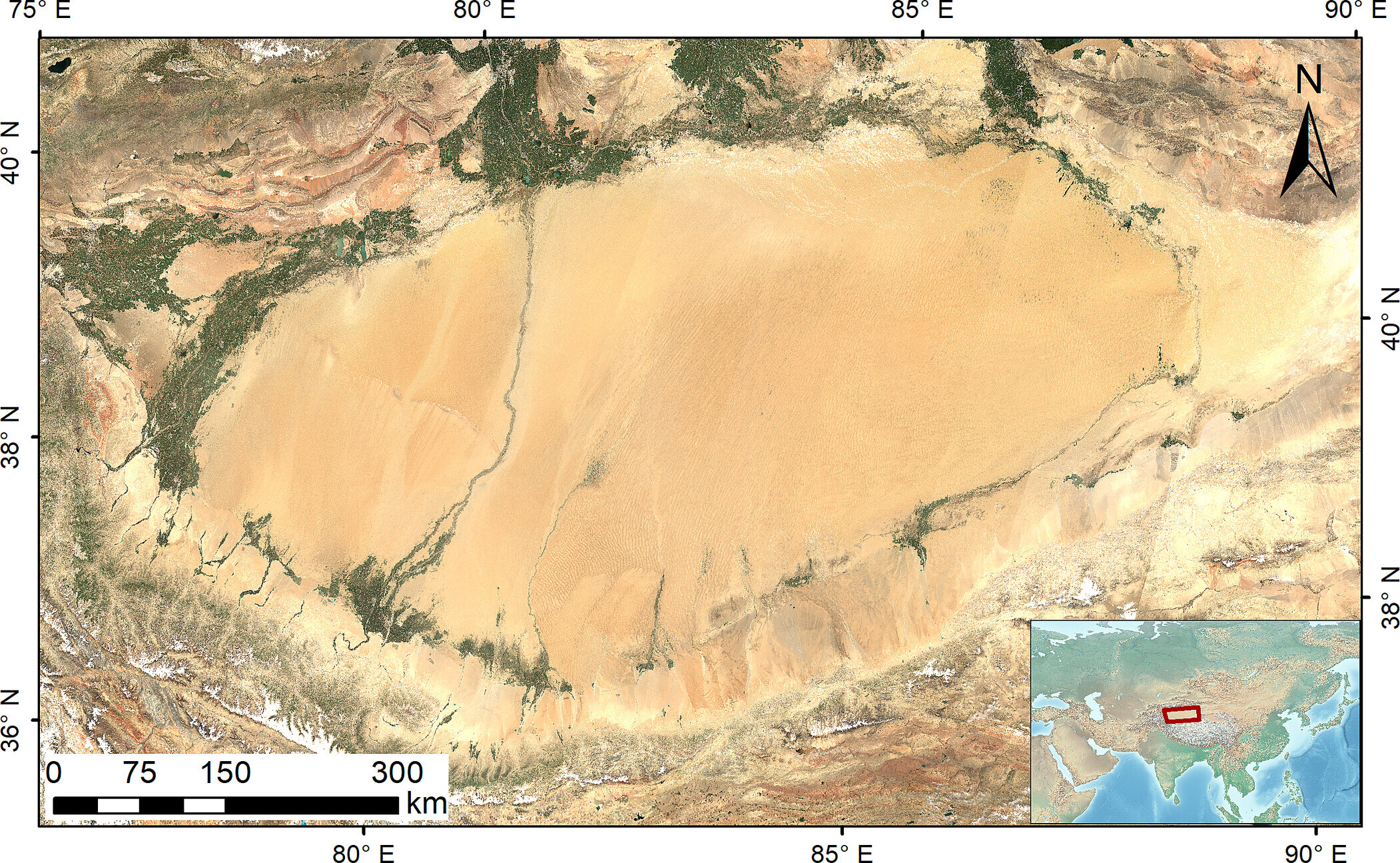
Satellite imagery of vegetation distribution in the Taklamakan Desert, showing afforested and natural vegetation concentrated in in the peripheral ecotone surrounding the desert (Image by GAO Tian)
