
Newsroom


A recent study published in Functional Ecology reconstructs the long-term dynamics of above-ground biomass in the Indus Delta mangroves and projects their potential changes through 2050, revealing a significant increase in the above-ground biomass of this ecosystem.
The research, led by Professor WANG Faming at the South China Botanical Garden (SCBG) of the Chinese Academy of Sciences (CAS), offers new evidence for the recovery and blue carbon potential of mangroves in arid coastal environments while also delivering a modeling framework to support mangrove restoration and adaptive management.
As highly productive blue carbon ecosystems, mangroves remove carbon dioxide from the atmosphere while also contributing to shoreline stabilization, protection from coastal hazards and biodiversity conservation. Located along the Arabian Sea coast of Pakistan, the Indus Delta supports one of the world's largest mangrove systems occurring in an arid climatic region.
Subject to less than 200 mm of annual rainfall, high evaporation and elevated salinity, and facing substantial pressures from reduced freshwater discharge, declining sediment delivery, land-use change and other human activities, the ecosystem has also experienced considerable stress. Although large-scale planting and community-based conservation programmes have promoted mangrove recovery in recent decades, quantification of the long-term dynamics of mangrove biomass and its future trajectory has remained insufficiently detailed.
To fill this knowledge gap, the researchers integrated field-derived above-ground biomass data with multisource remote-sensing, climatic and land-use variables. They compared four machine-learning approaches—random forest, gradient-boosted regression trees, support vector regression, and classification and regression trees—to reconstruct spatial and temporal biomass patterns from 2002 to 2022 and project potential changes for 2030, 2040 and 2050.
The results revealed a significant increase in the mean above-ground biomass of the Indus Delta mangroves, from 18.13±9.10 Mg ha-1 in 2002 to 25.75±8.32 Mg ha-1 in 2022. This long-term increase points to a gradual recovery of mangrove vegetation across the delta.
Among the algorithms tested, the gradient-boosted regression tree model delivered the best predictive performance, achieving an R2 of 0.65. Under a scenario assuming the continuation of current environmental trends, restoration activities and management conditions, the model projected that mean above-ground biomass could reach 30.31±4.80 Mg ha-1 by 2030, 40.12±6.40 Mg ha-1 by 2040 and 48.60±7.90 Mg ha-1 by 2050.
The analysis further identified key environmental controls on mangrove biomass. Above-ground biomass correlated positively with remotely sensed vegetation indices and negatively with land surface temperature and land-use change. These relationships suggest that increasing thermal stress and continued coastal development could constrain biomass accumulation, whereas sustained vegetation recovery, freshwater availability and sediment supply are critical for maintaining mangrove productivity and resilience.
By integrating long-term trend analysis, multisource environmental data and comparative machine-learning modelling, this study presents the first spatially explicit reconstruction and forward projection of mangrove above-ground biomass for the Indus Delta. This approach goes beyond static biomass mapping and establishes a decision-support framework that could be adapted for biomass monitoring and restoration planning in other climate-sensitive coastal wetlands.
The authors caution that the projections represent potential trajectories under the continuation of current trends rather than definitive predictions. Further research incorporating higher-resolution observations, long-term field measurements, species-specific information, hydrological and sediment dynamics, and socioeconomic scenarios will be required to reduce uncertainty.
For the Indus Delta, securing adequate freshwater and sediment delivery, curbing damaging land-use conversion, sustaining restoration programmes and strengthening the participation of local communities will be vital to translate mangrove recovery into lasting blue carbon and climate-adaptation benefits.
Dr. Muhammad Naveed, a postdoctoral researcher at the SCBG, is the first author of the study. Professor WANG is the corresponding author. The research was conducted in collaboration with researchers from Central South University, the University of Ghana and other institutions.
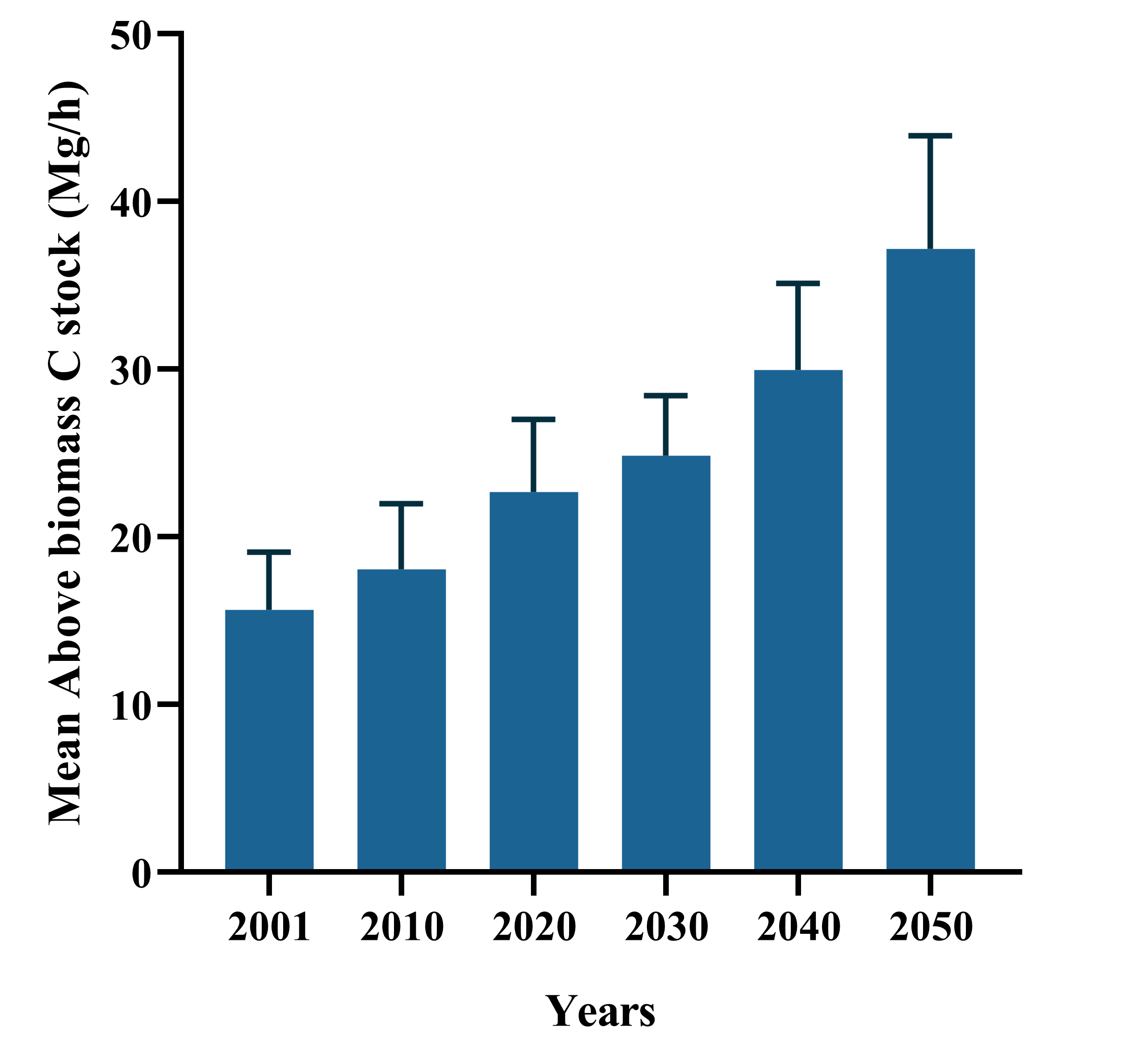
Mangrove Biomass C stocks. (Image by WANG Faming)

