Newsroom


Gastrulation is a key step in early human development, during which the embryo begins to form the body axis and produces early cells that later give rise to organs. A major sign of gastrulation is the appearance of primitive streak at the tail end of embryonic disc in the early third week. However, it is difficult to study how the human primitive streak is induced and how gastrulation is precisely guided.
In a study published in Cell on June 24, a research team led by Prof. YU Leqian from the Institute of Zoology of the Chinese Academy of Sciences, and the collaborators, built a human embryonic disc-like gastruloid model, named disc-Gastruloid, which can recreate the ordered formation of a primitive streak-like structure in vitro.
Extra-embryonic tissues play coordinated roles in guiding primitive streak-like structure formation, which provides a new way to study early human development in a controlled system. In this study, researchers focused on three types of extra-embryonic cells: amnion-like cells (AMLCs), trophoblast stem cells (TSCs) and extra-embryonic mesodermal stem cells (ExMSCs). These cells provide important signals and spatial support during early development, and play different roles in regulating primitive streak-like structure formation.
The researchers found that AMLCs can promote embryonic stem cells to enter a gastrulation-like state and activate genes related to early cell fate change. They found that TSCs help keep cells in an undifferentiated state, suggesting that they may help restrict where gastrulation-related cells appear. Besides, they found that ExMSCs mainly guide the movement of gastrulation-related cells, helping organize their spatial pattern.
These findings suggest that primitive streak formation is not controlled by embryonic cells alone; instead, it depends on a coordinated environment created by both embryonic and extra-embryonic lineages. Separating the roles of different extra-embryonic cells provides a clearer view of how early human embryos organize signals, cell movement and tissue structure at the same time.
Moreover, the researchers established the disc-Gastruloid model through co-culture. After 72 hours, the model formed a groove-like primitive streak-like region and showed signs of cell movement and changes in cell identity, which are similar to key events that occur during early gastrulation. Many structures subsequently developed into elongated, multilayered embryo-like forms. They contained regions similar to the neural tube, primitive gut, neuromesodermal progenitors and early cardiac progenitors. Some of them showed spontaneous contraction, suggesting that the model can support further organization beyond the initial primitive streak-like stage.
This model is important because natural human embryos at this stage are extremely difficult to study directly. Ethical limits and the scarcity of samples have long made early post-implantation development a "black box." By rebuilding part of this process in vitro, disc-Gastruloid offers a controllable platform for observing how cells communicate, move and choose their developmental paths.
Compared with many existing embryo models, disc-Gastruloid emphasizes both cell fate and spatial organization, which makes it useful for describing which cell types appear, as well as studying where they appear, how they move and how tissue patterns are formed. Such features are important for understanding how the human body plan is first established.
This study provides an important tool for studying human gastrulation, early organ formation and developmental abnormalities. It also helps explain how extra-embryonic and embryonic cells work together during the earliest stages of human development. In the future, this tool may support research on early pregnancy loss, congenital defects and basic principles of human body plan formation.
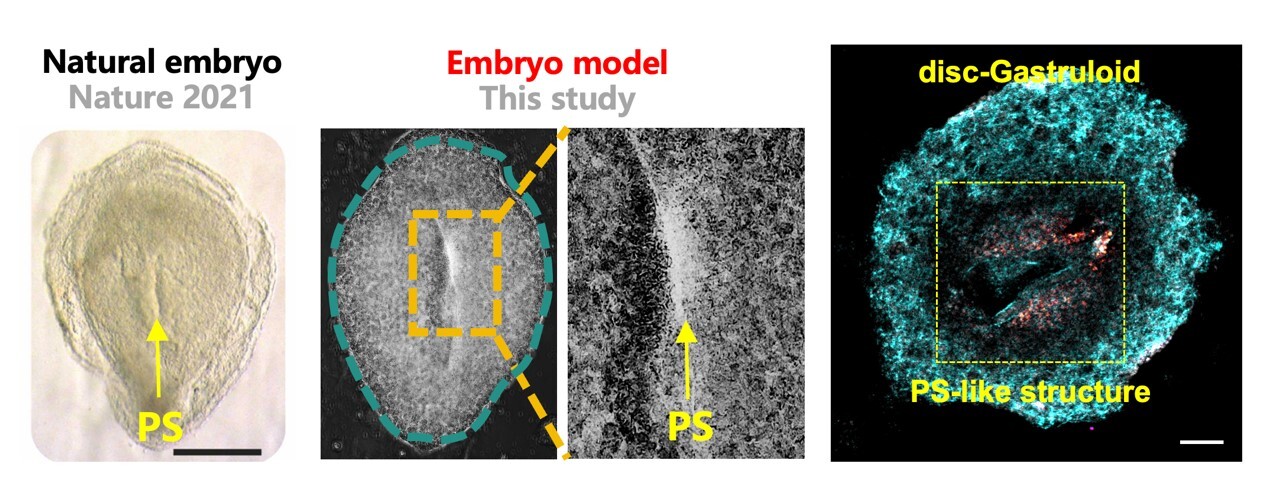
Representative images of the disc-Gastruloid model. (Image by SHEN Qiaoyan)