Newsroom


Scientists have recently discovered a Lyman-continuum-emitting galaxy, designated LCEz4-M1, at a redshift of z=4.444 in the Hubble Ultra Deep Field. This object is the highest-redshift, the most distant Lyman-continuum-emitting galaxy known to date, and it carries significant implications for understanding the early universe and cosmic reionization.
The discovery and analysis were led by the "Early Universe and High-redshift Galaxies" group at the Shanghai Astronomical Observatory (SHAO) of the Chinese Academy of Sciences (CAS), in collaboration with researchers from the European Southern Observatory (ESO) and Arizona State University. The findings are reported in The Astrophysical Journal Letters.
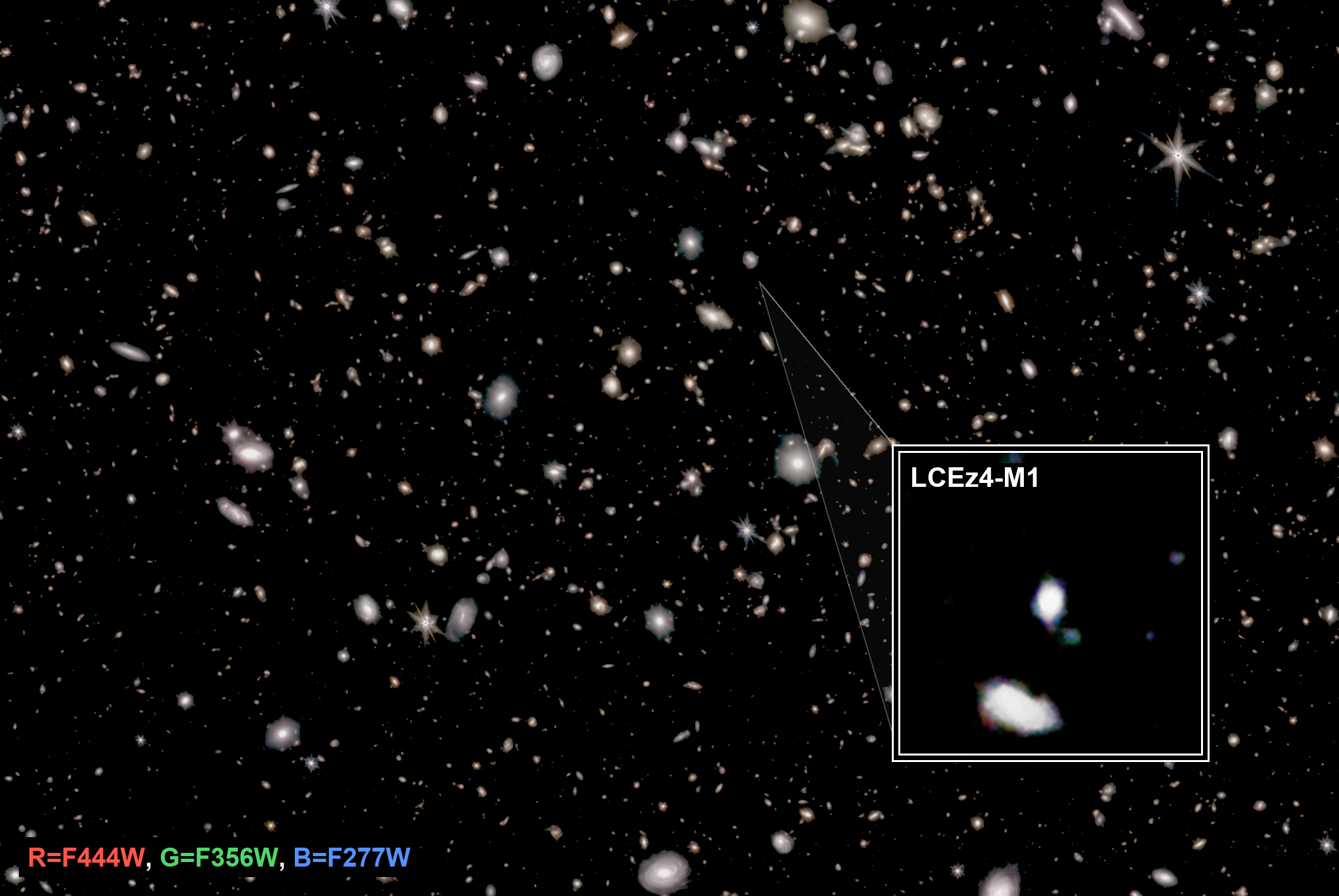
The highest-redshift Lyman continuum galaxy candidate known to date, LCEz4-M1. (Image by SHAO)
Lyman continuum (LyC) radiation refers to high-energy ultraviolet light with wavelengths shorter than 912 angstroms, capable of ionizing neutral hydrogen gas in the universe. Whether early galaxies could produce and release enough LyC photons is one of the central questions in understanding cosmic reionization.
However, in the high-redshift universe, the intergalactic medium strongly absorbs LyC photons, making such radiation extremely difficult to observe directly. As a result, detections of LyC-emitting galaxies at redshifts greater than 4 are exceedingly rare.
To overcome this challenge, the team combined data from three powerful facilities: the Hubble Space Telescope (HST), the James Webb Space Telescope (JWST), and the MUSE integral-field spectrograph on ESO's Very Large Telescope (VLT). This multi-observatory approach provided the sensitivity and depth needed to capture the faint signal.
According to the study, LCEz4-M1 existed just 420 million years after the Big Bang, placing it squarely in the cosmic dawn. Its detection provides critical observational evidence for how early galaxies emitted ionizing photons—and what role such galaxies played in the universe's ionization history.
The galaxy sits within the Hubble Ultra Deep Field, one of the richest multi-wavelength datasets in the sky. The team first pinned down its redshift of z=4.444 using the Lyman-alpha emission line in VLT/MUSE spectra. They then detected LyC signals from the galaxy's direction in both HST/ACS F435W imaging and VLT/MUSE spectral data. Because these two datasets come from different telescopes and entirely independent observing techniques, they provide mutually corroborating evidence—significantly strengthening the case that the signal is real. Further analysis ruled out the possibility that the LyC signal was from foreground source contamination or random noise.
Based on these two independent measurements and adopting conservative assumptions for intergalactic medium transmission, the team estimated that the galaxy has a relatively high LyC escape fraction—meaning a substantial number of ionizing photons appear to have broken free from the galaxy into intergalactic space. This finding carries important implications for understanding how galaxies transformed their cosmic surroundings during the cosmic dawn and the epoch of reionization.
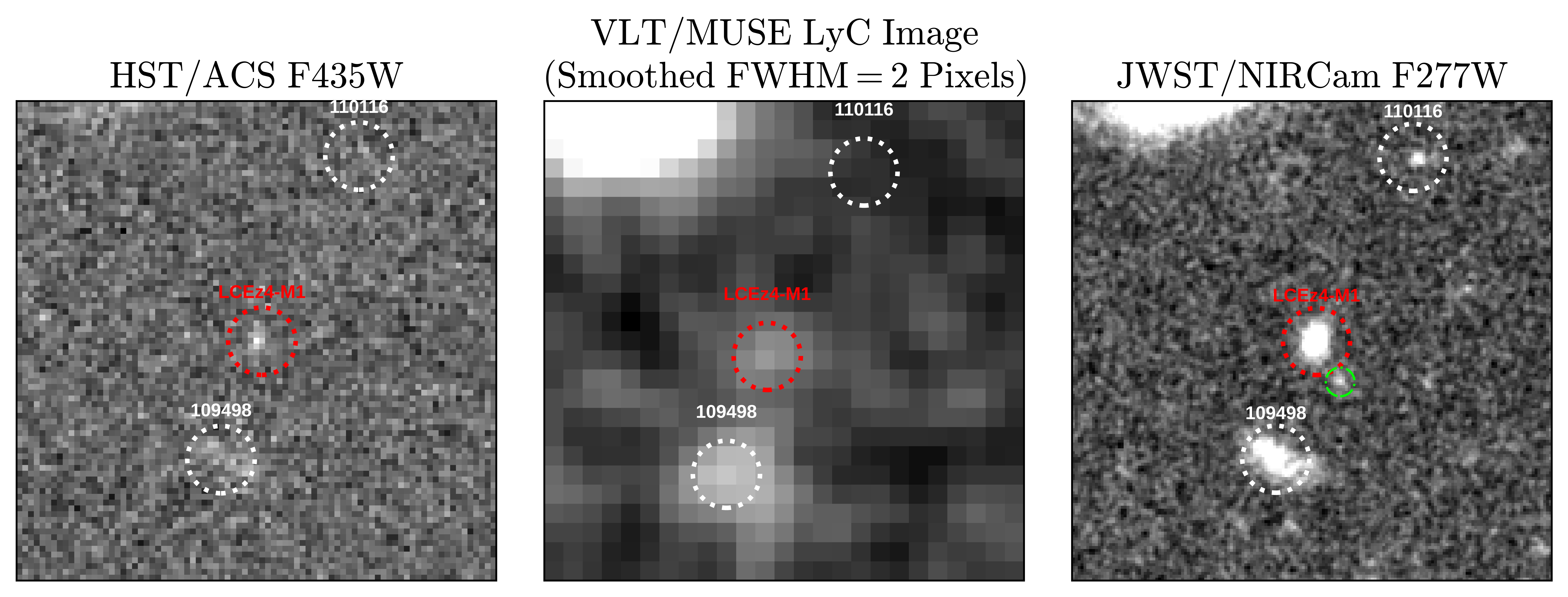
Left: HST/ACS F435W image; middle: VLT/MUSE LyC image; Right: JWST/NIRCam F277W image. The red dashed circles mark the position of LCEz4-M1. Both the independent HST and MUSE datasets detect a LyC signal at this location, and the JWST/NIRCam image shows that it coincides with the main body of the galaxy, supporting that the signal originates from the high-redshift galaxy LCEz4-M1 at z=4.444. (Image by SHAO)
This work builds on a series of recent studies by the Shanghai Astronomical Observatory team on high-redshift LyC-emitting galaxies. Looking ahead, as deeper JWST observations become available and new space facilities come online—such as the Chinese Space-station Survey Telescope (CSST)—astronomers expect to move from studying a handful of individual cases to conducting statistical investigations of larger samples.
According to the researchers, such advances will lay a new observational foundation for understanding the formation and evolution of the first generations of galaxies, the reionization process that ionized the entire universe, and the co-evolution of galaxies and the intergalactic medium.