Newsroom


Chinese scientists have unveiled BioMedAgent, an "AI Data Scientist" framework with self-evolving capabilities. Developed by integrating large language models (LLMs) with multi-agent technology, the system marks a significant breakthrough in autonomous biomedical scientific data analysis.
The work, led by the Institute of Computing Technology (ICT) of the Chinese Academy of Sciences, was published recently in the journal Nature Biomedical Engineering.
While AI agents are proving to be powerful applications of LLMs—capable of automating complex tasks and driving scientific data exploration—their adoption in biomedical analysis has been hampered by the challenges of handling specialized tools and multistep reasoning.
BioMedAgent tackles this by learning to use diverse bioinformatics tools and chain them into executable workflows via interactive exploration and memory retrieval algorithms. Crucially, it allows biomedical users to initiate tasks using natural language, eliminating the need for computational expertise.
When put to the test on the newly released BioMed-AQA benchmark—which comprises 327 biomedical data tasks—BioMedAgent achieved a 77% success rate, outperforming other LLM agents. It also demonstrated robust generalization to the external BixBench dataset. Going beyond benchmarks, the framework autonomously performs cross-omics analysis, machine-learning modelling, and pathology image segmentation, showcasing substantial real-world utility.
The researchers said that this achievement highlights AI's potential to transition from simple tool assistance to autonomous scientific collaboration—a capability that could extend to other scientific domains requiring complex tool integration and multistep reasoning.
The research received support from the National Key Research and Development Program of China, the National Natural Science Foundation of China, and the Beijing Natural Science Foundation, among others.
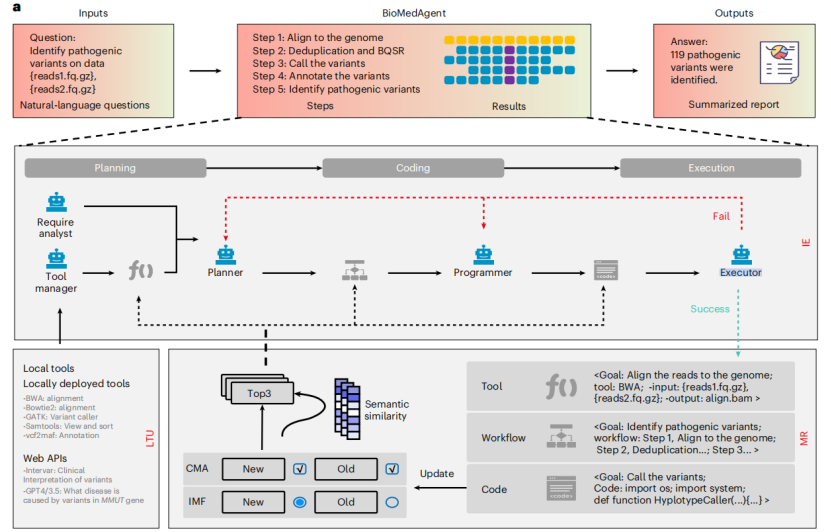
The "AI Data Scientist" computational framework BioMedAgent. (Image by ICT)