
Newsroom


Dynamic restructuring of electrode surfaces and interfaces frequently occurs under electrochemical polarization in solid oxide electrolysis cells (SOECs), yet a fundamental grasp of these processes has been hampered by the lack of in situ characterization under realistic operating potentials and high temperatures.
Now, a research team led by Prof. FU Qiang from the Dalian Institute of Chemical Physics (DICP) of the Chinese Academy of Sciences (CAS) found that the electric field and oxygen spillover act in tandem to govern electrode migration in SOECs.
The study was published in the Journal of the American Chemical Society.
To probe the dynamic behavior, the researchers constructed a planar Ag|yttria-stabilized zirconia (YSZ)|Ag model cell and investigated the dynamic evolution of the working Ag anode using in situ photoemission electron microscopy (PEEM) and micro-region X-ray photoelectron spectroscopy (μ-XPS).
They found that the spilled-over oxygen drives Ag transport via the formation of mobile Ag−Oδ− species and the distribution of the electric field dictates the direction and speed of Ag migration. Furthermore, the dynamic restructuring of the Ag anode enhances the oxygen evolution reaction by generating more active triple-phase boundaries (TPBs).
"This work establishes an operando methodology for correlating electric-field distributions with oxygen spillover dynamics, enabling a deeper understanding of coupled physical and chemical processes at electrochemical interfaces in high-temperature energy conversion systems," FU said.
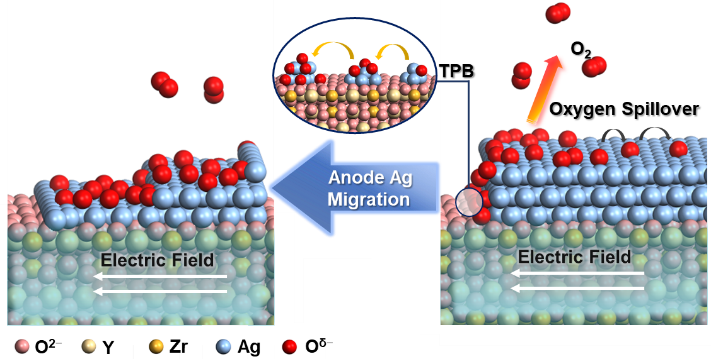
Schematic of Ag migration dynamics in the model SOECs governed by coupled electric field and oxygen spillover. (Image by PEI Jinhui)

