Newsroom


A unique class of long-period binary systems—known as Algol-type binaries—consists of a hot primary star and a cooler companion that has expanded to fill its Roche lobe, transferring material via a steady stream onto the primary. The system 2MASS J06281154+164439.3 is precisely such a pair, and it is currently undergoing active mass transfer.
Now, a study has constructed the first comprehensive profile of this long-period system. In a key finding, the team shows that even with an orbital period of 21.6 days, this system can maintain a structurally stable accretion disk—directly challenging the long-held expectation that long-period binaries struggle to sustain persistent disks.
The study was led by Dr. YANG Daoye, a PhD student at the Xinjiang Astronomical Observatory (XAO) of the Chinese Academy of Sciences (CAS), supervised by Prof. Esamdin Ali from XAO and Prof. SHI Jianrong from the National Astronomical Observatories of the CAS. The findings were recently published in The Astronomical Journal.
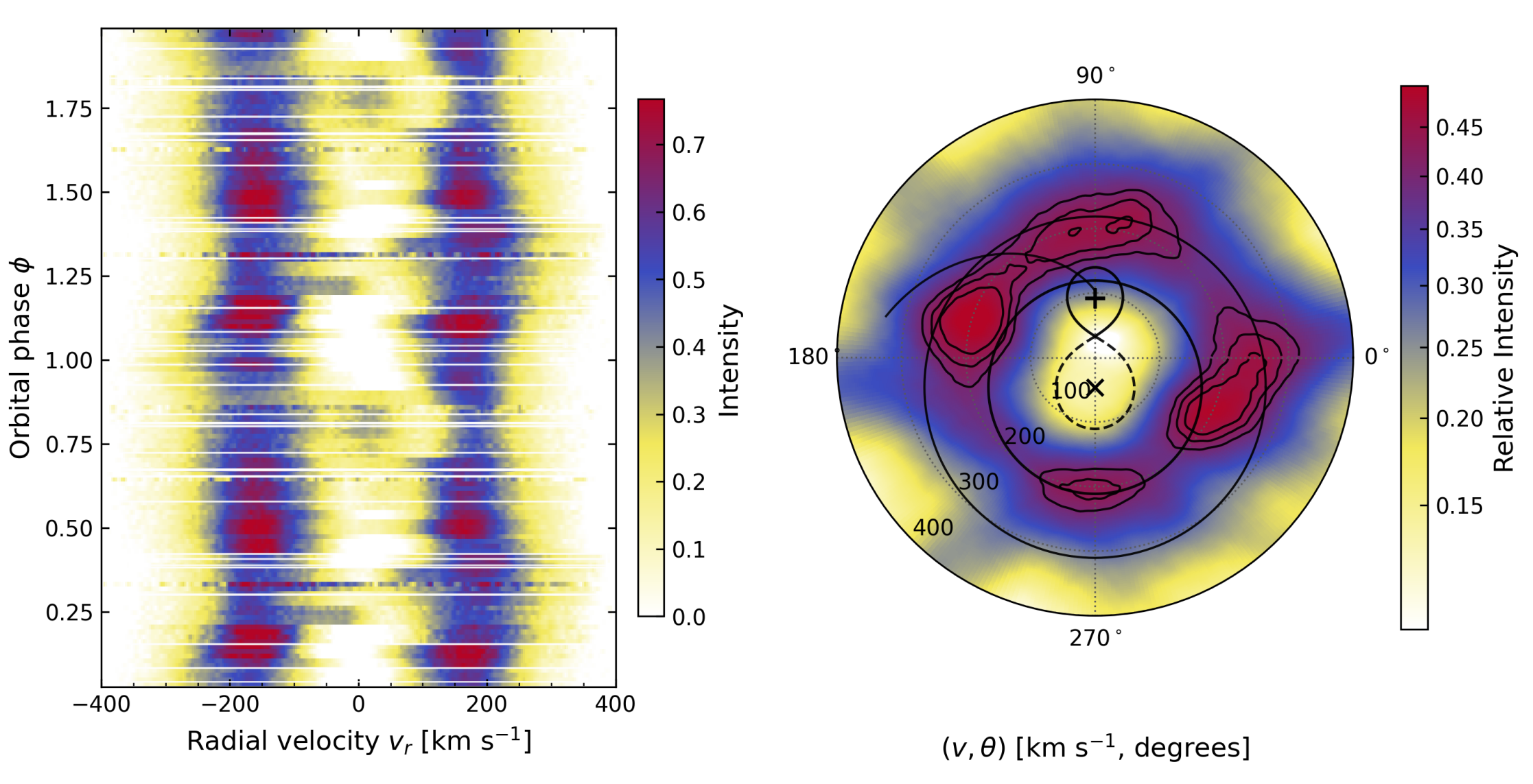
Doppler tomography of Hα using a maximum-entropy inversion. The left panel shows the observed trailed spectra as a function of orbital phase and radial velocity. The right panel shows the reconstructed Doppler map displayed as a polar projection. (Image by XAO)
Drawing on 1,082 days of continuous photometric data from NASA's Transiting Exoplanet Survey Satellite (TESS) and 21 medium-resolution spectra from China's Large Sky Area Multi-Object Fiber Spectroscopic Telescope (LAMOST), the researchers found that the transferred material does not directly impact the primary star. Instead, it forms a rotating structure—an accretion disk. Hydrogen atoms within this disk emit a characteristic Hα line with a stable double-peaked profile, like two rotating searchlights, clearly signaling the presence of the disk.
They found that the separation between the peaks remains nearly constant, indicating that the outer boundary of the disk is stabilized at approximately 26 solar radii from the primary—right within the star's gravitational domain. However, slight fluctuations in peak intensity suggest a "hot spot" on the disk, likely generated by the impact of the accretion stream.
To validate this model, the researchers integrated light curves and spectral data into a physical model, successfully reconstructing the disk's gas density, temperature (approximately 6,000 Kelvin), and internal turbulence velocity (nearly 50 km/s). They further identified a hot spot at the disk's outer edge that accounts for subtle asymmetries in the light curve, removing the need for ad hoc assumptions about "starspots" on the stellar surface.
According to the researchers, beyond providing precise measurements of the masses, radii, and temperatures of the binary components, this work also clarifies the stable structure of the accretion disk during mass transfer.
It demonstrates that even with an orbital period of three weeks, an accretion disk can persist over extended timescales, making this system an exceptional testbed for understanding stellar mass transport. Future high-precision spectroscopy will enable astronomers to trace the dynamic evolution of the hot spot and the disk, promising to further unveil the secrets of binary star evolution, they said.