Newsroom


A recent study has measured the quantum‑state populations in collisions between highly charged nitrogen ions and helium atoms, shedding new light on the key atomic processes underlying solar coronal mass ejections. Crucially, the researchers found that double‑excited‑state populations contribute significantly to the soft X‑rays observed during these events.
The study, conducted by researchers from the Institute of Modern Physics (IMP) of the Chinese Academy of Sciences (CAS) and their collaborators, was published in The Astrophysical Journal Supplement Series on June 8.
Coronal mass ejections are extreme space weather phenomena in which intense solar activity triggers the massive release of charged ionic matter and energy. They can generate severe geomagnetic storms, disrupting satellite communications, navigation systems and power‑grid stability. During ejections, highly charged ions undergo charge‑exchange reactions with neutral particles in Earth's magnetosphere, emitting characteristic X‑rays.
As a result, precise modelling of observed X‑ray spectra is an ideal tool for tracing the chemical composition, solar activity characteristics and internal dynamics of the Sun associated with coronal mass ejections.
However, a long‑standing obstacle to understanding these events has been the lack of precise atomic data and an insufficient grasp of the microscopic mechanisms of highly excited states in charge‑exchange reactions.
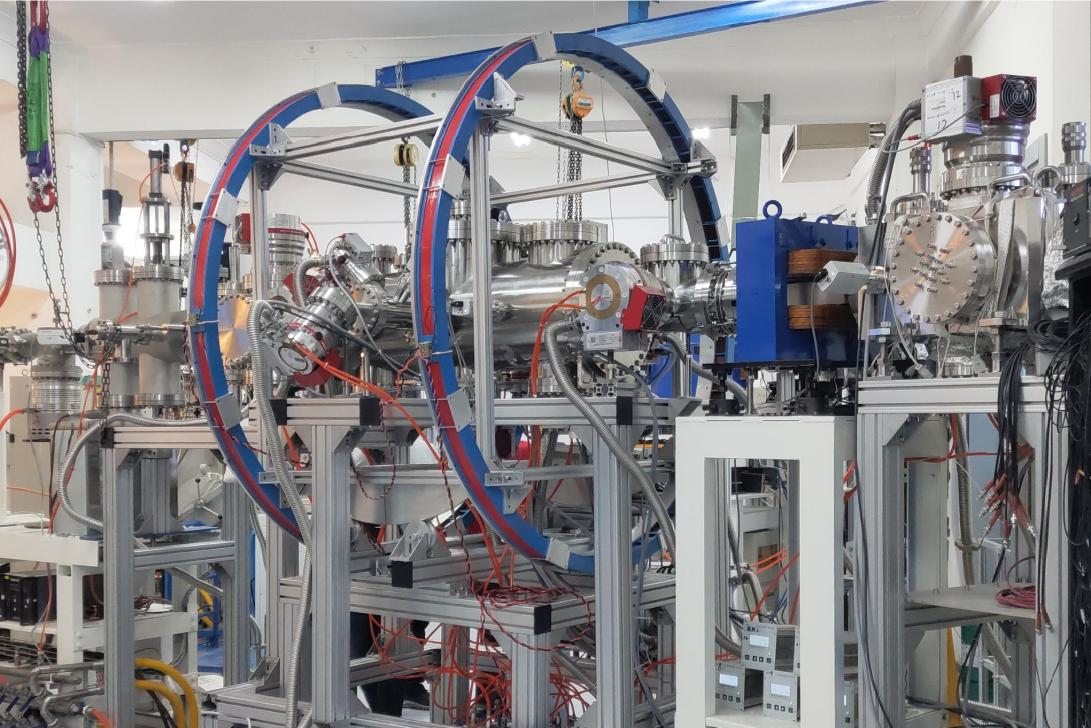
For this study, the team used the 320 kV platform for multi‑disciplinary research with highly charged ions in Lanzhou, China, employing an innovative strategy to directly measure excited quantum‑state populations. They quantified the highly excited‑state populations in collisions between neutral helium gas and highly charged nitrogen ions (N6+) — a key species in coronal mass ejections.
"The experiment provided benchmark cross‑sections for quantum‑state populations and resolved discrepancies among previous theoretical calculations — a finding that is significant for advancing close‑coupling theoretical methods in atomic collision research," said Dr. ZHANG Ruitian from IMP, the first and corresponding author of the study.
The study also revealed that the experimentally measured double‑excited‑state populations make a considerable contribution to the soft X‑rays observed during coronal mass ejections. The experimental methodology developed in this work can be applied to future laboratory astrophysics research.
The research was jointly conducted by IMP, the Beijing Institute of Applied Physics and Computational Mathematics, Shenzhen Technology University, the High Energy Accelerator Research Organization (Japan), the National Astronomical Observatories of CAS, the Netherlands Space Office, the Technion–Israel Institute of Technology, Tianjin University and Eckerd College (USA).