Newsroom


A recent study published in Physics Letters B has provided direct experimental evidence that tensor interactions generate high‑momentum components within atomic nuclei.
The study, led by a research team from the Institute of Modern Physics (IMP) of the Chinese Academy of Sciences (CAS) in collaboration with international partners, advances the understanding of nucleon‑nucleon short‑range correlations in atomic nuclei.
Short‑range correlations in atomic nuclei represent a frontier topic in nuclear physics. As a fundamental component of nucleon‑nucleon interactions, the tensor force can induce strong proton‑neutron correlations and generate high‑momentum nucleons.
These high‑momentum components not only influence the evolution of shell structures and magic numbers in nuclei far from stability, but also play a crucial role in establishing the saturation density of nuclear matter. Understanding these effects is essential for unraveling the structure of exotic nuclei and neutron stars. However, it has remained a major experimental challenge to sensitively probe tensor‑driven high‑momentum nucleons in rare isotopes.
To address this challenge, the team conducted experiments at the Fragment Separator (FRS) of the GSI Helmholtz Centre for Heavy Ion Research in Germany. They bombarded an oxygen‑16 target with proton beams at four different energies and systematically measured the cross sections of neutron pickup reactions at zero degrees.
By comparing the cross sections for populating positive‑parity and negative‑parity states in the residual oxygen‑15 nucleus, the researchers found that transitions to positive‑parity states were significantly enhanced, providing clear evidence of high‑momentum neutrons. In contrast, transitions to negative‑parity states showed much weaker effects. The ratio of cross sections for positive‑ to negative‑parity states rises sharply with momentum transfer and exhibits a distinct peak around 2 fm-1, in good agreement with theoretical predictions that include tensor interactions.
These results demonstrate that zero‑degree neutron pickup reactions can serve as a sensitive probe for detecting high‑momentum nucleon components in atomic nuclei. This new method offers a promising pathway for studying short‑range correlations in exotic nuclei using medium‑ to high‑energy radioactive beams.
In the future, the researchers plan to further explore tensor‑force‑driven exotic structures in neutron‑rich nuclei using the HIgh rigidity Radioactive Ion Beam Line (HIRIBL) at the High Intensity heavy‑ion Accelerator Facility (HIAF), a major national scientific and technological infrastructure project in China.
The work was jointly carried out by IMP, the State Key Laboratory of Heavy Ion Science and Technology, Beihang University, Osaka University (Japan), the GSI Helmholtz Centre for Heavy Ion Research (Germany), RIKEN (Japan) and several other institutes. The first author of the paper is Dr. WANG Xuan, an assistant professor at Beihang University. The corresponding authors are Professor Ong Hooi Jin and Professor Terashima Satoru from IMP.
This research was supported by the CAS President's International Fellowship Initiative (PIFI), the CAS International Partnership Program, the National Natural Science Foundation of China, and the Major Science and Technology Project of Gansu Province, among other sources.
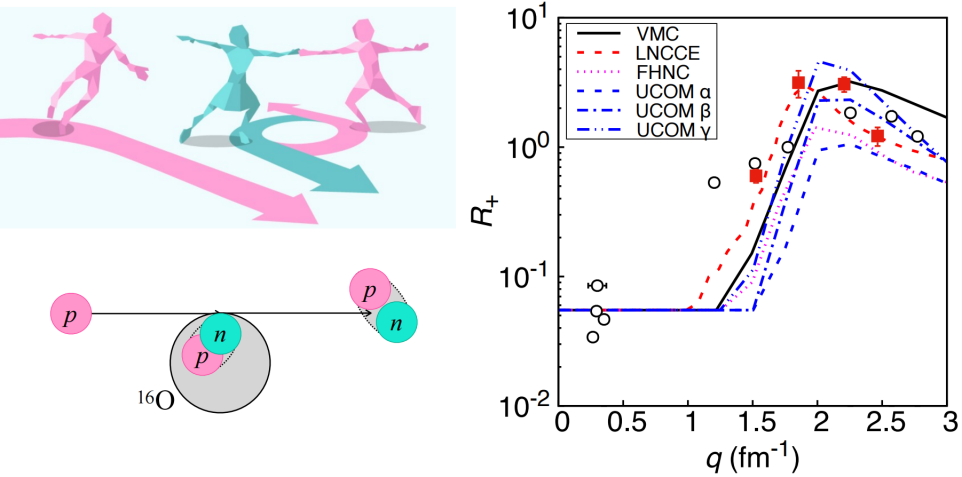
Left: Schematic illustration of the neutron pickup reaction. A fast proton "removes" a neutron with matched momentum from an oxygen-16 nucleus, forming a deuteron that flies out. Right: Ratio of cross sections for positive-parity to negative-parity states as a function of momentum transfer. Red dots: present experimental data; white dots: literature values; curves: theoretical prediction. The peak appears at approximately 2 fm-1, confirming the high-momentum components driven by the tensor force. (Image from IMP)