
Newsroom


Global climate change has increased the frequency of regional cold spells, causing substantial yield losses and even crop failure. Meanwhile, excessive nitrogen fertilizer use in agriculture has increased non-point-source pollution. Improving both stress resilience and nitrogen use efficiency has therefore become a major challenge for sustainable crop production.
In rice production, farmers commonly apply nitrogen fertilizer after chilling stress to stimulate tiller regeneration and reduce yield loss. Although this practice is widely used, it increases production costs and environmental impacts. Furthermore, the molecular mechanism linking post-chilling recovery with nitrogen utilization had not been well understood.
Now, a team led by Prof. CHONG Kang from the Institute of Botany of the Chinese Academy of Sciences has identified what it calls an "intelligent molecular module," Chilling Phoenix (CHPO), which coordinates chilling resilience and nitrogen use in rice by automatically changing its function depending on environmental conditions. During chilling stress, CHPO enhances chilling tolerance. Conversely, when temperatures return to normal, CHPO promotes nitrogen uptake and tiller regeneration during recovery.
The study was published in Nature on June 17.
To provide a framework for their study, the researchers established the post-chilling tiller regeneration rate as a key indicator of chilling resilience. They subsequently employed genome-wide association studies (GWAS), quantitative trait locus (QTL) mapping, and map-based cloning to identify CHPO as a key genetic module that jointly regulates chilling resilience and nitrogen use efficiency.
The researchers identified two alleles: The superior allele, CHPOjap, originated from Chinese common wild rice and was positively selected during the domestication of temperate japonica rice. Compared with CHPOjap, the indica allele CHPOind carries a different number of GCG repeats in its coding region, leading to distinct cold responses, DNA-binding preferences, and contrasting effects on chilling resilience.
Mechanistic analyses revealed that CHPOjap dynamically switches its regulatory program between the chilling and recovery phases. During chilling stress, it accumulates in the nucleus and activates chilling-related genes to enhance chilling tolerance. During recovery, it directly activates the nitrogen transporter gene OsNRT2.4 while repressing OsTCP19, thereby enhancing nitrogen use efficiency and promoting tiller regeneration.
"To evaluate the breeding potential of this molecular module, we established a novel phenotyping system for chilling resilience to test the breeding potential of CHPOjap, which is of critical importance for agricultural applications," Prof. CHONG said.
Following chilling stress, plants were allowed to recover under different nitrogen conditions before being transplanted to the field for yield evaluation. Under all nitrogen treatments, CHPOjap-overexpressing plants consistently produced higher grain yield per plant and exhibited greater nitrogen use efficiency than wild-type plants, while chpo mutants showed the opposite phenotype.
The findings demonstrated the robust breeding potential of CHPOjap as a molecular module for molecular-design breeding aimed at improving yield and nitrogen use efficiency under post-chilling conditions.
The study uncovers the molecular mechanism that coordinates chilling resilience with nitrogen use efficiency. It also provides a genetic explanation for the long-standing agricultural practice of applying nitrogen fertilizer to promote tiller regrowth after chilling stress. In addition, it offers a molecular module and breeding strategy for developing climate-resilient rice varieties with stable yield and efficient nitrogen utilization.
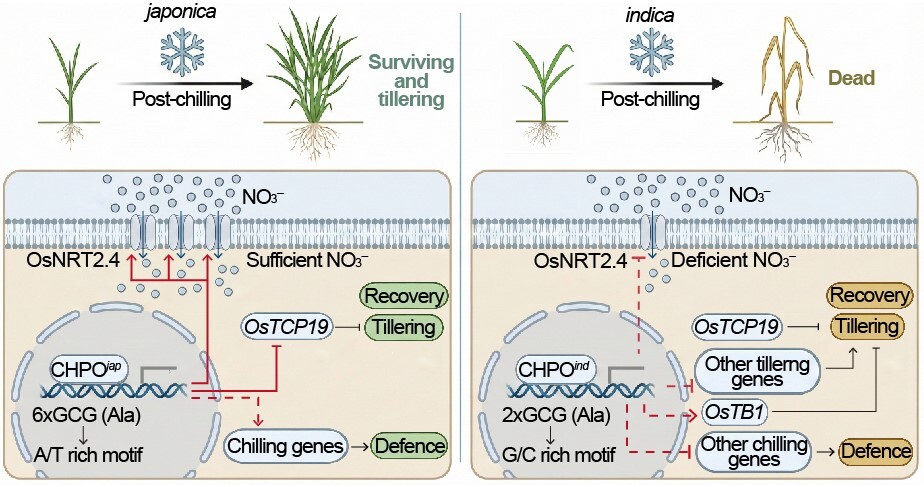
Figure: Molecular mechanism underlying the functional differences Between CHPOjap (left) and CHPOind (right). (Image by CAO Jie)
