
Newsroom


Planting trees is widely promoted as a natural solution to climate change. A new study published in One Earth and led by researchers from the Institute of Atmospheric Physics of the Chinese Academy of Sciences revealed that the hydrological consequences of reforestation depend critically on how much the world warms.
Using the latest Earth system model simulations from the climate model intercomparison project phase 6, researchers compared the effects of the same large‑scale reforestation activity under two contrasting future scenarios: a low‑warming pathway (SSP1‑2.6) and a high‑warming pathway (SSP3‑7.0). They focused on land water availability—the balance between precipitation and evaporation—which is essential for ecosystems, agriculture, and human water use.
"The same trees, planted at the same scale, lead to nearly opposite outcomes depending on the background climate," said Dr. TANG Tao, the first author of the study. "Under low warming, reforestation slightly increases global water but widens the gap between wet and dry regions. Under high warming, it reduces overall water availability but makes water distribution more equal.”
Besides, researchers examined water availability per capita. They found that population differences further amplify these contrasting patterns. Because SSP3‑7.0 scenario assumes a much larger global population than SSP1‑2.6 scenario, the per‑capita water loss in wet regions under high warming is even more pronounced.
To find out the cause, researchers conducted a moisture budget analysis. They revealed that divergent responses of water availability to reforestation under different warming scenarios are driven by differences in atmospheric circulation—specifically, how moisture converges over wet regions under the two warming levels. Further investigation was required to explain why circulation responds differently under low versus high warming requires.
Importantly, these findings resolve the issue of conflicting results in earlier studies—some showing reforestation increases water, others showing decreases—by proving that both outcomes can be correct, depending on the background climate state that these studies largely ignored.
"Reforestation is not a one‑size‑fits‑all solution," said Dr. CAO Junji, one author of this study. "Policymakers need to consider not just how many trees to plant, but also where and when, because the same reforestation effort may benefit water resources under a low‑emission future but reduce them in a hotter world.”
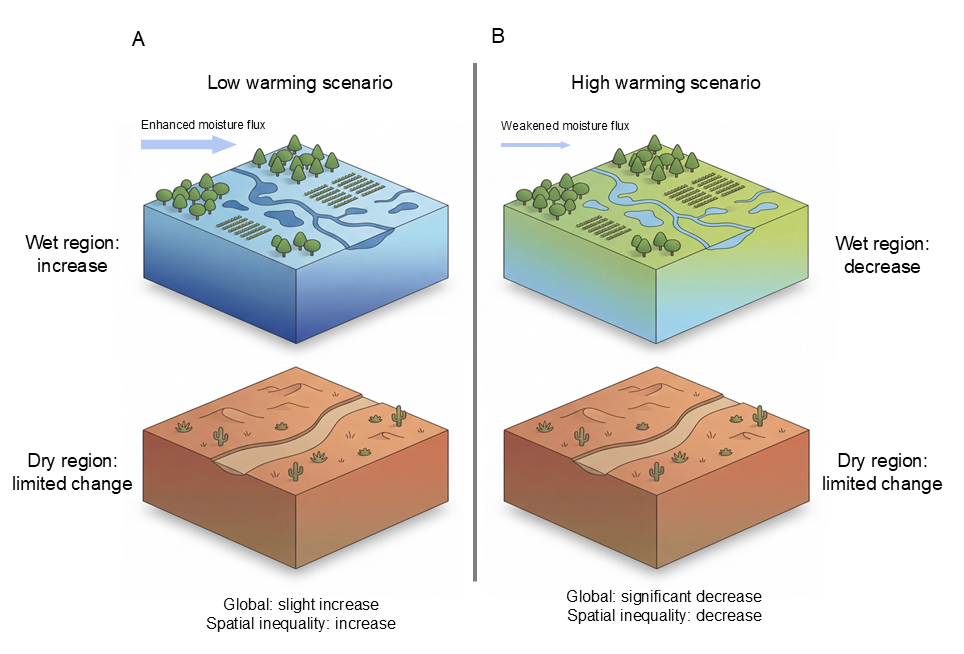
Illustration of divergent responses of water availability to reforestation under low versus high warming. (Image by TANG Tao)
