Newsroom


A study published in Plant Diversity on June 3 has produced the most complete family tree yet for the plant genus Phlomoides, covering the majority of known species worldwide.
The work was led by the Arid Zone Biological Resources Conservation Team from the Xinjiang Institute of Ecology and Geography (XIEG) of the Chinese Academy of Sciences (CAS), in partnership with researchers from the Kunming Institute of Botany of CAS and other institutions.
Phlomoides Moench is the second largest genus in the subfamily Lamioideae (Lamiaceae), with approximately 180 species spread widely across Eurasia. Its main diversity hotspots include Central Asia, the Iranian Plateau, the Hengduan Mountains, and the Himalayas in southwestern China.
The genus inhabits a wide range of environments, from forest understories and alpine meadows to arid steppes and deserts, showing remarkable morphological and ecological diversity. This makes it an important model group for studying how plant communities form, adapt to their surroundings, and diversify across Eurasia.
For a long time, scientists have debated the infrageneric classification of Phlomoides. Recent phylogenetic studies have expanded the genus to include seven traditionally distinct genera and one section of Phlomis (Phlomis sect. Phlomoides). However, previous work suffered from insufficient taxon sampling and incomplete geographical coverage, which hindered the establishment of a stable classification. As a result, the genus's evolutionary origin, dispersal routes, and adaptive mechanisms remain unclear.
To tackle this problem, the researchers analyzed 132 species, covering 73% of all known species, and built a dataset of 206 chloroplast genomes, 154 of which were newly sequenced. They combined these data with nuclear ribosomal ETS and ITS sequences to reconstruct the global phylogeny of Phlomoides.
Their findings support the broadly circumscribed generic concept of Phlomoides and show that the old infrageneric classification, based on Phlomis and Eremostachys, is no longer tenable. Phylogenetic analyses reveal that Phlomoides divides into six major clades, each with potential morphological synapomorphies, providing a foundation for a new infrageneric classification.
Using divergence time estimation and ancestral range reconstruction based on chloroplast genome data, the team found that Phlomoides originated in the Hengduan Mountains or Central Asia during the Middle Miocene Climatic Optimum (ca. 17.72 Ma). Driven by the Mid-Miocene global cooling event around 14.94 Ma, the genus split into two main lineages. Clades I–II originated and evolved mainly in the Hengduan Mountains or the Himalayas, while Clades III–VI dispersed to Central and West Asia and diversified in arid and semi-arid regions.
The study further revealed significant ecological niche differentiation among the different lineages of Phlomoides. Both annual precipitation and annual temperature range are key environmental factors driving lineage divergence. Compared to Clades I–II, Clades III–VI are better adapted to drier environments with wider seasonal temperature variation.
Diversification analyses detected a clear rapid radiation within a subclade of Clade VI beginning around 4.42 Ma. This subclade is characterized by pinnately divided basal leaves, suggesting that a change in leaf shape may have helped the plants adapt to open, arid habitats and triggered rapid species diversification.
Ancestral state reconstruction showed that basal leaf morphology, mericarp indumentum, and root type are key traits shaping Phlomoides' ecological adaptation.
The evolution of traits such as pinnately dissected basal leaves, densely hairy mericarps, and robust tuberous roots allowed Phlomoides to move from early shaded, humid forest understories into extreme environments like alpine meadows, steppes, and deserts. These morphological innovations boosted tolerance to drought, cold, and high irradiance, helping different lineages spread widely across Eurasia and occupy distinct ecological niches.
According to the researchers, this study provides a basis for a new infrageneric classification, clarifies the genus's origin, dispersal, and diversification history, and reveals the co-evolution between key morphological innovations and ecological adaptation.
They added that these findings advance our understanding of how the Eurasian flora formed and evolved, offering new evidence for the historical floristic connections between the Qinghai-Xizang Plateau-Himalaya-Hengduan Mountains and Central-West Asia.
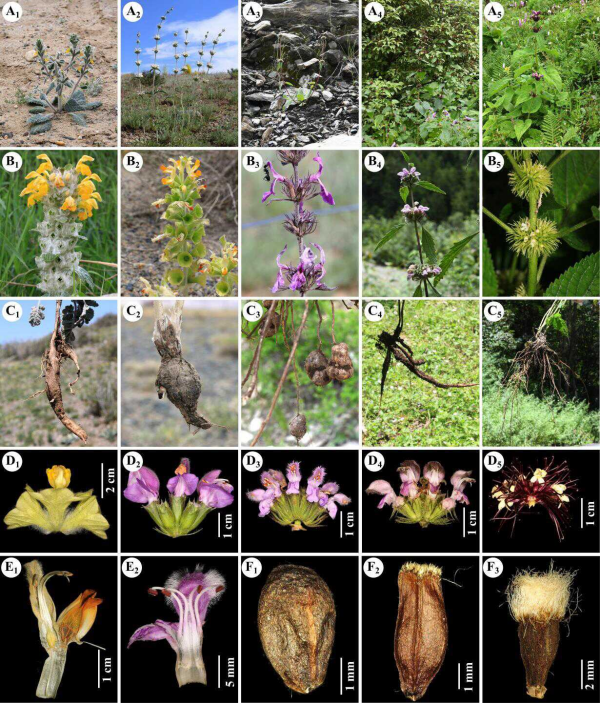
Habitat and morphological diversity of Phlomoides. (Image by XIEG)