Newsroom


Researchers from the Qingdao Institute of Bioenergy and Bioprocess Technology (QIBEBT) of the Chinese Academy of Sciences and Shenzhen Third People's Hospital have developed a Ramanome-based phenotypic platform to improve the efficiency of bacteriophage evaluation for potential clinical use.
Their study was published in mLife on May 21.
By combining Raman spectroscopy with a random forest model, the researchers introduced the Ramanome-based Phage Susceptibility Test (RPST). This phenotypic method reduces the turnaround time for host range verification to approximately one hour, compared to the 11–21 hours typically required by traditional plaque-based assays.
Bacteriophages offer a precise alternative to antibiotics in the fight against antimicrobial resistance. However, matching phages to clinical bacterial isolates remains challenging due to their narrow host ranges and the slow, qualitative nature of conventional assays.
To address this challenge, the researchers developed the RPST. "Clinical translation remains hindered by the lack of rapid, quantitative susceptibility test," said Prof. XU Jian, director of the Single-Cell Center at QIBEBT. "RPST captures infection-induced remodeling of bacterial macromolecular composition to unify these requirements within a single workflow."
The RPST framework monitors bacterial metabolic changes within 40 minutes of phage-host co-incubation and identifies four conserved Raman spectral biomarker regions linked to nucleic acids, proteins, and lipids. Combining these biomarkers into a Composite Infection Index (CII), the system achieved a 96.0% concordance rate across 25 phage-host pairs.
"RPST enables rapid, lysis-independent discrimination between susceptible and resistant populations within one hour," said Prof. LU Hongzhou, co-corresponding author of this study from Shenzhen Third People's Hospital. "By providing faster, quantitative information, it may help accelerate phage selection and support precision therapy."
Unlike static assays, the continuous CII metric estimates the fraction of infected cells, enabling researchers to rank phage potency and determine the minimum MOI required to sustain infection.
"By resolving CII trajectories across MOI and time, RPST determines the minimal effective MOI, defining the lower boundary for therapeutic feasibility," said co-first author HAN Xiao from the Single-Cell Center.
While the method shows operational promise, the researchers acknowledge the need for large-scale, multi-center validation across different instruments to ensure long-term clinical reproducibility.
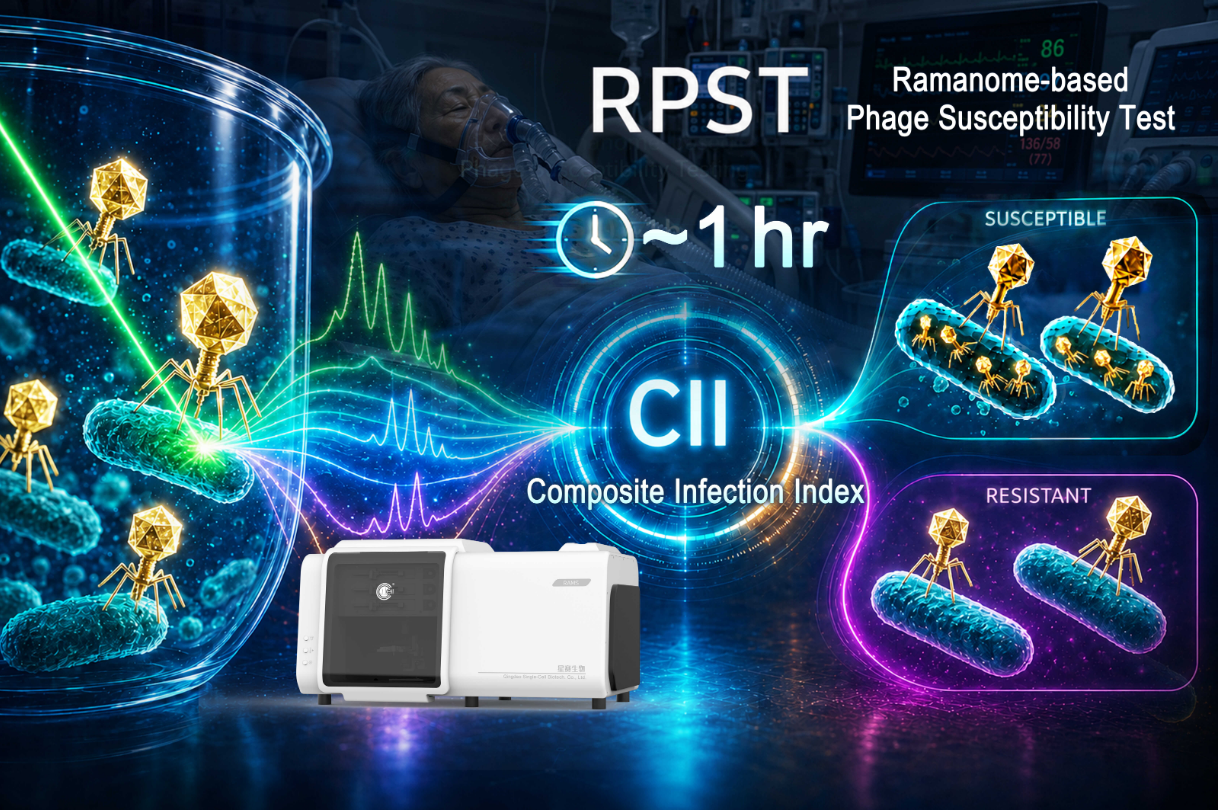
Overview of ramanome-based phage susceptibility test (Image by LIU Yang)