Newsroom


The idea of humans and fungi becoming one may have belonged only to the fictional world, such as in Resident Evil. But researchers are now finding real-world applications for fungal mycelium—in this case, to support bone regeneration.
A recent study published in the journal Advanced Materials has developed an effective strategy for creating mycelial bioceramic scaffolds that enhance bone regeneration by modulating cellular energy metabolism.
The study was carried out by a research team from the Shanghai Institute of Ceramics (SIC) of the Chinese Academy of Sciences (CAS).
Inspired by the natural symbiotic relationship between mycelium and plants, the researchers developed a biomimetic engineering strategy. Specifically, they used 3D-printed bioceramics as a "plant-like" framework and directed mycelium—the root-like network of fungi—to self-grow within the scaffold, thereby constructing a hierarchical structure that mimics natural bone. The resulting scaffolds release bioactive components, including glucose and ions, which form a metabolically active platform for bone formation.
Bone tissue possesses intricate hierarchical structures that underpin its mechanical and biological functions. During bone formation, key processes such as collagen synthesis and mineralization require substantial bioenergy. Traditional scaffolds can provide macroporous structures but fail to replicate the fine hierarchical features of native bone and suffer from an insufficient local energy supply, which leads to limited regeneration efficiency.
The study found that these mycelial bioceramic scaffolds promote stem cell recruitment, adhesion, and differentiation. Moreover, they effectively activate the YAP/Piezo mechanotransduction pathway—a cellular sensor that converts mechanical signals into biological responses—stimulate mitochondrial biogenesis, and shift cellular metabolism toward oxidative phosphorylation, a more efficient energy-producing process. These metabolic changes synergistically promote osteogenic gene and protein expression via the PI3K-AKT signaling pathway.
In vivo experiments on rabbit femoral condyle defects showed that mycelial bioceramic scaffolds exhibited enhanced bone tissue regeneration ability compared with conventional scaffolds.
This research highlights the potential of integrating microbial self-growth with 3D printing technology to create biomimetic scaffolds that simultaneously recapitulate bone structure and regulate cellular metabolism. The strategy provides a new avenue for designing advanced regenerative biomaterials with both structural and metabolic functionality.
The first author of the research is HUANG Jiyi, a PhD candidate at SIC, and the corresponding authors are Professor WU Chengtie and Associate Professor MA Hongshi. This work was supported by the National Key Research and Development Program of China, the National Natural Science Foundation of China, and the Chinese Academy of Sciences Project for Young Scientists in Basic Research.
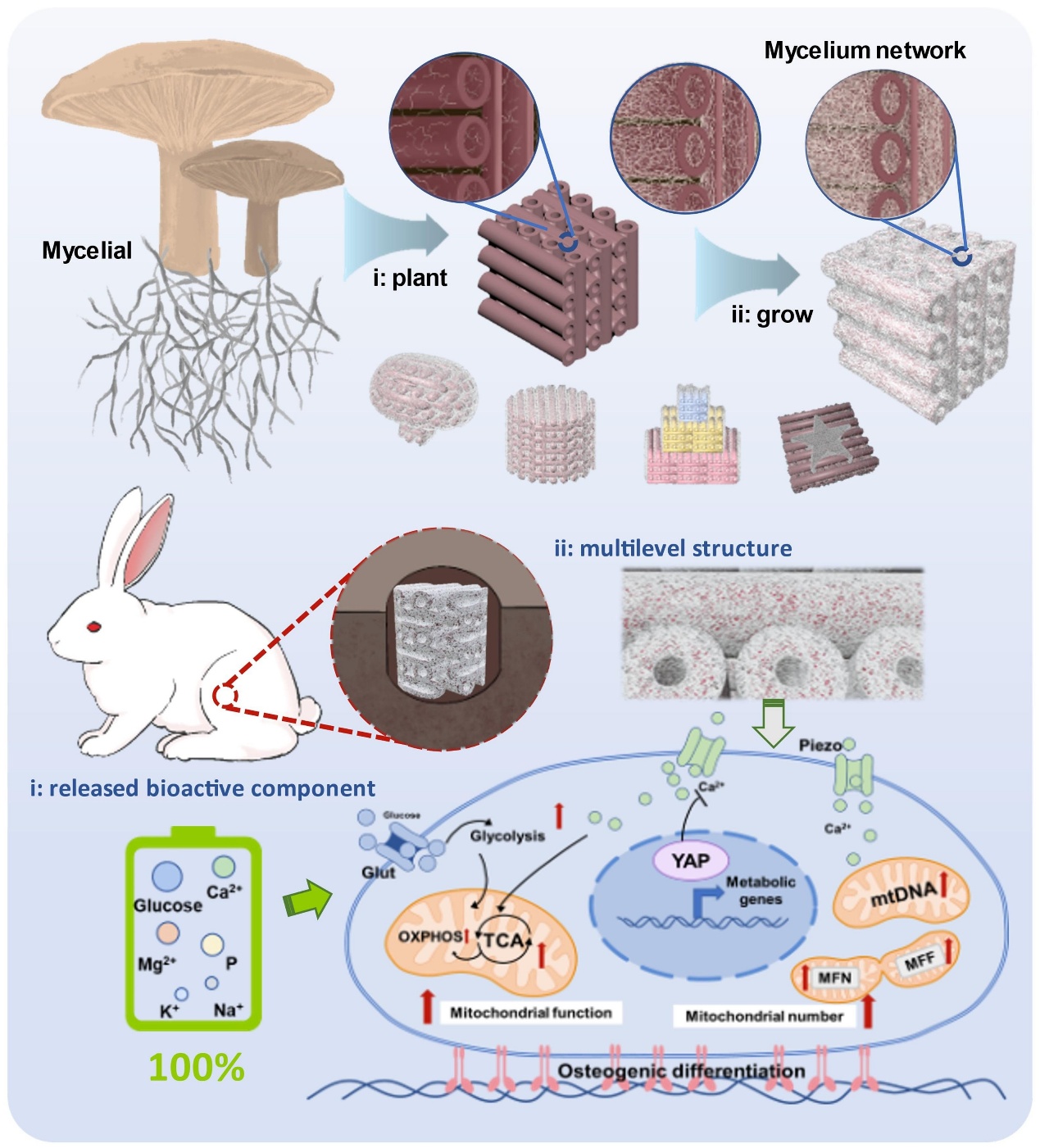
Schematic diagram of the design, fabrication, and application of mycelial bioceramic scaffolds for modulating energy metabolism in bone regeneration. (Image by SIC)