
Newsroom


Researchers from the Institute of Metal Research (IMR) of the Chinese Academy of Sciences developed a quantitative model accurately describing the inverse relationship between strength and fracture toughness in metallic materials. This model provides a powerful theoretical tool for designing high-performance structural alloys.
Their work was published in Acta Materialia on May 21.
Strength, ductility and fracture toughness are the core mechanical properties that ensure the safe use of metallic structural materials. However, in most metal alloys, enhancing strength inevitably comes at the cost of reduced ductility or fracture toughness, creating a long-standing trade-off that has challenged materials scientists and engineers for decades. Understanding the underlying physical mechanisms and establishing quantitative models that describe and predict these property relationships is a central scientific question in materials research.
In 2025, researchers led by Prof. ZHANG Zhefeng reported a dislocation-pileup-based quantitative model for the strength-ductility relationship of metallic materials, revealing the intrinsic origin of the ubiquitous inverse relationship between strength and plasticity.
Building on that foundation, the researchers have now developed a quantitative model for the strength-fracture toughness relationship. Considering that for macroscopically homogeneous metallic materials, crack-tip blunting through plastic deformation is the primary toughening mechanism, the researchers established a quantitative relationship between tensile strength and plane-strain fracture toughness by accounting for dislocation emission, dislocation pile-up, and their effects on crack tip geometry and maximum stress concentration.
The model demonstrates that as material strength increases, the capacity for plastic deformation and dislocation activity at the crack tip is suppressed, reducing crack-tip blunting and consequently lowering fracture toughness, which gives rise to an inverse relationship.
The researchers systematically validated the model against experimental data for a range of steels and titanium alloys under various heat-treatment and microstructural conditions. The results show that the model accurately captures the quantitative relationship between strength and fracture toughness across different alloy systems, demonstrating its broad applicability to typical metallic engineering materials.
Importantly, the model reveals that key parameters are closely related to alloy composition, enabling the evaluation of strength-toughness synergy potential for different alloy systems. The researchers also proposed a strength-fracture toughness synergy factor to quantitatively rank the overall performance of different alloy compositions.
This approach enables the rapid establishment of the strength-toughness curve for a given alloy system using limited experimental data. It offers a new theoretical tool for alloy screening and designing high-strength, high-toughness metallic materials.
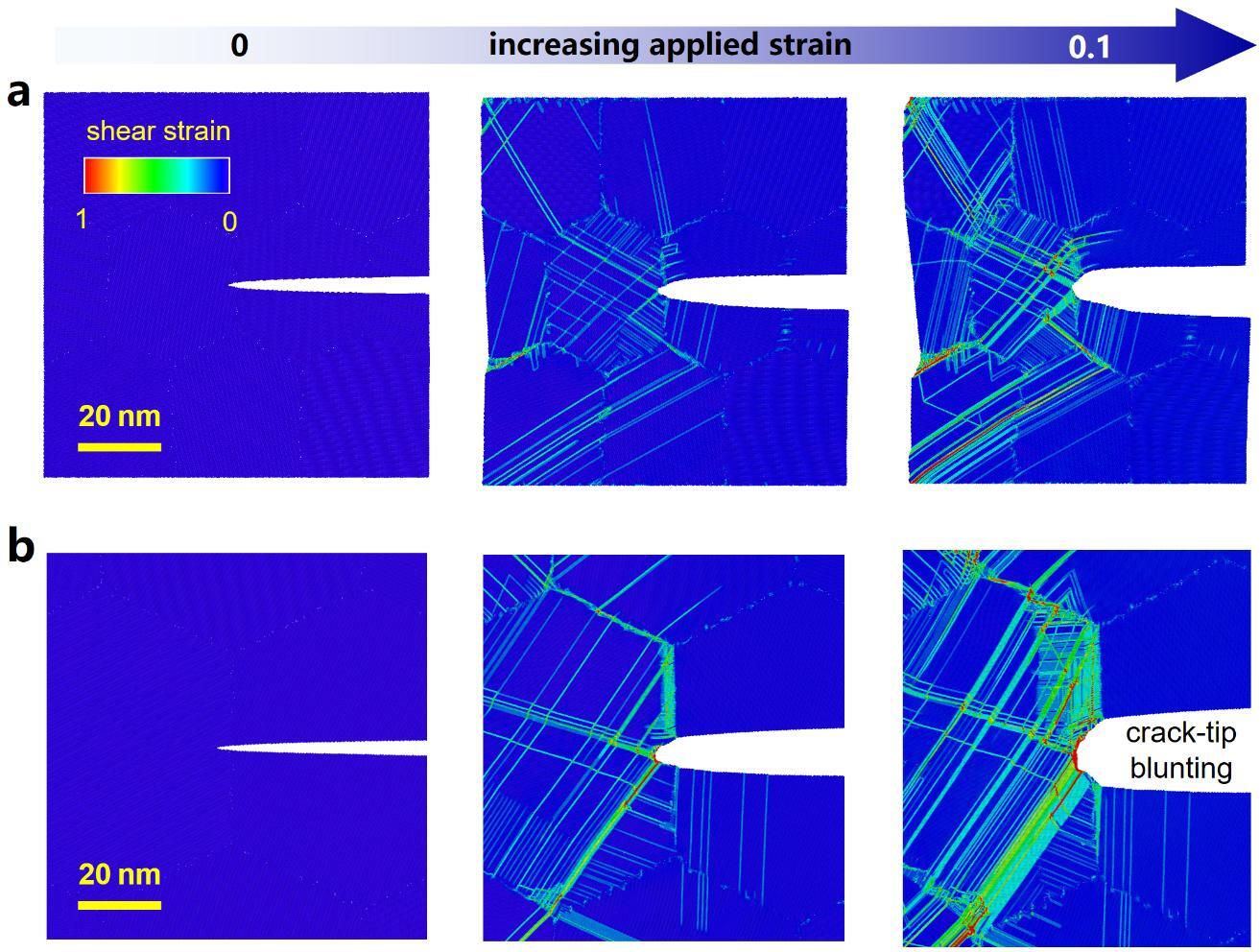
Crack-tip blunting toughening mechanism revealed by molecular dynamics simulations. (Image by IMR)
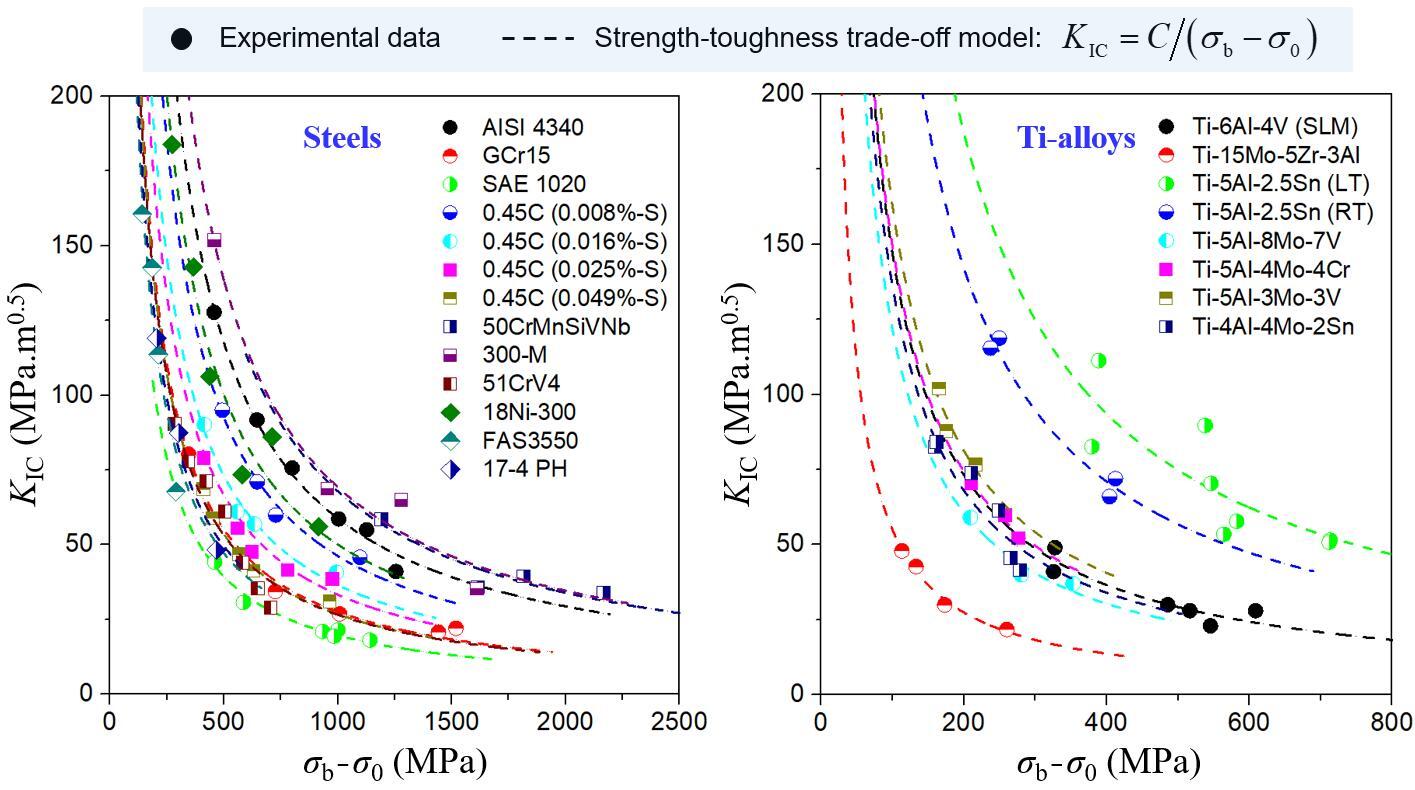
Comparison between experimental data and theoretical model for strength-fracture toughness relationship in various steels and titanium alloys. (Image by IMR)
