
Newsroom


Xenon (Xe) and krypton (Kr), as the vital noble gases, are widely applied in aerospace, healthcare and commercial lighting. Developing stable, high-efficiency adsorbents, such as hydrogen-bonded framework (HOFs), for rapid and selective Xe/Kr separation is urgently needed for industrial noble gas purification and nuclear waste gas treatment. However, current HOFs suffer from slow adsorption kinetics and limited dynamic selectivity, severely restricting their practical applications.
In a study published in Angewandte Chemie International Edition, a team led by Prof. WU Mingyan from Fujian Institute of Research on the Structure of Matter of the Chinese Academy of Sciences designed and synthesized an ultrastable microporous hydrogen-bonded organic framework (HOF-TBPDM) with unique two-dimensional (2D) interconnected pores, achieving record-high Xe/Kr separation performance and ultra-fast adsorption kinetics.
Researchers found that HOF-TBPDM features size-matched 2D pores and abundant accessible aromatic rings on the pore surface, which exerts a stronger polarization effect on Xe than Kr, enabling preferential Xe adsorption. At 298 K and 1 bar, HOF-TBPDM delivered a high Xe uptake and a record IAST Xe/Kr selectivity, outperforming all reported organic porous materials. Kinetic adsorption tests confirmed that the 2D pore architecture endows HOF-TBPDM with a rapid Xe diffusion rate, far exceeding that of 1D-pore HOFs.
Dynamic breakthrough experiments showed that 4.8 mol kg-1 of high-purity (>99.99%) Kr and 1.0 mol kg-1 of high-purity (>99.9%) Xe could be directly obtained from Xe/Kr mixtures in a single cycle. The dynamic Xe/Kr separation selectivity reached 16.5, setting a new record for porous organic materials. Notably, HOF-TBPDM maintained excellent separation performance under high gas flow rates, elevated temperatures and long-term air exposure.
Moreover, HOF-TBPDM exhibited exceptional structural stability. It remained intact at 400 °C, in boiling water for seven days, in strong acid/alkali solutions and various organic solvents, a rare property among 2D-pore HOFs. It could be rapidly synthesized on a large scale via a simple room-temperature method, with scaled-up samples retaining high crystallinity and separation efficiency identical to single crystals.
This study not only develops an ultrastable HOF with 2D pores for efficient Xe/Kr separation but also provides a universal strategy for designing advanced porous materials with balanced thermodynamic adsorption and kinetic diffusion.
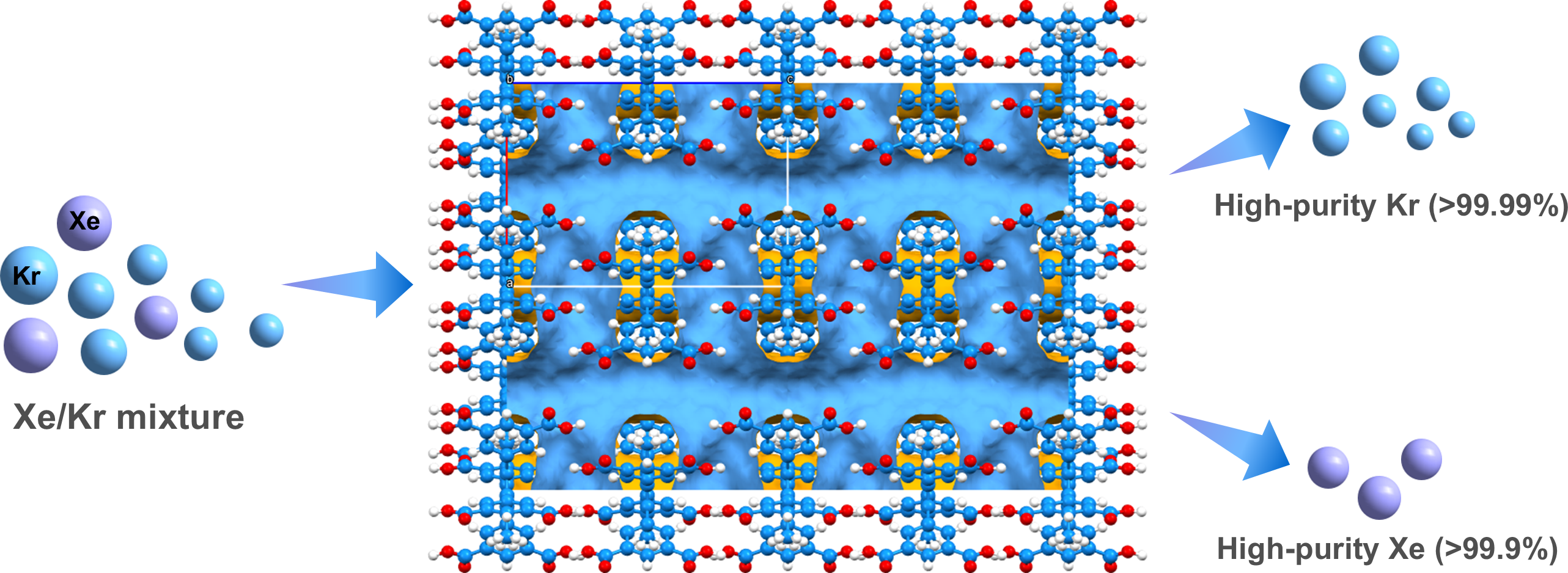
An ultrastable hydrogen-bonded organic framework featuring unique 2D pores demonstrates rapid Xe adsorption kinetics as well as unprecedented dynamic selectivity for Xe/Kr separation. (Image by Prof. WU's team)
