Newsroom


Soil organic carbon (SOC) stability is central to the sustainability of terrestrial ecosystem C sinks. The priming effect triggered by fresh C inputs accelerates the decomposition of native SOC, representing a key process governing SOC retention or loss.
Nature-based climate solutions emphasize enhancing plant diversity to increase C inputs. However, whether diversity exacerbates priming effect and causes C loss, or suppresses the priming effect and strengthens C stability, remains unknown. Especially in subtropical forest ecosystems, the understanding on how tree species diversity regulates microbial metabolism, functional genes, and community networks, is lacking.
In a study published in Ecology Letters, a team led by Prof. LI Dejun from the Institute of Subtropical Agriculture of the Chinese Academy of Sciences provided the first evidence in a subtropical karst forest that tree species diversity significantly suppresses priming effects, and elucidates a novel synergistic regulatory mechanism on alleviating microbial energy limitation, functional guild transition, and gene expression rewiring.
Based on a tree species diversity gradient established across 45 forest plots in the Guangxi Mulun National Nature Reserve, researchers systematically dissected the driving patterns and regulatory pathways of the priming effect using a technical framework including 13C isotope labeling incubation, metagenomic sequencing, microbial network analysis, and structural equation modeling.
Researchers found that that soil priming effects decreased significantly and linearly with increasing tree species diversity, shifting from strong positive priming to weak or even negative priming. This relationship remained robust after strictly controlling for environmental factors, stand structure, and mycorrhizal types, confirming tree species diversity as an independent core factor suppressing the priming effect.
Furethermore, researchers advanced the theoretical framework of biodiversity-regulated soil C stability from the perspective of the priming effect. They demonstrated that increasing tree species diversity locks in native soil C and reduces C loss while boosting C inputs.
"Our findings highlight that forest C sink assessments and Earth system models must incorporate tree species diversity and microbial functional strategy parameters, providing support for ecological restoration, close-to-natural transformation of plantations, and C neutrality pathway optimization in subtropical and karst regions of China," said Dr. DUAN Pengpeng, the first author of the study.
This study provides support for the synergy between biodiversity enhancement and forest C sequestration.
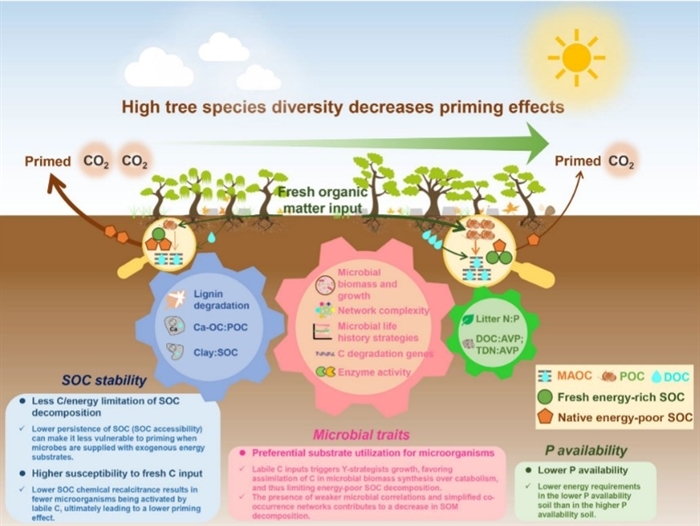
A conceptual framework illustrating how tree species diversity suppresses the soil priming effect. (Image by HOU Xinyu)