
Newsroom


A recent study has developed a new non-antibiotic strategy to treat central nervous system (CNS) bacterial infections using two-dimensional magnesene nanosheets that kill bacteria through a "localized magnesium overload" mechanism.
The study, led by Profs. SHI Jianlin and LIN Han from the Shanghai Institute of Ceramics (SIC) of the Chinese Academy of Sciences (CAS), in collaboration with Prof. XIE Rong from Huashan Hospital, Fudan University, was recently published in the Journal of the American Chemical Society.
CNS bacterial infections remain a major clinical challenge because antibiotics have difficulty crossing the blood-brain barrier and drug-resistant bacteria are becoming more common. Conventional antibiotic therapies often work poorly and cause significant side effects.
Unlike conventional antibiotics that attack bacterial proteins or metabolic pathways, magnesene nanosheets stick to bacterial membranes via electrostatic interactions. Once attached, they continuously release magnesium ions (Mg²⁺) at the interface, forming a localized magnesium-rich microenvironment rather than raising magnesium levels throughout the extracellular space.
This localized magnesium overload disrupts bacterial membrane ion balance and transmembrane transport. Specifically, magnesene blocks glucose uptake and bacterial energy metabolism by interfering with the phosphotransferase system, which ultimately leads to membrane dysfunction and bacterial death. This antibacterial mechanism differs fundamentally from traditional reactive oxygen species-mediated killing or antibiotic inhibition, offering a new ion-dysregulation-based strategy.
To test this mechanism, the team used zeta potential analysis, magnesium ion fluorescence imaging, ICP quantification, electron microscopy, and molecular dynamics simulations. The results confirmed strong adhesion between magnesene and bacterial membranes, significant magnesium enrichment on the bacterial surface, and severe membrane disruption caused by the sharp edges of the two-dimensional nanosheets.
Experiments both in vitro and in vivo showed that magnesene is highly effective against methicillin-resistant Staphylococcus aureus (MRSA), a common multidrug-resistant bacterium. In a rat CNS infection model, magnesene significantly reduced bacterial burden in brain and spinal cord tissues, performing as well as vancomycin—a standard antibiotic—while causing minimal liver and kidney toxicity.
This study introduces a previously unrecognized antibacterial paradigm based on localized ionic dysregulation and offers a promising non-antibiotic strategy for treating multidrug-resistant CNS bacterial infections, researchers said.
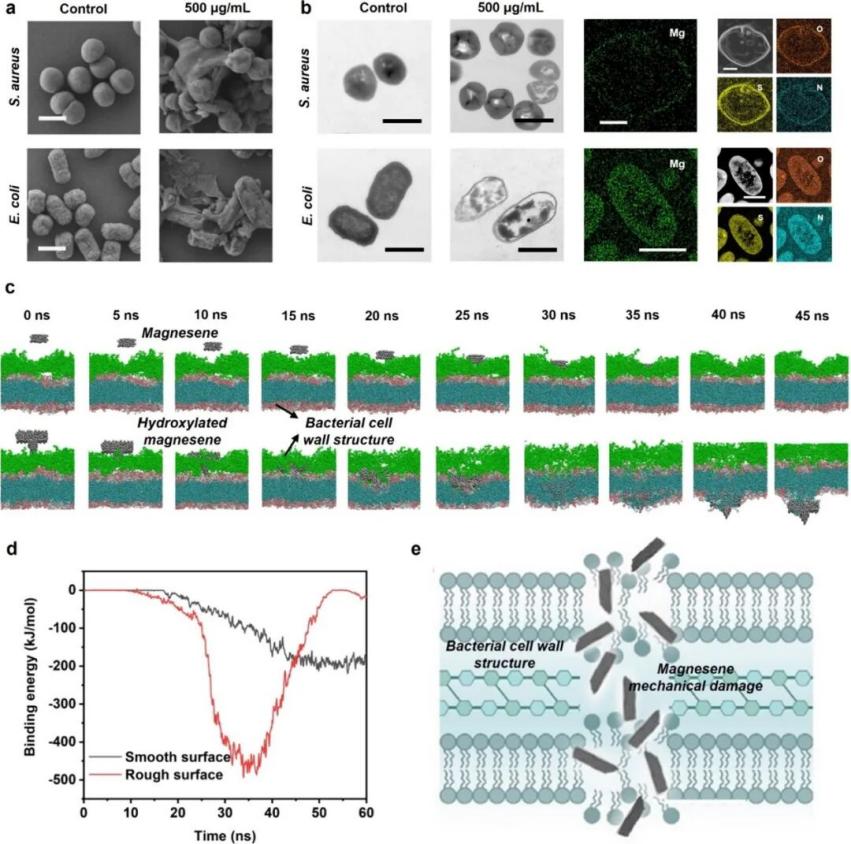
Structural, simulation, and membrane damage analysis reveal magnesene's preferential interfacial interaction and mechanical disruption mechanism on bacterial membranes. (Image by SICCAS)

