Newsroom


A new study reveals that tiny marine phytoplankton may play a much larger role in shaping Earth's climate than previously understood. These microscopic organisms can influence the evolution of multi-year La Niña events.
The study, published in Communications Earth & Environment on May 25, was conducted by a research team from the Institute of Oceanology of the Chinese Academy of Sciences (IOCAS).
La Niña refers to the persistent abnormal cooling of sea surface temperatures in the central-eastern tropical Pacific Ocean. When such an event lasts more than two years (multi-year La Niña), its global climate impacts can become significantly stronger. Although multi-year La Niña events have become increasingly frequent in recent decades, the role of marine biogeochemical processes in their evolution has remained poorly understood.
For years, El Niño-Southern Oscillation (ENSO) studies have focused mainly on ocean-atmosphere physical interactions, overlooking marine life. To address this gap, the researchers hypothesized that phytoplankton might hold the key, which contain chlorophyll and influence sunlight penetration. More chlorophyll traps solar radiation near the surface, while less allows deeper warming.
Using decades of observations and advanced physical-biogeochemical coupled models, the researchers tested how phytoplankton-driven heating feedback affects the development of multi-year La Niña events.
Their results showed that multi-year La Niña events strengthen east-west currents in the western-central equatorial Pacific, leading to higher chlorophyll levels for two consecutive years. Increased chlorophyll traps more solar radiation, which initially slows surface cooling but eventually makes the mixed layer shallower. This process enhances the circulation of heat from the equator to the poles, further cooling the region and intensifying second-year La Niña conditions by about 8%.
In the eastern equatorial Pacific, however, a different pattern emerges. Influenced by a northwest Pacific anticyclone, chlorophyll levels drop sharply in the second year. Reduced chlorophyll allows sunlight to warm subsurface waters, which then rise via upwelling, weakening the second-year La Niña by a substantial 45%.
These contrasting chlorophyll patterns amplify the east-west sea surface temperature gradient and reinforce air-sea coupling, challenging traditional understandings of ocean-atmosphere interactions. The researchers also found that deep chlorophyll maxima further enhance the cooling effect.
This study provides the first direct evidence that phytoplankton-driven heating exerts critical control over multi-year La Niña events on interannual timescales. These findings provide a physical basis for improving ENSO prediction models and support climate risk prevention under global warming.
"Tiny phytoplankton play an outsized role in shaping major climate events—a reminder that the ocean's smallest inhabitants hold big clues for understanding Earth's changing climate," said Dr. TIAN Feng, first author of the study.
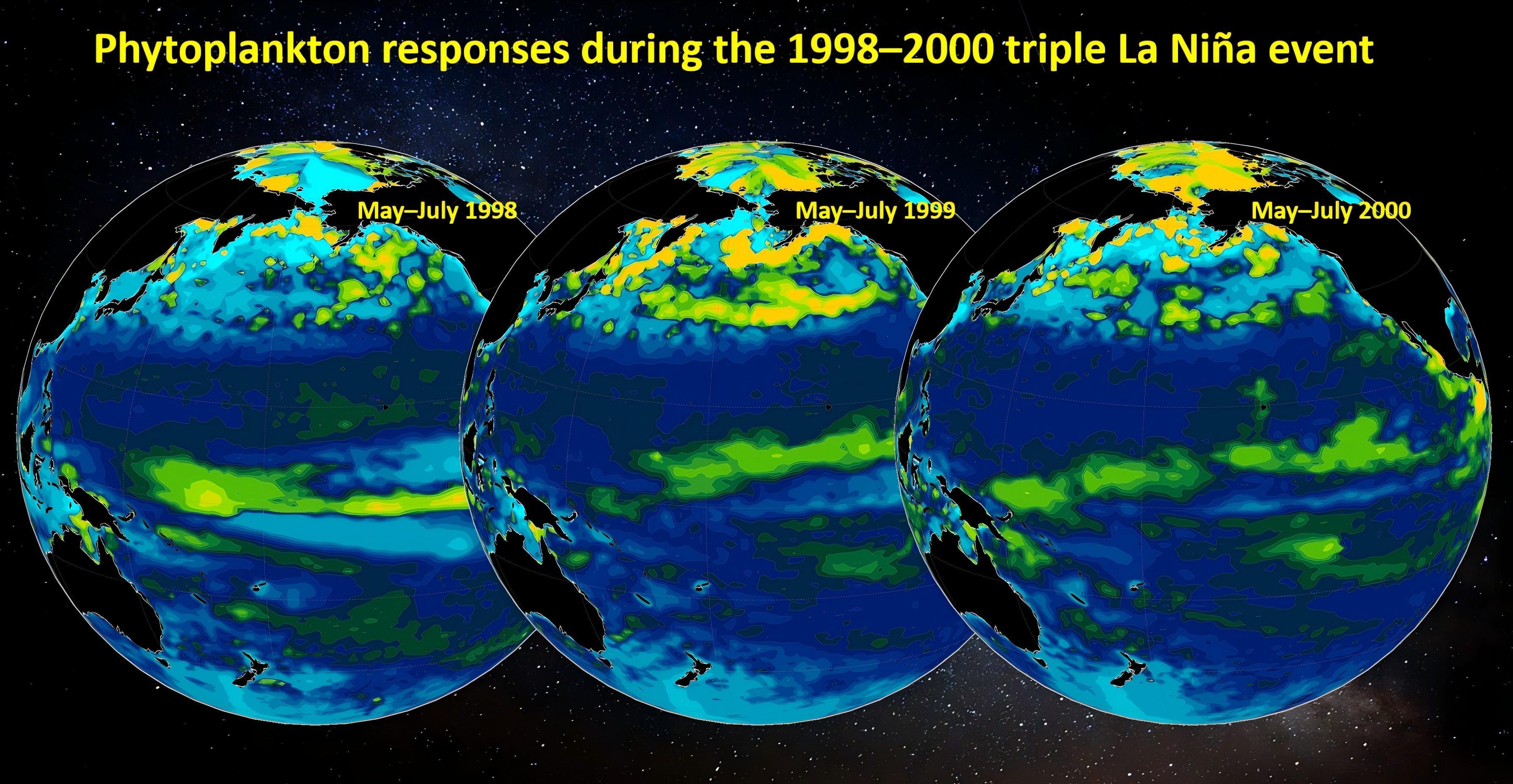
Sea surface chlorophyll anomaly distribution in late spring and early summer during the 1998–2000 triple La Niña event. (Image by IOCAS)