Newsroom


On the Moon, the lack of atmosphere and accompanying features such as biological activity, oxygen-rich air, flowing water and rain, wind, and most erosion allows the lunar regolith to preserve a long-term record of surface processes in the space environment.
Such processes, which have a major effect on airless bodies such as the Moon, Mercury, and asteroids, include solar wind irradiation, micrometeorite bombardment, impact melting, sputter deposition, and rapid quenching—all of which continuously alter the structure, composition, and optical properties of surface materials.
Understanding these processes at the micro- and nanoscale is essential for interpreting lunar space weathering, remote-sensing spectra, and the form and distribution of surface resources.
To enhance this understanding, a collaborative team jointly led by Prof. YIN Zongjun from the Nanjing Institute of Geology and Palaeontology of the Chinese Academy of Sciences (NIGPAS), together with Profs. SHEN Bing and ZHOU Jihan from Peking University, has conducted systematic studies of impact-glass particles associated with Chang'e-5 lunar regolith grains.
The findings were published in the Journal of Geophysical Research: Planets and PNAS. Together, these studies focus on the same type of Chang'e-5 impact glass, revealing the nanoscale evolution of lunar surface materials through two complementary processes: impact-induced silicate phase separation and the formation of nanophase metallic iron.
In the Journal of Geophysical Research: Planets study, the researchers examined Chang'e-5 impact glass using aberration-corrected transmission electron microscopy, scanning transmission electron microscopy, and spectroscopic analyses.
They identified Fe-rich nanodroplets within Si-rich glass, as well as Si-rich nanodroplets within Fe-rich glass. The nanodroplets were amorphous, i.e., lacked a regular crystal structure, and were found in clusters that had partially merged and grown. The results suggest that micrometeorite impacts not only induce local melting of lunar regolith, but can also trigger silicate liquid immiscibility on extremely short timescales, with rapid quenching preserving the transient phase-separated structures in impact glass where different materials separated from one another.
Building on this work, the PNAS study examined nanophase metallic iron (nanophase Fe0, npFe0) in the impact glass, which is a major product of lunar space weathering. It also plays a key role in modifying the reflectance spectra of lunar soils.
Using electron tomography alongside energy-dispersive X-ray spectroscopy and electron energy-loss spectroscopy, the researchers directly resolved the three-dimensional distribution, morphology, local abundance, and iron valence states of npFe0 at the nanometer scale.
In one reconstructed volume, 1,506 npFe0 particles were identified, with an average diameter of approximately 3.4 nm and a median diameter of approximately 2.9 nm. Different layers showed distinct particle sizes, number densities, and Fe⁰ volume fractions, with the Fe⁰ volume fraction in a local large-particle layer reaching up to 30 vol%.
To determine how the nanoparticles formed in different regions, the researchers combined structural reconstructions with elemental and iron valence-state analyses. They also introduced a parameter, ξ, to evaluate the contribution of external electrons during iron reduction.
The study showed that the sulfur-rich layer containing irregular large particles mainly originated from iron sulfide decomposition. It also showed that several layers with high concentrations of small particles were dominated by Fe2+ disproportionation—a process in which Fe2+ is simultaneously oxidized and reduced. The near-surface region exhibited evidence of later modification due to solar wind irradiation, promoting glass-structure modification and npFe0 particle ripening.
The researchers further estimated that metallic iron in mature impact-glass domains could reach 7.1 wt%, substantially exceeding previous bulk-soil estimates for Chang’e-5 samples. This result highlights significant microscale heterogeneity in the distribution of npFe0 in lunar regolith.
Together, the two studies demonstrate that Chang’e-5 impact glass simultaneously records several related processes—impact melting, silicate liquid immiscibility, redox reactions, sulfide decomposition, and solar wind modification. Using electron tomography and high-resolution spectroscopic techniques, the researchers were able to overcome the limitations of conventional two-dimensional imaging and quantitatively reconstruct nanoscale structures and their formation histories in three dimensions.
The findings provide new sample-based insights into the spectral evolution of the Moon and other airless bodies, the processes responsible for forming lunar impact glass, and the distribution and physical state of iron resources on the lunar surface.
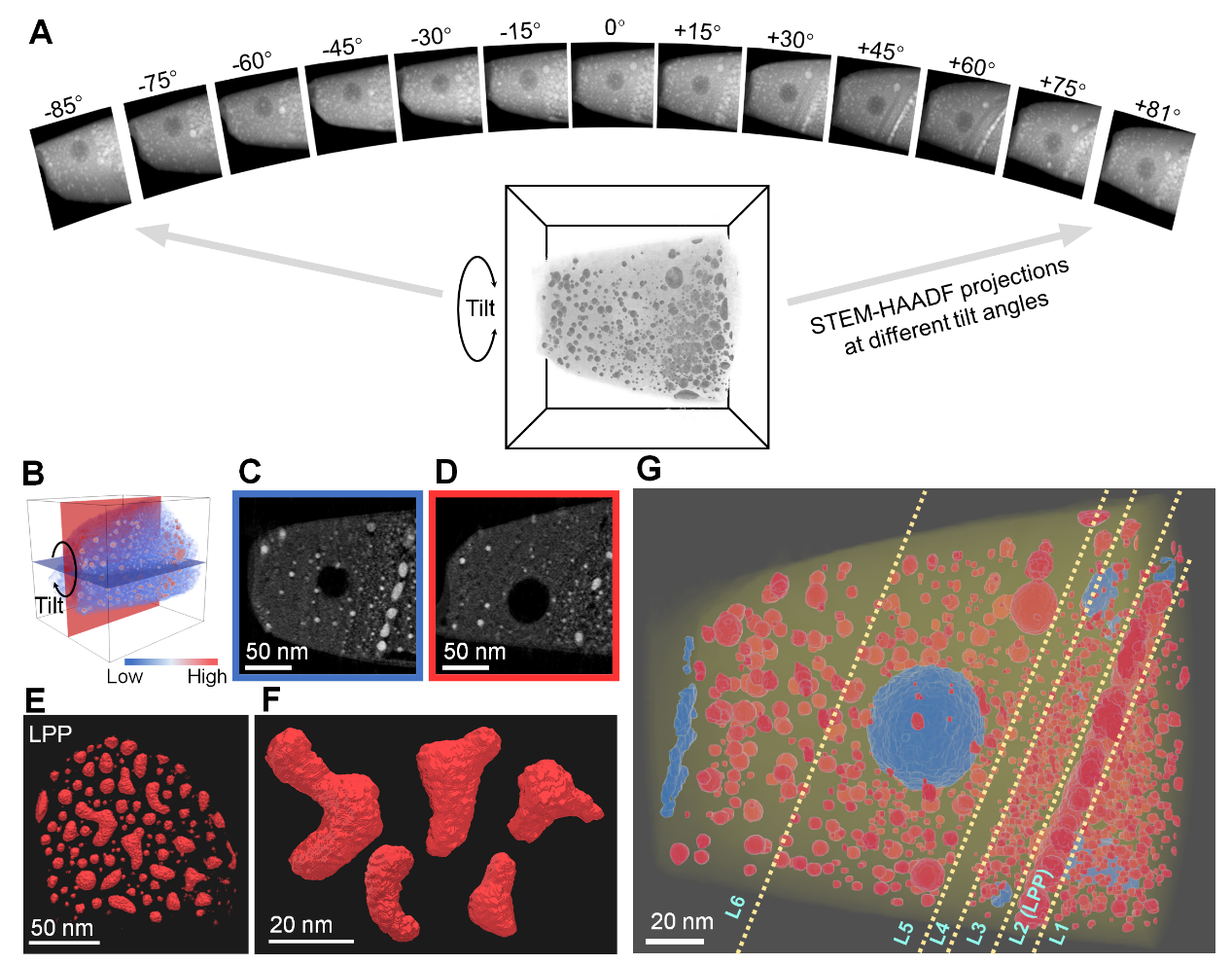
The schematic of ET experiment for tip samples and the 3D reconstruction results of Tomo-1. (Image by NIGPAS)
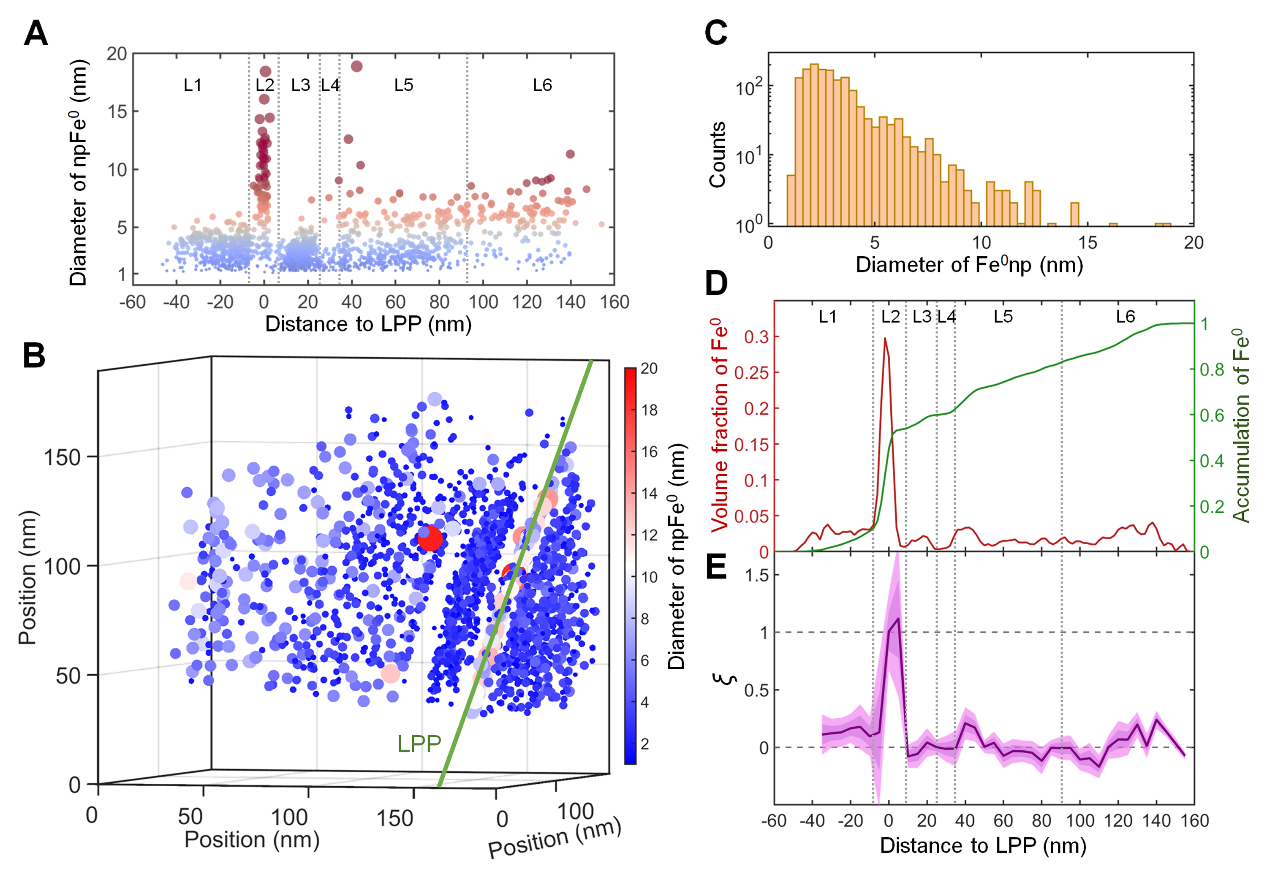
3D spatial distribution and size statistics of npFe0 particles in Tomo-1, and the calculation of the amounts of extra electrons. (Image by NIGPAS)
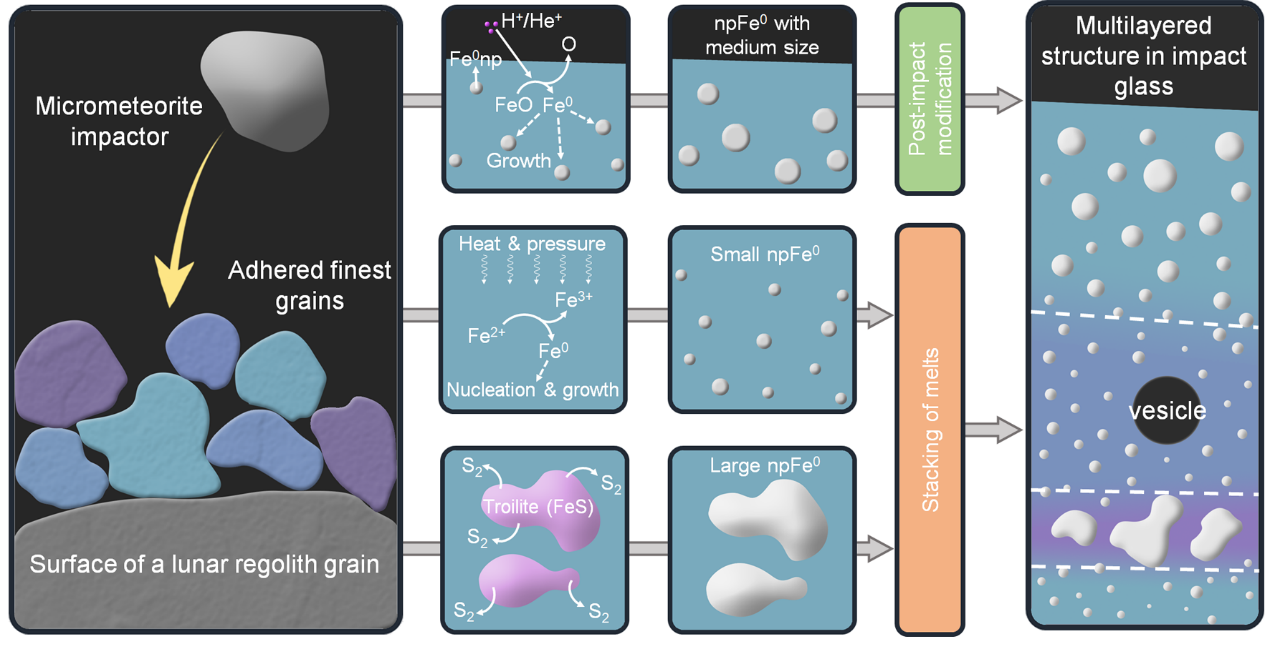
Formation mechanism of multilayered structure containing npFe0 particles. (Image by NIGPAS)