Newsroom


Differences between individual cells play a critical role in mammalian development, immune responses, and disease progression. However, tools capable of capturing, monitoring, and recovering selected cells for downstream analysis are often complex and expensive, limiting their use in many laboratories.
To address this need, scientists from the Qingdao Institute of Bioenergy and Bioprocess Technology (QIBEBT) of the Chinese Academy of Sciences have developed a microfluidic platform based on the Digital Colony Picker (DCP). This platform integrates single-cell capture, on-chip incubation, and real-time bright-field and fluorescence detection with precise target-cell recovery into one streamlined workflow.
The study was published in Sensors and Actuators B: Chemical on May 5.
To improve single-cell capture efficiency, the researchers designed a low-cost polydimethylsiloxane-indium tin oxide (PDMS-ITO) glass chip containing 8,192 parallel hydrodynamic trapping units. The platform achieved an average single-cell capture efficiency greater than 93% across cells approximately 10–20 μm in diameter.
The chip also supports on‑chip incubation, medium exchange, and in situ staining. In a macrophage infection model using fluorescent E. coli, scientists observed macrophage-mediated bacterial killing at the single‑cell level, confirming that the captured cells retain normal immunometabolic activity. Cell viability remained above 80% after 24 hours of incubation.
For target-cell recovery, the platform uses a laser-induced microbubble strategy. A 1,064-nm laser is focused on the ITO glass region to generate a transient microbubble that gently pushes the selected cell into the flow channel for collection into a 96-well plate. The platform achieved release efficiencies above 97%, and the recovered cells were successfully used for whole-genome amplification and Sanger sequencing.
"A key challenge in functional single-cell analysis is not only to identify cells with interesting phenotypes, but also to recover the same living cells," said Dr. LI Xiuyun, first author of the study. "This platform remains compatible with downstream molecular assays."
To demonstrate the platform's utility for heterogeneity studies, the researchers investigated the responses of single macrophages to reactive oxygen species (ROS) under phorbol 12-myristate 13-acetate (PMA) stimulation. Real-time fluorescence monitoring revealed striking cell-to-cell variability in ROS induction.
"Cellular heterogeneity is central to understanding immune responses, cancer progression and drug effects," said Prof. MA Bo, a corresponding author of the study . "This platform helps link phenotype, function and downstream molecular information at the single-cell level."
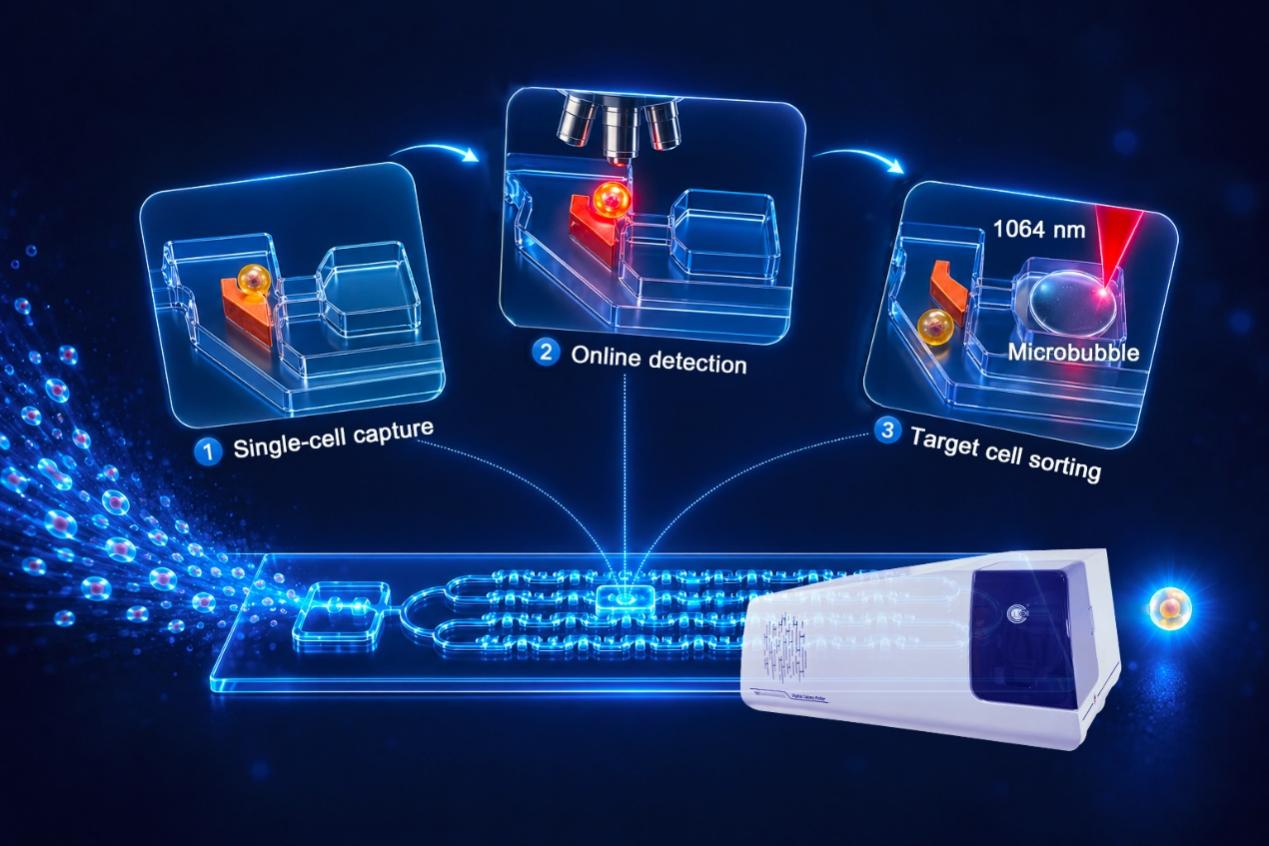
The Digital Colony Picker (DCP)-based platform integrates single-cell capture, real-time detection and target-cell sorting for mammalian cells (Image by LI Xiuyun)