
Newsroom


Researchers from the Institute of Metal Research (IMR) of the Chinese Academy of Sciences have developed a "internal decomposition" mechanism promoted by defects in Ti2AlC MAX phase precursors, enabling the fabrication of a hierarchical Al3Ti/Al composite that simultaneously achieves high strength and high modulus at elevated temperatures. This overcomes the long-standing drawback that has limited the high-temperature application of aluminum matrix composites (AMCs).
The study was published in Nature Communications on May 13.
AMCs are widely used in aerospace and lightweight structural applications due to their high specific strength and specific modulus. However, interfacial degradation and matrix softening at elevated temperatures have historically limited their service temperature to below 300 °C.
To improve high-temperature performance, in situ AMCs with strong metallurgical interfaces have attracted considerable attention. However, conventional reaction systems face a dilemma: micron-sized precursors have a low specific surface area, which leads to an insufficient reaction and coarse, agglomerated reinforcements that limit strength gains. On the other hand, nano-sized precursors can produce nanoscale reinforcements but are prone to agglomeration and yield low reinforcement volume fractions, which makes achieving a high modulus difficult.
The researchers overcame this challenge by introducing a defect‑promoted internal decomposition mechanism. Using high‑energy ball milling to induce a dual‑pathway elemental diffusion architecture in Ti2AlC. This process enabled the internal decomposition of the MAX phase. The result was a hierarchical microstructure containing two key features: a high volume fraction of sub-micron Al3Ti particles that were uniformly dispersed in an ultrafine-grained Al matrix and intraparticle carbon-containing clusters and rod-like phases that were dispersed within the Al3Ti particles.
This hierarchical Al3Ti/Al composite features a multi-level strengthening mechanism, enhancing the high-temperature performance of the composite.
This hierarchical design delivers outstanding mechanical performance at high temperatures. At 350 °C, the composite exhibits an ultimate tensile strength of 246 MPa and a Young's modulus of 106 GPa. Its specific modulus at 350 °C surpasses that of TC4 titanium alloy, QZr0.2 copper alloy, 45 steel, and GH93 nickel‑based alloy by margins of 88%, 190%, 55%, and 42%, respectively.
This work opens a new pathway for designing lightweight structural materials for demanding high‑temperature aerospace and defense applications.
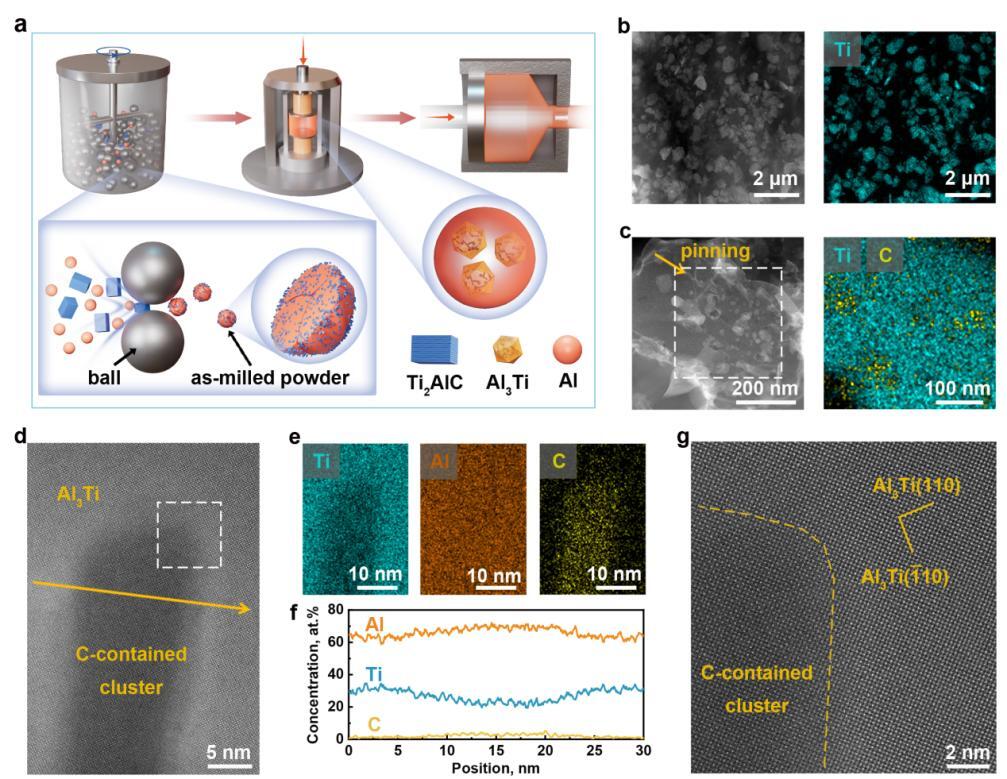
Fabrication process and microstructure of the composite. (Image by IMR)
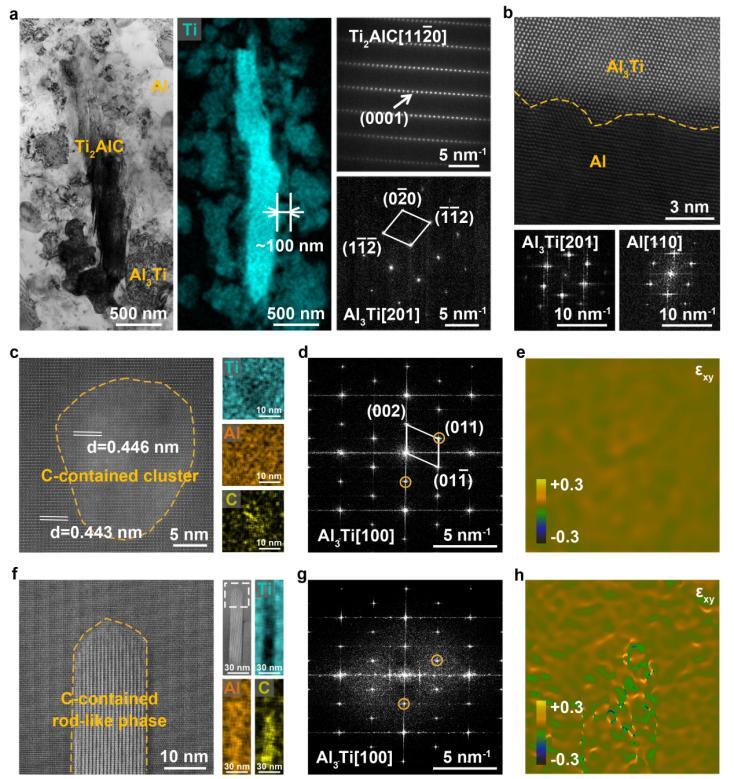
Microstructure of the composite Al3Ti particles. (Image by IMR)
