Newsroom


A study published in Advances in Atmospheric Sciences and led by PhD student LI Ming and Dr. WU Xue from the Institute of Atmospheric Physics (IAP) of the Chinese Academy of Sciences uncovered a mechanism through which intense storms over the Himalayas contribute to increasing moisture in the lower stratosphere—a layer of the atmosphere crucial to global climate regulation.
Stratospheric water vapor influences the Earth's radiation balance, ozone chemistry, and atmospheric circulation. It is known that some powerful storms can push moisture into the stratosphere, but the exact processes over the Himalayan region, a hotspot for such storms during the Asian summer monsoon, have remained unclear.
In this study, using high-resolution satellite data and numerical modeling, researchers found that overshooting storms over the southern slope of the Himalayas excite gravity waves which break and cause turbulent mixing, allowing more water vapor and ice particles to move between atmospheric layers. These waves enhance wind shear, which promotes the formation and spread of "above-anvil cirrus plumes"—cloud-like structures that linger in the lower stratosphere.
"What we've found is that these lingering ice plumes, driven by gravity waves, can add even more water vapor to the stratosphere than the initial storm top injection. This turns 'above-anvil cirrus plumes' into a key indicator of stratospheric moistening," explained Dr. WU.
The study highlights the important role of gravity waves generated by deep convection. It combines CloudSat observations with high-resolution topography-sensitive simulations, offering new insights into how the Himalayas influences upper-atmosphere humidity.
To further investigate cloud processes and troposphere-stratosphere interactions, researchers plan to integrate multi-satellite and ground-based observations, including measurements from the Atmosphere Profiling Synthetic Observation System (APSOS) station. The APSOS was built by IAP In 2017. It was located about 90 km northwest of the Chinese city of Lhasa.
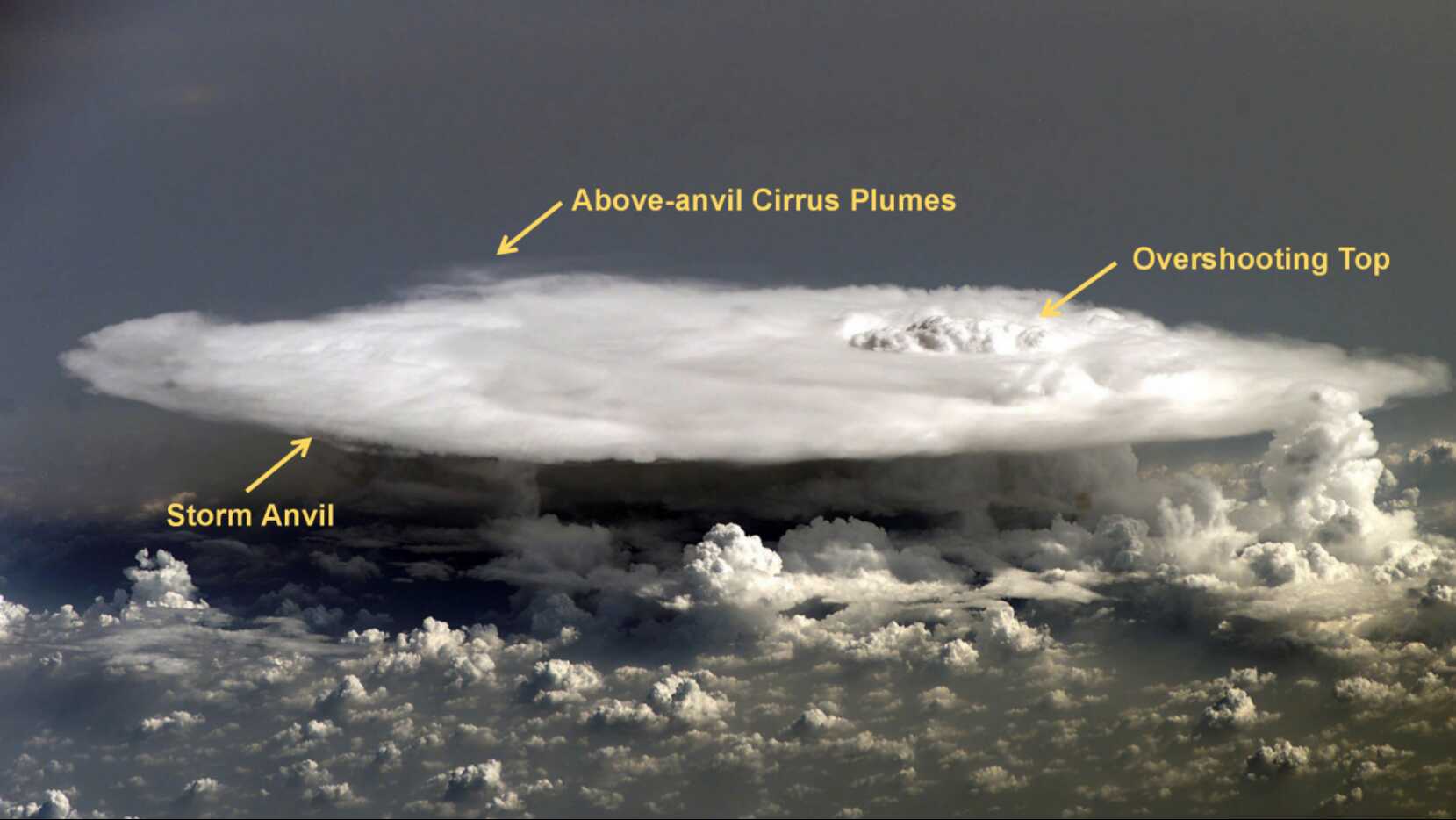
Photograph from the International Space Station showing an overshooting storm with an anvil and above-anvil cirrus plume. (Image by ESA/NASA)