
Newsroom


A research team led by Prof. WU Haichen from the Institute of Chemistry of the Chinese Academy of Sciences (ICCAS), and Prof. LIU Lei from Xihua University, developed an innovative nanopore probe that enables the real-time, multiplexed, and label-free monitoring of biomolecules within single living cells. This study was published in PNAS.
Understanding molecular activities within single live cells is essential for deciphering cellular heterogeneity, differentiation, senescence, and disease progression. However, traditional approaches usually rely on micromanipulation or sample extraction, followed by offline measurements, making it difficult to capture dynamic biochemical changes in real time.
To address this challenge, the researchers designed a device that combines an aluminum oxide (Al2O3) nanostraw membrane with a glass nanopore membrane containing a functionalized Mycobacterium smegmatis porin A protein nanopore, known as MspA-Phen-Cu.
The Al2O3 nanostraw membrane enables efficient and nondestructive molecular extraction, and the protein nanopore performs single-channel electrical detection. Under the combined influence of diffusion and an applied electric field, intracellular molecules migrate through the nanostraw membrane toward the protein nanopore. Their translocation generates characteristic current signatures, allowing for the identification of individual molecules and the quantification of their concentrations.
Using an oxygen-glucose deprivation (OGD) hippocampal neuron model to simulate ischemic-hypoxic stress, the researchers simultaneously monitored dynamic changes in three biologically important molecules: glutamate (Glu), ascorbic acid (AA), and adenosine triphosphate (ATP). These molecules play important roles in excitotoxic neuronal edema, a pathological process associated with neurological injury.
The experiments revealed that excessive activation of NMDA receptors (NMDARs) serves as a key regulatory switch in excitotoxic neuronal edema.
Compared with existing single-cell analysis technologies, this platform offers several notable advantages: minimal cellular disruption for long-term continuous observation, in situ extraction with real-time monitoring, and simultaneous detection of multiple target molecules.
This work successfully applies nanopore sensing inside living cells, providing a powerful platform for investigating cellular processes and disease mechanisms at the level of individual molecules.
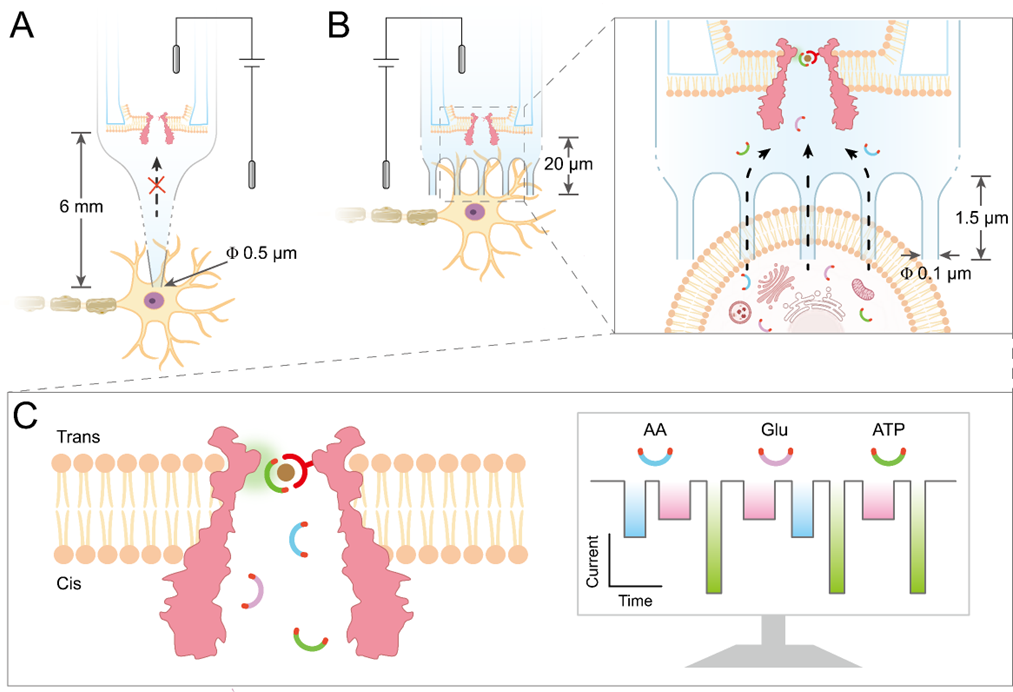
Nanopore probes for in situ molecular extraction and detection in single cells (Image by HUANG Xiaobin)
