
Newsroom


A study published in Global Change Biology on May 15 has provided the first evidence that tropical plants can adapt to long-term high nitrogen (N) deposition by up-regulating root exudation, revising the traditional view that N deposition reduces belowground carbon allocation.
Led by researchers from the South China Botanical Garden (SCBG) of the Chinese Academy of Sciences, the study showed that instead of passively reducing root carbon release, tropical forests actively enhance root exudates to mobilize soil phosphorus—a key adaptation that helps explain how “N‑rich” tropical forests maintain high productivity and stability under chronic environmental stress. This insight is crucial for predicting the dynamics of tropical forest carbon sinks under future climate change.
Global nitrogen (N) deposition is intensifying, disrupting the balance between nitrogen and phosphorus (P) in ecosystems—especially in tropical and subtropical regions, where available P is relatively scarce. Extensive studies in temperate N‑limited ecosystems have established a classic paradigm: N addition eases plant competition for N, which in turn reduces the allocation of photosynthates belowground, particularly decreasing the release of root exudates.
But can this paradigm be directly applied to "N‑rich" yet P‑deficient tropical and subtropical forests? For a long time, experimental evidence has been lacking, creating a critical knowledge gap in predicting forest carbon‑phosphorus feedbacks and ecosystem stability under high N deposition.
To address this issue, the term studies investigated how tropical forest plants adapt to chronic high N addition by regulating root exudates and rhizosphere P dynamics in a primary broadleaved forest.
The results showed that plants evolved an active adaptation mechanism in facing chronic high N addition: firstly, increased root C exudation rate to stimulate microbial phosphatase activity and accelerated the mineralization of organic P; secondly, enhanced the release of organic acids to promote the dissolution of mineral-bound P. More importantly, the organic acid pathway played a dominant role, driving approximately twice as much P release as the phosphatase pathway.
Associate Professor ZHU Xiaomin and Professor LU Xiankai from the SCBG are the first author and the corresponding author respectively. Other co-authors include Professor MO Jiangming, Associate Professor CHEN Weibin and MAO Qinggong from SCBG, Professor Benjamin L. Turner from Shandong Agricultural University, and Professor ZHANG Ziliang from Northwestern Polytechnical University. This work was supported by Guangdong S&T Program and National Natural Science Foundation of China.
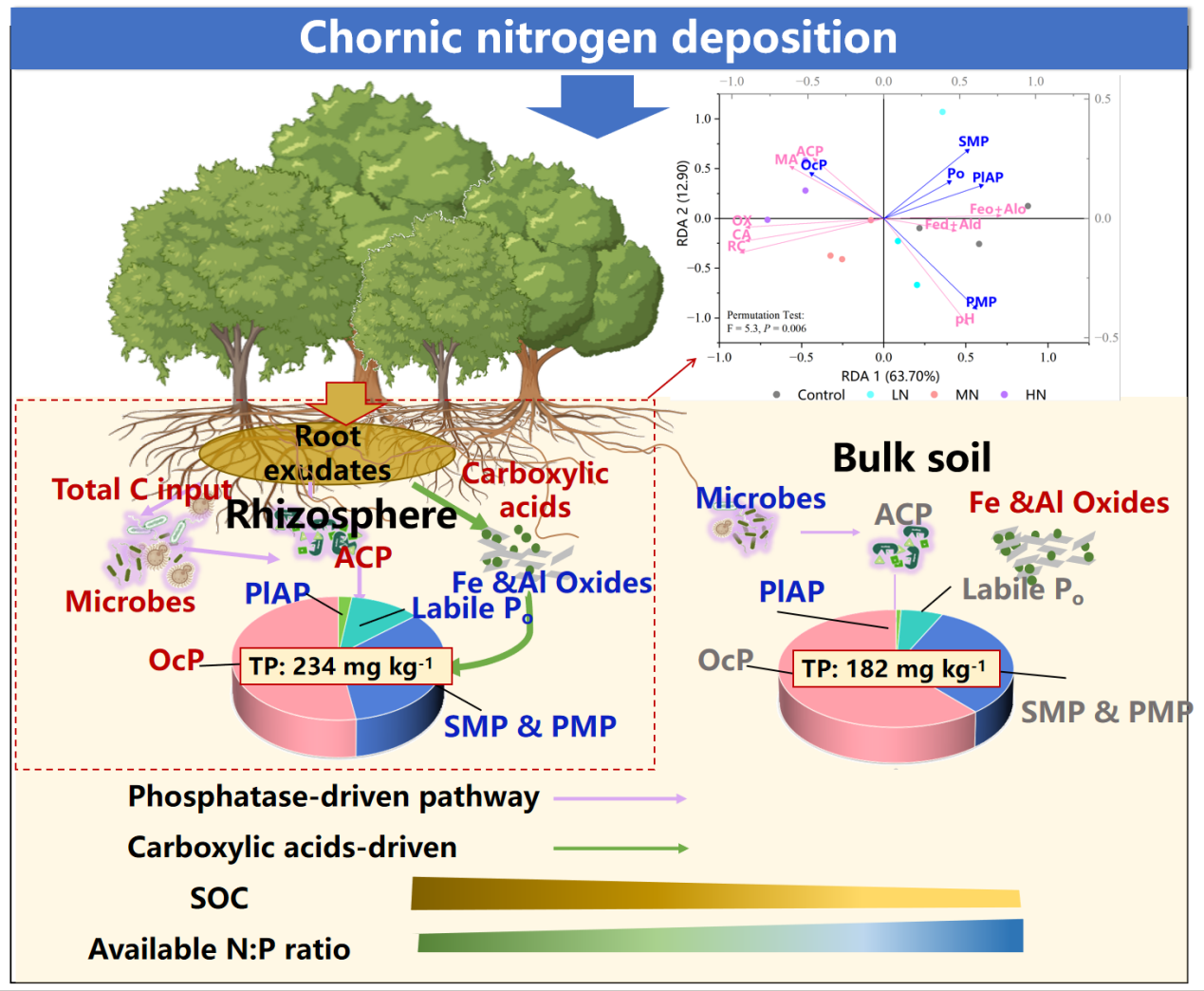
A theoretical framework for long-term N deposition promoting root exudation and rhizosphere P cycling in primary tropical forests. (Image by ZHU et al.)
