Newsroom


As extreme droughts become more frequent and severe, forests around the world are dying off at alarming rates. However, the interaction between tree species' physiological strategies and local microenvironments that shapes landscape-scale dieback patterns remains poorly understood.
In a study published in Forest Ecology and Management on May 13, researchers from the Xishuangbanna Tropical Botanical Garden (XTBG) of the Chinese Academy of Sciences revealed how two dominant pine species in Southwest China responded to the extreme drought of 2023. Their findings reveal that forest dieback is not uniform but is instead shaped by species-specific vulnerabilities and local environmental conditions.
The study was conducted across 20 large forest plots (four hectares each) in Yunnan Province, a biodiversity hotspot that experienced an unprecedented eight-month drought between 2022 and 2023.
The researchers used drone surveys, high-resolution satellite imagery, and environmental data to investigate a widespread dieback event affecting Pinus yunnanensis (Yunnan pine) and Pinus kesiya var. langbianensis (Simao pine). They systematically assessed the post-drought canopy mortality dynamics, water response trajectories, and recovery capacity of the two pine species. They also quantified the key drivers behind the spatial patterns of dieback.
The results showed that the 2023 drought caused a sharp drop in the normalized difference water index (NDWI) for both species. However, their post-drought recovery paths diverged significantly. Areas of Yunnan pine dieback exhibited irreversible damage with no meaningful recovery. By contrast, Simao pine showed rapid but incomplete recovery, suggesting a lasting effect of the drought.
Further analysis identified distinct constraints driving dieback in each species. For Yunnan pine, dieback was primarily driven by intrinsic stand traits, such as tree age, canopy height, and soil potassium levels. Older stands and those with nutrient imbalances were far more likely to collapse. For Simao pine, the dominant factor was topography, especially slope aspect and steepness. South-facing slopes, which receive more solar radiation and experience greater water loss, were disproportionately affected.
The study generated spatially explicit risk maps, revealing that dieback hotspots are disproportionately located near the distributional margins of both species. Populations living at the edge of their physiological limits are most vulnerable to climate-driven extremes.
"Our results provide new mechanistic insight into species-specific drought vulnerability. Effective adaptation strategies must move beyond generalized assessments toward species- and site-specific interventions. It is necessary to integrate multi-scale observations, such as unmanned aerial vehicle (UAV) and satellite data, to improve the accuracy of forest mortality predictions," said FAN Zexin of XTBG.
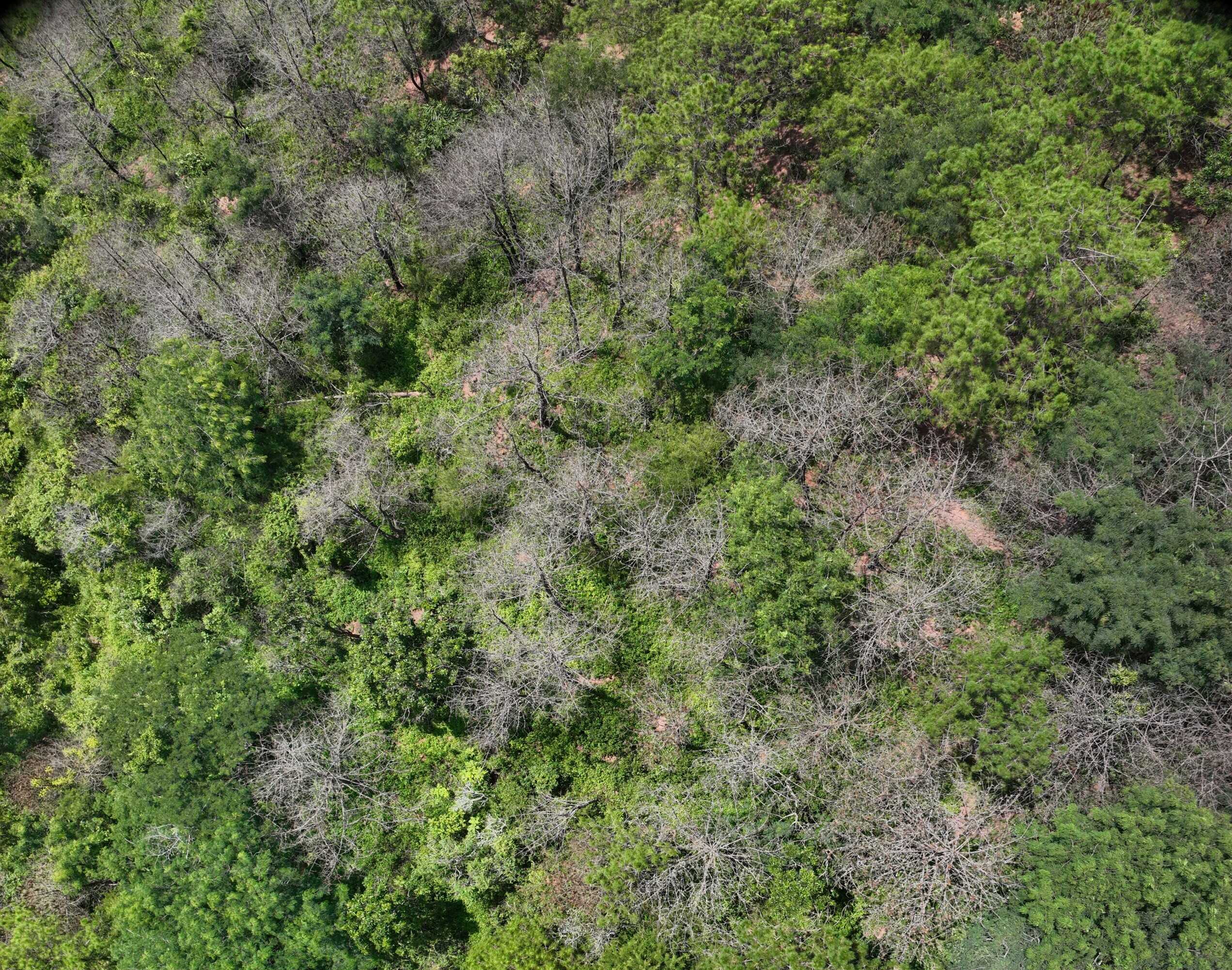
Forest of Pinus kesiya var. langbianensis (Simao pine) after drought. (Image by GAO Daoxiong)
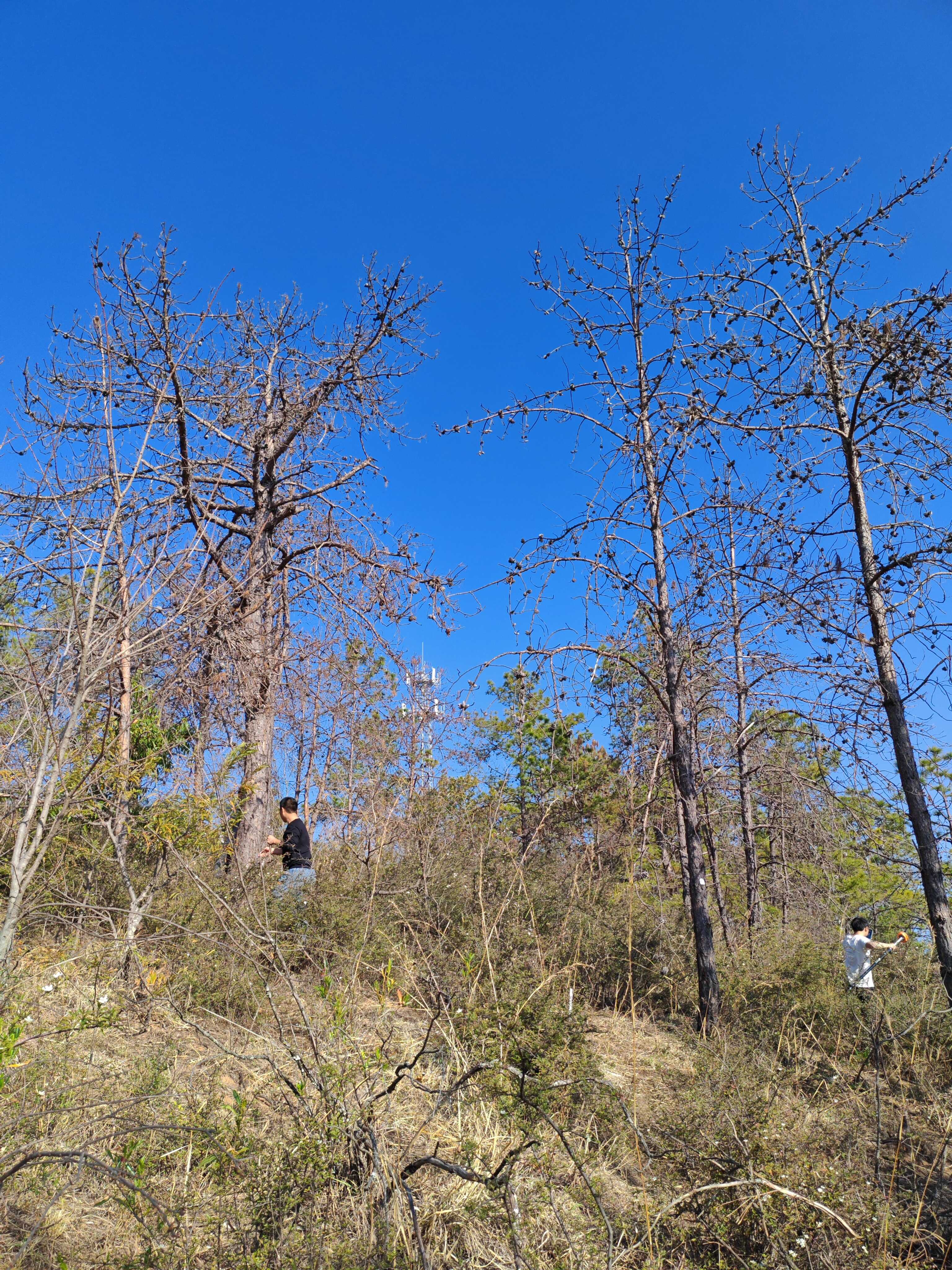
Forest of Pinus yunnanensis (Yunnan pine) after drought. (Image by GAO Daoxiong)