Newsroom


To counteract the adverse effects induced by chronic stress, individuals often engage in behaviors that activate the brain's reward system, exerting compensatory regulation over emotional states. The consumption of palatable food represents a simple yet effective strategy for alleviating stress-induced anxiety. However, the underlying neural circuit mechanisms linking reward processing to stress regulation remain largely unclear.
In a study published in Advanced Science, Dr. TU Jie's team from the Shenzhen Institute of Advanced Technology (SIAT) of the Chinese Academy of Sciences identified a neural circuit from dopamine 1 receptors (D1R) neurons in prefrontal cortex (PFC) to corticotropin-releasing factor (CRF) neurons in paraventricular nucleus (PVN) of hypothalamus—PFCD1R→peri-PVNCRFR1→PVNCRF—that functionally connects the brain's reward system with the stress-response system and mediates reward-driven top-down regulation of stress.
Using both high-resolution three-dimensional (3D) behavioral mapping and conventional behavioral assays, researchers demonstrated that chronic stress induces the hyperactivation of PVNCRF neurons and produces anxiety-like behaviors in mice. Notably, the intake of palatable food reversed these neural and behavioral abnormalities.
Through in vivo neural activity recordings, researchers revealed that palatable food consumption triggers dopamine release within the PFC, leading to the activation of excitatory D1R-expressing neurons, and these PFCD1R neurons, in turn, suppress the stress-induced hyperactivity of PVNCRF neurons.
Because PFCD1R neurons are excitatory, researchers hypothesized that the inhibitory regulation of PVNCRF neurons require an intermediate inhibitory relay. Besides, they identified CRFR1-expressing neurons in the peri-PVN region as the critical relay node mediating this effect.
The findings of this work provide important insights into how reward-related experiences modulate stress responses and emotional homeostasis.
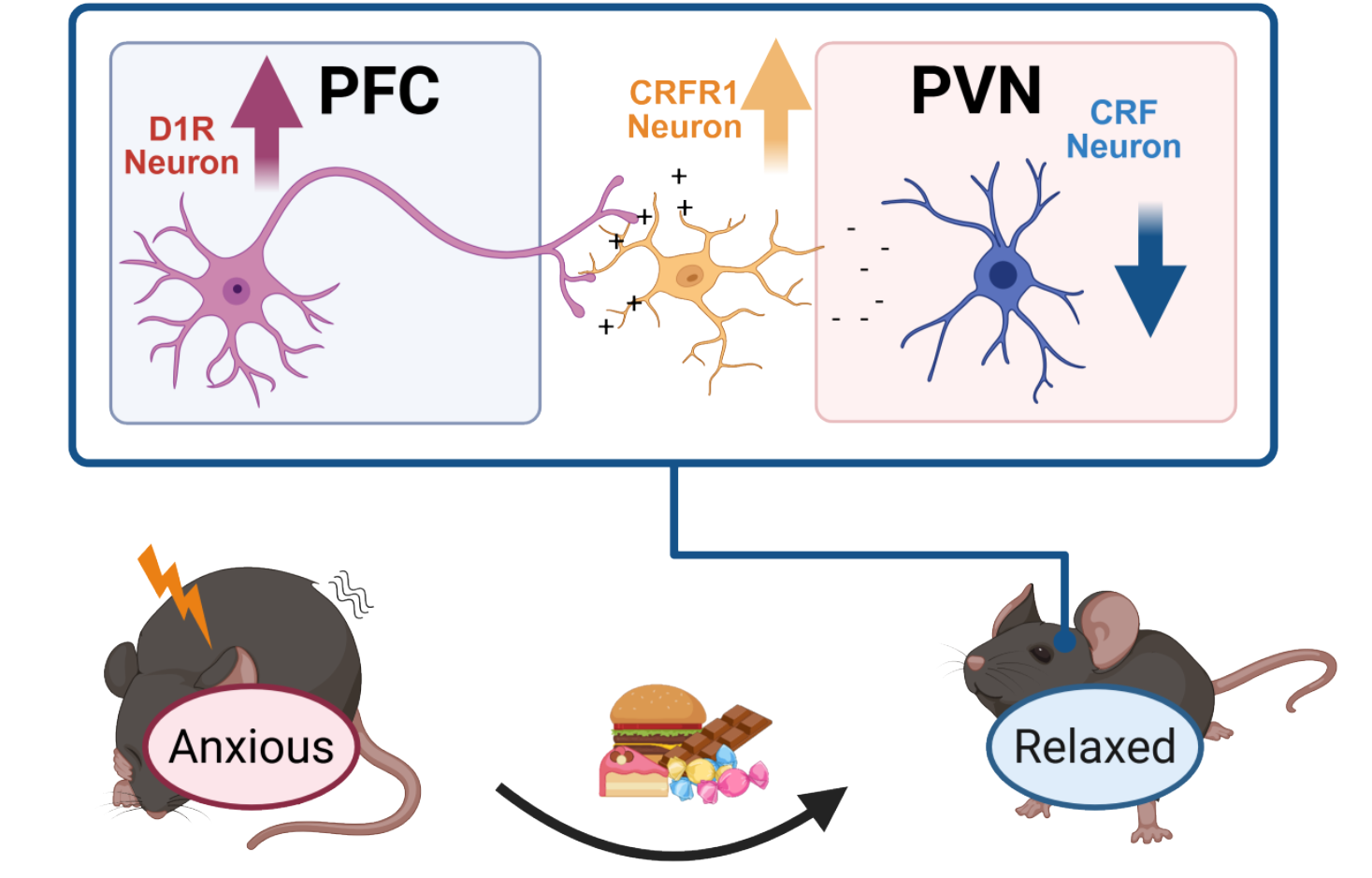
Mechanism of palatable food-driven alleviation of anxiety-like behaviors via the PFCD1R→peri-PVNCRFR1→PVNCRF circuit. (Image by SIAT)