
Newsroom


In a study published in Nature Geoscience, a research team led by Prof. LIU Lingli from the Institute of Botany of the Chinese Academy of Sciences (IBCAS) identified a mean annual precipitation (MAP) threshold of approximately 700 mm, beyond which the dominant controls on ecosystem nitrogen retention shift.
Researchers used naturally occurring soil nitrogen isotope (δ15N) as an integrated indicator of the long-term balance between nitrogen retention and loss in ecosystems. They analyzed data from 31 sites across the National Ecological Observatory Network (NEON) in the United States.
Researchers revealed a robust precipitation threshold that aligns with the widely recognized arid–humid divide of North America (the 100th Meridian, now shifting toward the 98th under climate change). Below this 700 mm threshold, soil δ15N decreases as MAP rises, reflecting stronger nitrogen retention. Above it, soil δ15N increases with MAP, indicating greater nitrogen loss.
In dry ecosystems (MAP < 700 mm), researchers found that higher MAP is associated with greater plant diversity, which intensifies competition with soil microbes for nitrogen, effectively "locking" nitrogen within the biomass and reducing its loss from the system. Plant community structure and microbial composition are the key regulators of nitrogen retention in these water-limited environments.
However, in humid regions (MAP > 700 mm), the researchers found that further increases in MAP lead to nitrogen "leakiness" through increased hydrological leaching and microbial transformation (denitrification), with soil physicochemical properties, such as carbon-to-nitrogen ratios, nitrate levels, and clay content, playing a dominant role.
These findings provide insights into how precipitation regulates ecosystem nitrogen retention by altering the balance among plant, microbial, soil, and hydrological processes. The study suggests that changes in hydroclimatic boundaries could potentially reshape continental nitrogen cycling under climate extremes. It provides an important reference for improving ecosystem and Earth system model predictions of natural nitrogen dynamics under changing precipitation regimes.
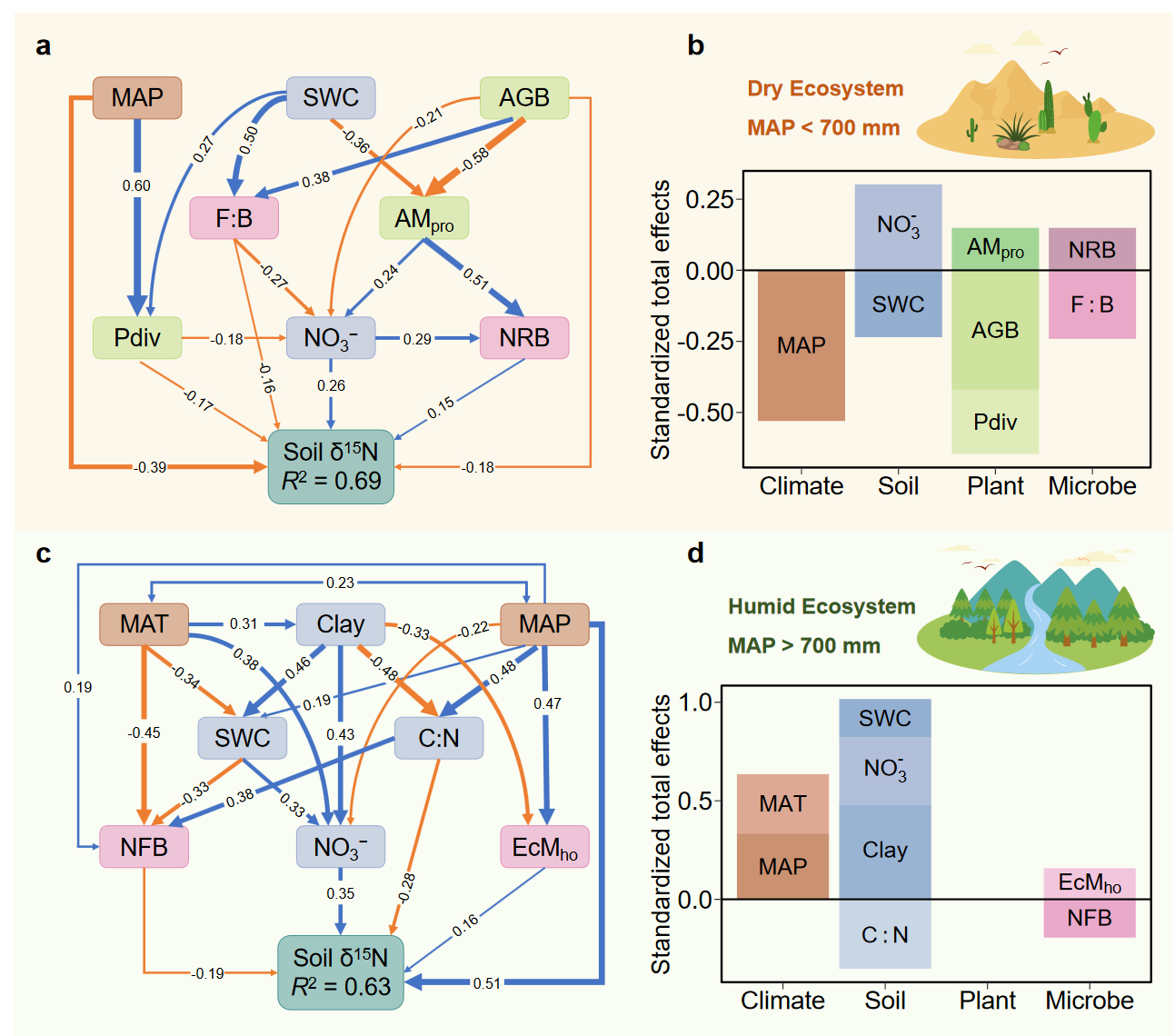
Contrasting controls of soil δ15N across precipitation regimes. (Image by PENG Yong)
