
Newsroom


The "Asian Water Towers" (AWTs), a high-altitude region with a mean elevation exceeding 4,000 meters, serve as the primary freshwater source for nearly two billion people. While the Indian summer monsoon is well known for shaping seasonal rainfall patterns that help feed the AWTs, the hydrological role of the mid-latitude westerlies—which dominate regional weather patterns for three-quarters of the year—has been unclear.
Now, a research team led by Profs. GAO Jing and YAO Tandong from the Institute of Tibetan Plateau Research of the Chinese Academy of Sciences, in collaboration with international scientists, has determined how the westerlies integrate their moisture into the local water cycle under non-precipitating conditions.
Specifically, the researchers have identified a "vertical conveyor" atmospheric mechanism whereby moisture carried by high-altitude winds is transported toward the plateau through a complex process of nocturnal "decoupling."
The results were published in PNAS on May 6.
In this study, the researchers combined in situ vertical observations with the state-of-the-art ECHAM6-wiso isotope-enabled atmospheric model, providing the first unified, process-based picture of how the AWTs' atmospheric water is supplied.
Using specialized helium-tethered "Jimu balloons," the researchers collected 32 unprecedented vertical profiles of atmospheric water vapor stable isotopes (δDᵥ and d-excessᵥ) and meteorological parameters at two locations on the Tibetan Plateau: Lulang, a forested moisture corridor, and Nam Co, a high-altitude inland lake.
These isotopes allowed the researchers to identify a highly stratified atmospheric structure comprising three layers: the atmospheric boundary layer, located at roughly 600 to 900 meters, where locally sourced moisture is shaped by diurnal cycles; the mixed layer, an intermediate zone between 600 and 1,600 meters, characterized by minimal isotopic variance; and the free troposphere, found above 1,600 to 1,800 meters, where large-scale westerlies transport moisture across the Himalayan barrier.
The researchers found that atmospheric water vapor transported by the westerlies undergoes subsidence, with large-scale descent of this moisture toward the AWTs' atmospheric boundary layer. As this moisture sinks, it interacts with local air, creating two distinct thermal inversion layers. These layers act as physical "caps" that suppress vertical mixing and decouple atmospheric water vapor into distinct layers.
This decoupling isolates the moisture aloft transported by the westerlies from the relatively moist, local air trapped within the atmospheric boundary layer. The condensation below these thermal inversion layers during the decoupling integrates the moisture brought by the westerlies into the local moisture budget. This process constitutes a primary pathway for integrating westerlies-advected moisture into the local moisture budget without precipitation, sustaining near-surface moisture accumulation.
The researchers discovered that even without precipitation, approximately 30% of the moisture transported by the westerlies is integrated into the local cycle through phase transitions at night.
These findings are significant as anthropogenic warming drives rapid hydrological transitions—including accelerated glacier retreat and altered runoff patterns—that affect the amount of moisture fed into the AWTs. The findings provide critical benchmarks for improving atmospheric models, optimizing climate projections for the AWTs' water cycle, and advancing the climatic interpretation of regional isotopic records, such as those from ice cores.
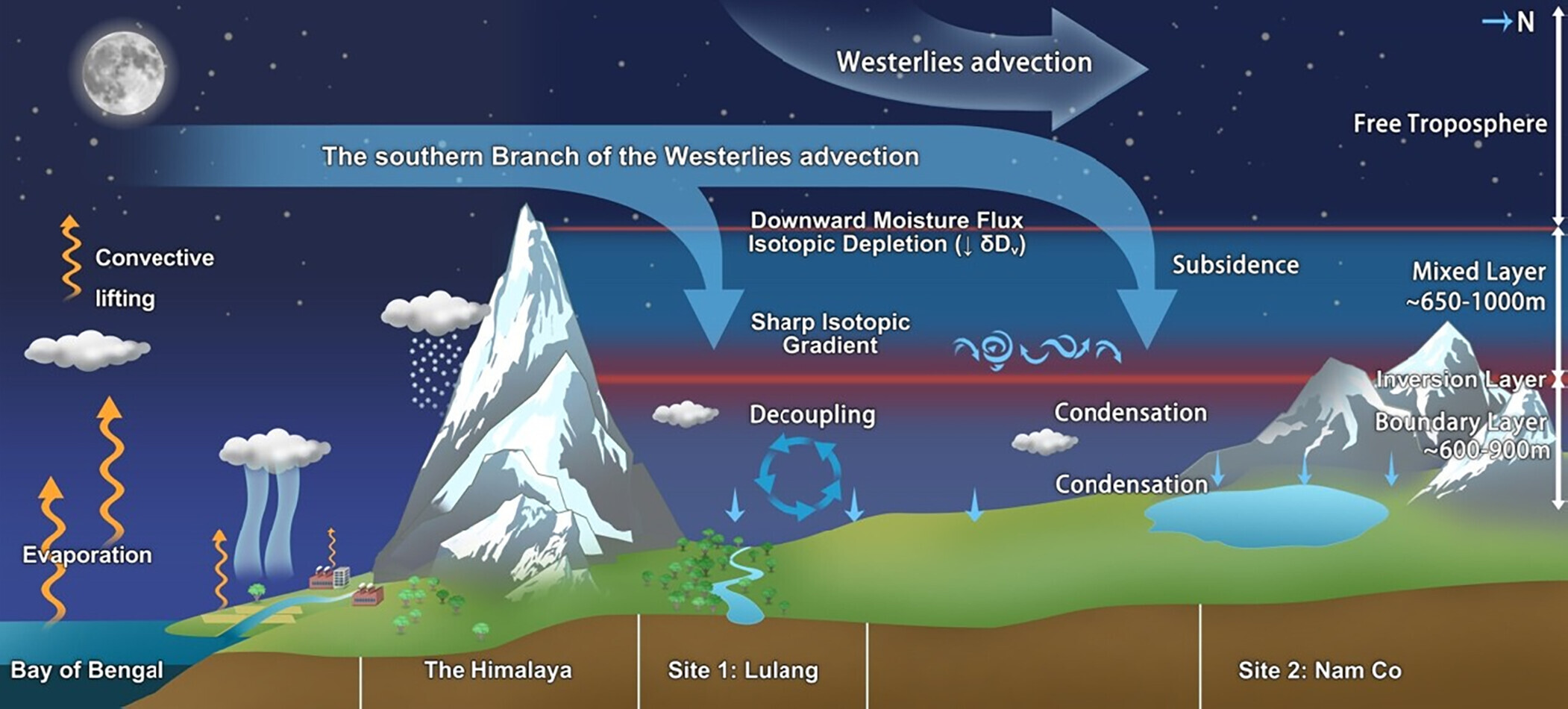
Schematic illustration of the two decoupled conveyor mechanisms driving the vertical integration of moisture advected by the westerlies into the atmospheric water cycle on the AWTs. (Image by GAO Jing)
