Newsroom


Spartina alterniflora is one of the most rapidly expanding invasive plant species in China’s coastal wetlands over recent decades. Owing to its fast growth rate and substantial organic matter inputs, this species has the potential to profoundly alter soil carbon cycling processes.
A research group from the South China Botanical Garden (SCBG), Chinese Academy of Sciences, has found that S. alterniflora invasion significantly increases soil methane emissions. They also observed a pronounced increase in the abundance of methanogens in invaded soils.
Based on a one-year in situ continuous monitoring campaign conducted in the Qi'ao Island Mangrove Nature Reserve in Zhuhai, this study compared mudflats, Spartina-invaded zones, and native mangroves
By integrating measurements of soil physicochemical properties, molecular composition of dissolved organic matter (DOM), and the community structure of the methane-cycling microorganisms, this study systematically elucidated the mechanisms by which S. alterniflora invasion regulates soil methane emissions. The study found annual mean methane flux in invaded soils was approximately 8.7 times higher than that in native mangrove soils.
Further analysis that invasion markedly increased labile organic matter fractions, such as lipid-like and protein/aliphatic compounds, while simultaneously reducing sulfate concentrations, soil organic carbon, and total nitrogen. These changes decreased the molecular stability of DOM and provided more readily available substrates for methanogens, thereby stimulating methane production.
Microbial community analysis further demonstrated a pronounced increase in the abundance of methanogens in invaded soils, particularly Methanococcoides, which preferentially utilize labile organic substrates.
In contrast, both the abundance and diversity of methane-oxidizing bacteria declined, especially type II methanotrophs with high methane affinity. This coupled effect of "enhanced methanogenesis" and "suppressed methane oxidation" ultimately led to substantially elevated soil methane emissions, thereby weakening the carbon sink function of coastal wetlands.
This study was published in the Journal of Plant Ecology. Dr. QIN Guoming from the Xiaoliang Research Station of the SCBG is the first author, and Prof. WANG Faming is the corresponding author.
This work was supported by the National Natural Science Foundation of China, the National Key Research and Development Program of China, the CAS Youth Scientist Basic Research Program, the Guangdong Basic and Applied Basic Research Foundation, and the Southern Marine Science and Engineering Guangdong Laboratory (Zhuhai), among others.
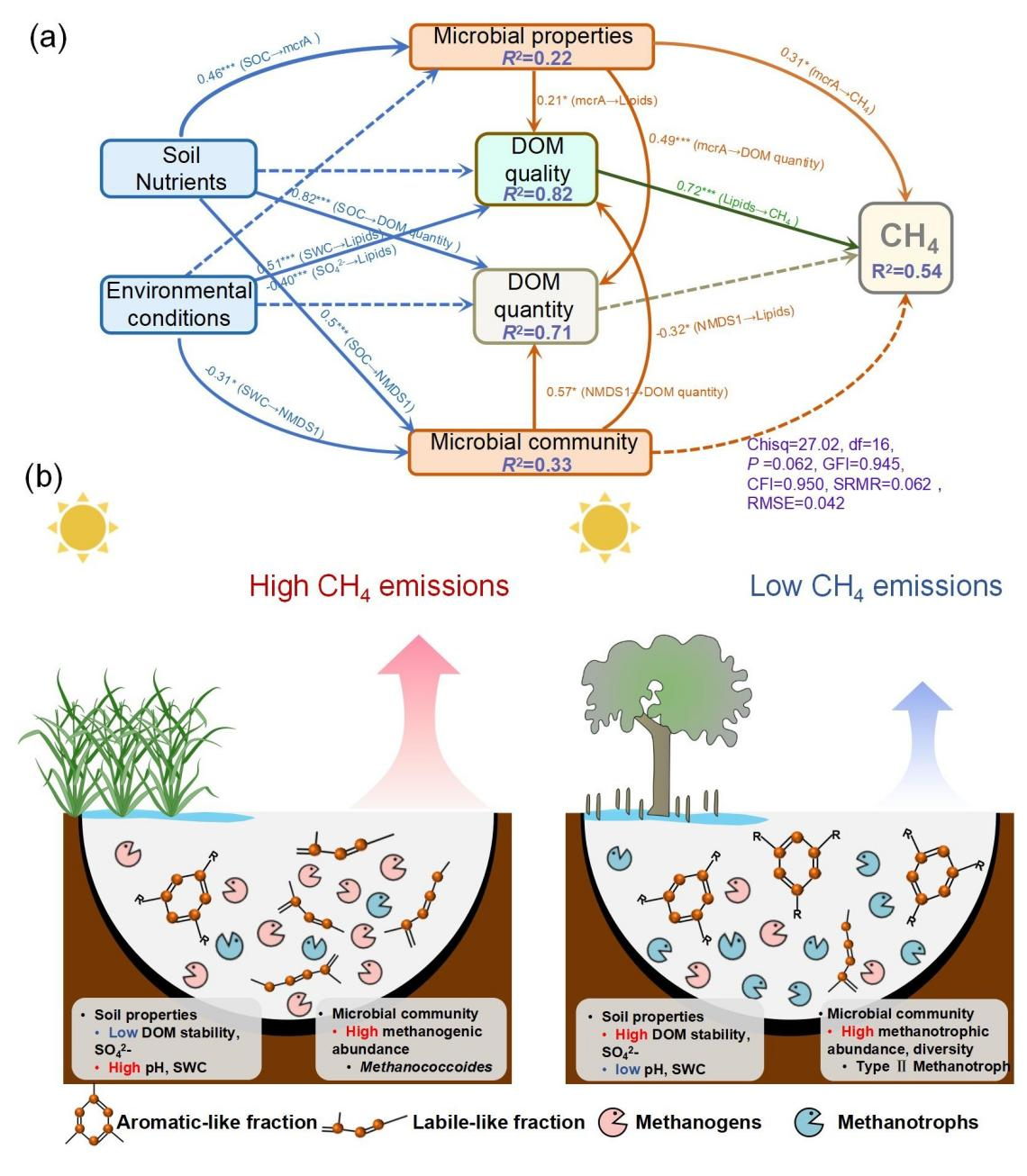
Conceptual diagram illustrating the mechanisms by which S. alterniflora invasion drives soil methane emissions in mangrove ecosystems.(Image by WANG et al.)