
Newsroom


Researchers from the Ningbo Institute of Materials Technology and Engineering (NIMTE) of the Chinese Academy of Sciences has confirmed the existence of native two-dimensional (2D) cellulose nanosheets (CNSs) and successfully extracted them from cellulose using a mild chemical approach. The study was published in SusMat.
Cellulose, the most abundant non-food bio-based material in nature, has an annual output of hundreds of millions of tons. It is a crucial green, eco-friendly raw material that supports the sustainable development of society.
Researchers have long been able to convert cellulose into one-dimensional (1D) nanomaterials with high strength and modulus. However, the existence of a 2D lamellar structure with a higher hierarchical level and greater functional potential in native cellulose remains a key question in this field.
Inspired by ionic liquids, researchers at NIMTE developed a strategy to hierarchically and selectively regulate the hydrogen-bond network in cellulose. They used a zwitterion combined solid catalyst that covalently connects weak acid and weak base units within a solid matrix. This design enables precise control over ionic strength and selective catalytic depolymerization, allowing for the gentle breakdown of natural cellulose at the molecular level.
The resulting 2D CNSs measure 1-20 μm in lateral size with a thickness of 15-28 nm, and are composed of multiple cellulose nanocrystals (150-400 nm in length and 5-28 nm in diameter).
This strategy is highly selective and broadly applicable, successfully extracting CNSs from diverse cellulose sources, including cotton, wood, viscose, bacterial cellulose, and more.
The discovery of native 2D lamellar nanostructures in natural cellulose has enriched our understanding of its hierarchical structure, providing new ideas for converting cellulose into high-performance nanomaterials and enabling future-oriented applications.
This work was supported by the Key Research and Development Program Project of Ningbo City, the Key Research and Development Program of Hainan Province, the National Natural Science Foundation of China, and others.
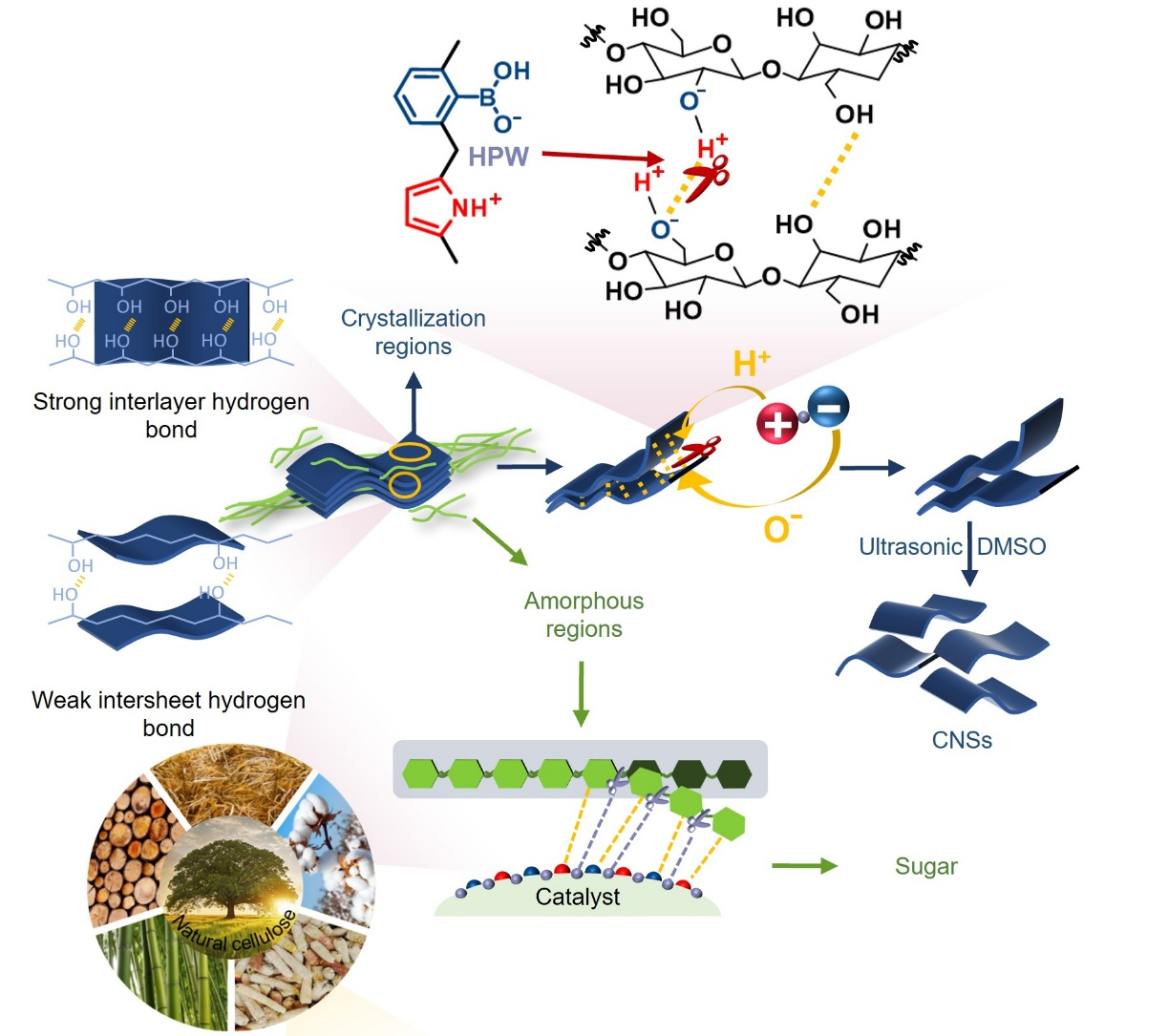
The selective hydrolysis of natural cellulose to acquire 2D CNSs (Image by NIMTE)
