Newsroom


Scientists have uncovered the earliest fossil evidence of annelids (ringed worms) in Cambrian microfossils dating back approximately 535 million years ago. This discovery offers fresh insights into the origin and early evolution of the annelids, a group of animals that includes bristle worms, earthworms, leeches, and peanut worms.
The study, led by researchers from the Nanjing Institute of Geology and Palaeontology of the Chinese Academy of Sciences (NIGPAS), in collaboration with Virginia Tech, LMU Munich, and the First Institute of Oceanography of the Ministry of Natural Resources of China, was published in PNAS on April 20.
Annelida is one of the most diverse and ecologically widespread animal phyla. It has traditionally been divided into three classes: Polychaeta (bristle worms), Oligochaeta (earthworms and their relatives), and Hirudinea (leeches and their relatives). The latter two classes constitute the clade Clitellata. However, phylogenetic analyses indicate that Clitellata is nested within the paraphyletic Polychaeta and that several groups previously considered as separate phyla (Echiura, Sipuncula, Orthonectida, Pogonophora, and Vestimentifera) are actually members of Annelida.
Several Ediacaran fossils, including Yilingia and cloudinids, have been tentatively interpreted as annelids. The most widely accepted annelid fossils, however, are sipunculans and polychaetes that have been found exclusively in Cambrian Burgess Shale-type fossil assemblages (dating to less than 518 million years ago) and are preserved as flattened macrofossils.
Given this, the researchers explored Orsten-type fossil localities from the earliest Cambrian period to fill this fossil gap.
They discovered seven millimeter-sized phosphatized fossils preserved as endocasts of trunk parts from the early Fortunian Kuanchuanpu Formation (dating to 535 million years ago) in China. These fossils replicate the space surrounded by the integument. The trunk is segmented with paired lateral or ventrolateral appendages that may be shorter or longer than the width of the corresponding segment. Based on these characteristics, the researchers established two new genera and species: Kuanchuanpivermis brevicruris and Zhangjiagoivermis longicruris.
Each appendage terminates in a bifurcation into two lobes of equal, subequal, or even unequal size and morphology. The appendages of the current specimens are comparable to the biramous parapodia of polychaete annelids. In particular, the appendages of Zhangjiagoivermis longicruris show notable similarities to those of living tomopterids. Accordingly, the two distal lobes on the appendages are comparable to notopodium and neuropodium.
Through detailed comparisons, the researchers ruled out alternative interpretations, such as that the fossils might belong to algae, gut structures (midgut with cecae), lobopodians, tardigrades, onychophorans, and arthropods. Instead, the anatomical features suggest that they are most likely polychaete annelids.
Trunk segments and biramous parapodia may have existed prior to the last common ancestor of living annelids. Therefore, Kuanchuanpivermis brevicruris and Zhangjiagoivermis longicruris are interpreted as annelids.
The study also sheds light on the early ecological diversification of annelids. The shorter appendages of Kuanchuanpivermis brevicruris suggest a benthic lifestyle similar to that of modern nereids. In contrast, the longer appendages of Zhangjiagoivermis longicruris indicate a pelagic lifestyle, representing the earliest known pelagic annelid. However, due to their small size and the physical constraints of their environment, these early worms likely moved more slowly than their modern counterparts.
Taken together, these findings provide the first evidence of annelid body fossils from Cambrian Orsten-type fossil localities. They indicate that early annelids were polychaetes and thus support the hypothesis that polychaete morphologies were primitive among annelids.
The findings show that early annelids had evolved benthic and pelagic lifestyles during the early Fortunian, thereby extending the fossil record of pelagic annelids to around 535 million years ago. They support the phylogenetic analyses resolving polychaetes as a paraphyletic group and imply that total-group annelids may have originated prior to the Cambrian explosion.
This work was funded by the Strategic Priority Research Program of CAS, the National Natural Science Foundation of China, and the National Science Foundation of the United States.

Cambrian Fortunian annelids. A–C, Kuanchuanpivermis brevicruris, holotype; B–D, Zhangjiagoivermis longicruris, holotype. (Image by ZHANG Huaqiao)
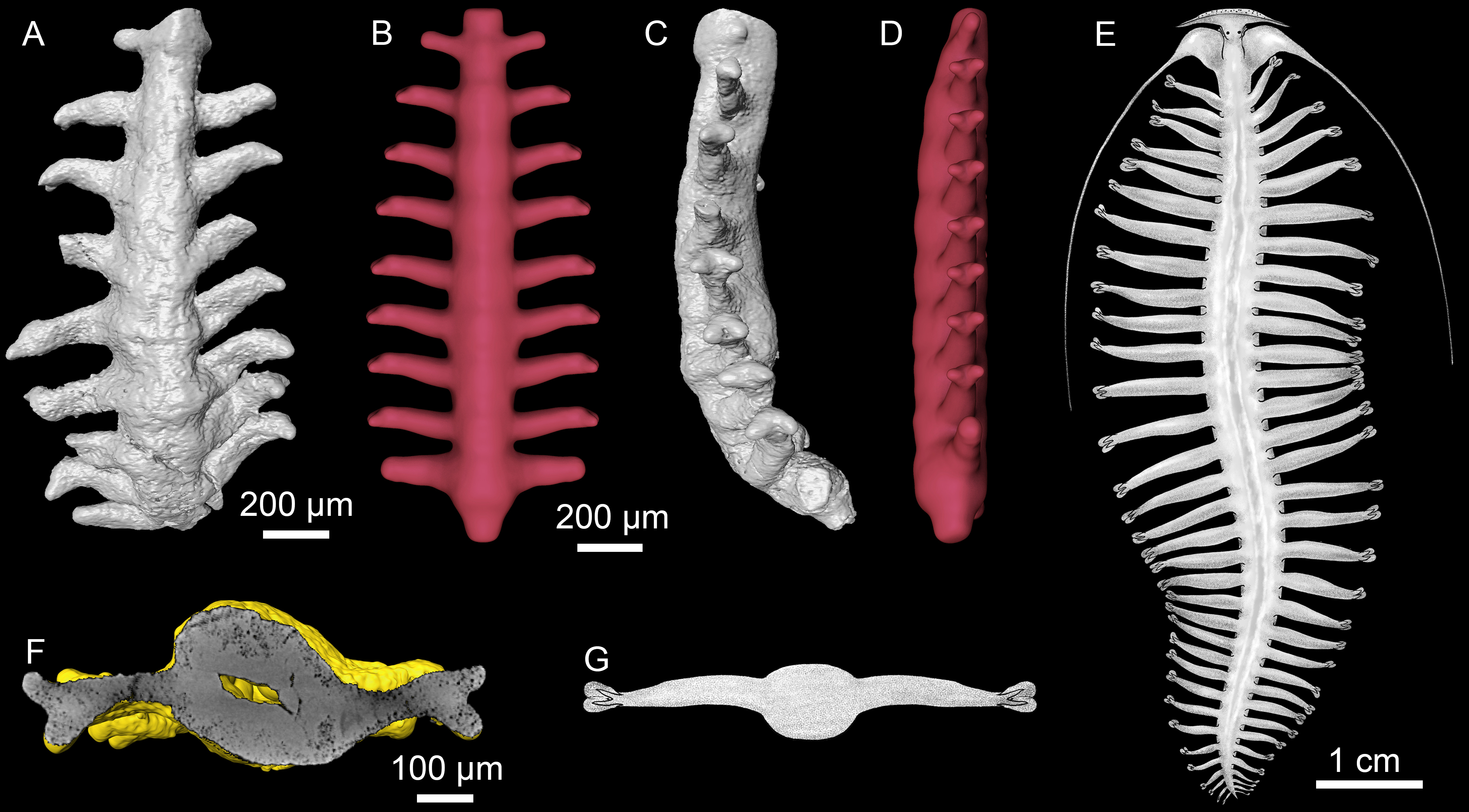
Comparison between Zhangjiagoivermis longicruris and Tomopteris. A–D, F, Zhangjiagoivermis longicruris, holotype; E, G, Tomopteris. (Image by ZHANG Huaqiao)
Kuanchuanpivermis brevicruris, holotype (Video by ZHANG Huaqiao)
Zhangjiagoivermis longicruris, holotype (Video by ZHANG Huaqiao)